---
title: "Artificial Intelligence in Law"
author: "Mitch Jackson, Esq."
url: "https://mitchjackson.xyz/3/ai-in-law"
---
##INTRODUCTION##
**This book isn’t just your guide to using AI to sharpen your legal skills and boost your efficiency. It’s about transforming lawyers and the legal profession for the better. -Mitch Jackson, Esq.**
___________________________
Your next legal assistant isn't going to be bound by the constraints of fatigue, time, or human error. Picture a tireless entity that processes data with surgical precision, forecasts case outcomes with a mind rivaling the most seasoned attorneys, and revolutionizes the entire legal process. This isn't a glimpse into a distant future; it's the tangible impact of artificial intelligence in today's legal arena.
I invite you to step into a world where the cumbersome volumes of legal texts, documents and case files are distilled in mere seconds. Here, predictive analytics craft strategies that are razor-sharp, and every mundane task that once chained you to an avalanche of paperwork is now seamlessly managed by a digital intellect.
###Live AI###
Before we dive into the book, I invite you to visit this book's AI avatar. It's up, running and ready to chat with you about AI, law, and all things related to this book. Just type in your question or click "call" and chat with my AI using your voice, and you'll get answers and responses in seconds. Click here to see this new technology in action.
As you can see, artificial Intelligence isn’t merely transforming the legal profession—it’s revolutionizing the world at an unprecedented scale. In my view, its impact on business and society will surpass that of the printing press, electricity, and the internet combined. AI’s capabilities are not just augmenting our current systems but fundamentally reshaping how we live, work, and interact. This technological evolution is set to redefine industries, enhance efficiencies, and create possibilities previously unimaginable, heralding a new era of innovation and progress.
###AI Becomes Integral to Business and Law###
According to a July 7, 2023 McKinsey report, the implementation of generative AI use cases has the potential to increase global corporate profits by $2.6 trillion to $4.4 trillion annually. This significant boost in value is attributed to various applications of generative AI across different industries, including customer operations, marketing and sales, software engineering, and research and development. This impact is comparable to the gross domestic product of Germany, underscoring the substantial economic potential of AI when effectively implemented across businesses
In it's 2024 insights, McKinsey reiterates that AI technology continues to evolve and will deliver substantial economic benefits across multiple industries, including banking, life sciences, and manufacturing, by 2030. Additionally, McKinsey underscores that effective scaling and adoption of generative AI remain critical challenges for many businesses, with only a fraction realizing its full potential so far.
With this in mind, and as AI, especially generative AI, becomes integral to business operations, I believe law firms will pivot to meet new demands: specialized advisory services on AI implementation and compliance, handling IP disputes and product liability cases, and internal efficiency improvements through AI tools. This shift will also bring ethical challenges and necessitate continuous AI training for lawyers, while fostering cross-disciplinary collaboration to navigate the evolving legal landscape. In short, AI's rise will revolutionize both the services provided by law firms and their internal operations, demanding agility and innovation at every turn.
###Back in the Day###
I often think back to when I started my legal journey—when the internet was a mere fledgling, and computers were little more than sophisticated typewriters. Each hum and beep of those early machines, not to mention dial-up modems, signaled a step towards greater efficiency. Fast forward to today, and these sleek, powerful devices are our constant companions, guiding us to unprecedented levels of client service and professional achievement.
AI isn't just about enhancing how we perform routine tasks; it's about transforming the very core of legal practice. Envision an assistant who tirelessly sifts through vast oceans of legal literature, distilling essential insights in moments. Imagine leveraging predictive analytics to not only forecast case outcomes but to tailor your strategies with unparalleled precision in just seconds.
###Lawyers and AI: Moving Beyond Efficiency to Imagination###
The integration of AI in law is a revolution. It promises not only to handle the drudgery of paperwork but to elevate the entire legal practice to new heights. This is the dawn of a new era, where technology and law intersect, creating a dynamic synergy that propels us forward.
For lawyers, the real power of AI isn’t just about being smarter, faster, or more efficient. Sure, that’s a nice bonus, but the true magic? It’s giving yourself permission to rethink what’s even possible in your practice. Let’s be honest—law has always been steeped in tradition, bound by precedent, and, at times, boxed in by the limits of human capacity. AI changes all that.
Beyond the Checklist Mentality
Most of us start using AI like we’d approach a new high-tech scanner or a better word processor. “Great, now I can sort documents faster,” or, “This will save me a few hours of research.” And hey, that’s useful. But if you stop there, you’re missing the point entirely. AI doesn’t just let you do old things more efficiently; it invites you to imagine—and tackle—what used to feel out of reach.
Think about it: What if you could analyze patterns across decades of case law in minutes? Or craft a predictive model for how a judge might respond to a specific argument? That’s not just working faster. That’s rewriting the rules of the game.
Linear Thinking Is So Yesterday
Here’s the thing—lawyers are trained to think linearly. Step one, then step two, then step three. It’s meticulous, deliberate, and logical. And for centuries, that approach worked. But AI doesn’t play by those rules. It’s not limited to the straight lines and narrow paths we’ve always followed.
Instead, AI works exponentially. It takes your input, processes it, connects it to vast pools of data, and generates insights or solutions you never even knew to ask for. It’s like having a brainstorming partner who doesn’t just think outside the box—they dismantle the box entirely and hand you a blueprint for something new.
Permission to Dream
But here’s the catch: AI doesn’t automatically make us better lawyers. It’s not a magic wand. It’s a tool—albeit a mind-blowing one—that still requires vision. And that means giving yourself permission to dream bigger.
What if AI could help you create fully customized legal strategies for clients, based on millions of past cases? Or allow you to predict disputes before they arise, offering proactive solutions that save your clients time and money based upon billions of business, legal and societal data points? The tech is already here. The question is whether you’ll let yourself step into that space.
It’s Not About Replacing You—It’s About Expanding You
Some lawyers worry AI will replace them. Let’s set the record straight: AI can’t replicate the human judgment, creativity, or empathy that make us truly great at what we do. What it can do is amplify those qualities—freeing you up to focus on the parts of lawyering that really matter. Building relationships. Solving complex problems. Advocating with heart and precision.
Today, we stand on the cusp of a new epoch with AI at its core. This technology is redefining what is possible.
###AI Is Only Getting Better###
Now, here's the kicker—this is as bad as AI will ever be.
Think about that.
AI is already an outstanding tool. For many of us who have been neck deep in the AI sandboxes, we know just how powerful this new technology is. But like I reference throughout the book, we're just getting started and AI is only going to get better. Much better.
AI's capacity to analyze data, understand patterns, and automate complex decision-making processes is improving outcomes and changing the face of legal practice. This book is your gateway to understanding and harnessing the power of AI. It invites you to explore the profound implications of this technology, which permeates every facet of legal work, from the drafting of contracts to the nuances of litigation strategy.
My intention with this narrative is to kindle a spark of curiosity and equip you with knowledge, pushing the boundaries of what you might achieve with AI in your legal practice. You may discover approaches and insights into AI that are entirely new to you, or you might deepen your understanding of familiar concepts, viewing them through a transformative lens.
As the capabilities of AI expand, so too will the content of this book. It’s written in a way and on a dynamic platform where my team and I can regularly revisit and revise these pages to encapsulate the latest developments and innovations in legal tech. Things are changing daily in the AI legal space, and this real-time approach ensures that each visit back to this text will offer new knowledge and tools, reflective of the latest advancements in the field.
In this narrative, you will find a purposeful approach to referencing AI tools, platforms, and services. For the most part throughout the chapters, I will generally reference these AI solutions to provide context and insight into their practical applications. To ensure you have access to the most current and comprehensive information, I have dedicated a "Resources" section at the end of the book for specific platforms, services and links. We'll update this section weekly.
This method acknowledges the rapid evolution of AI, allowing you, the reader, to stay informed about the latest tools and technologies. By integrating general references within the chapters and providing specific products and services in the "References" section, I aim to equip you with the most up-to-date resources available.
As I'm sure you've figured out, this book isn’t just a static resource; it’s a living document designed to grow alongside AI advancements. Each chapter is crafted to provoke thought and stimulate inquiry, while the references section ensures you have direct access to the latest innovations in legal tech. This combined approach offers a dynamic and comprehensive guide, ensuring that your journey through the evolving world of AI and legal practice is well-supported with the most current and relevant information.
Together, let’s embark on this journey into the future of law. With AI as our guide and an eagerness to explore the unknown, we stand ready to redefine the practice of law.
###Final Thoughts###
Enjoy the "audio version" of this book while you're out and about. Listen on all your favorite podcast platforms including Apple Podcasts, Spotify, and Youtube.
_Quick Tip- You can listen to the entire book or go through each chapter one at a time on Youtube (chapter links can be found in the description)._
Next, how many books do you know that have their own theme song? That's right, Drumroll, please! My new book now has its own theme song and music video titled, “It’s a Brand New Day!” It was completely written with the audio and video generated by AI. You can listen to it here and I also shared the production steps using a combination of ChatGPT4 (writing), Suno (music) and Runway Gen-3 Alpha (video).
And last but not least, at this time I would like to extend my heartfelt gratitude to Jason Fried
and his incredible team at 37Signals for creating Writebook, the exceptional free platform for this digital book. Your innovative approach and dedication to excellence have provided a seamless and inspiring experience for authors and readers alike.
**Leveraging AI**
And one more thing—just so we’re clear—yes, I used AI to help shape this book. Here’s the thing: like you, I'm busy. Decades of ideas, piles of notes, and those late-night flashes of inspiration don’t exactly organize themselves. Without AI, there’s no way I could have turned all that chaos into something this practical, this actionable, and—hopefully—this valuable.
I believe in walking the walk, using the tools we talk about to create something worth your time. Thanks to AI, I've not only made this book smarter but also included a bonus: access to a unique AI agent built just for you. Because leveraging the right tools isn’t just smart—it’s how we all move forward.

As mentioned at the beginning of the introduction, with this link you can ask the AI agent anything about the concepts shared in this book—type your questions or even start a voice conversation. Want follow-ups? Go for it. Do a deep dive on any concept you'd like to learn more about. This is a very cool addition to the book and it wouldn't have been available without AI.
Click here to talk to our AI Agent to do your own personal and unique deep dive.
_______________
###Join Our "AI In Law" LinkedIn Group!###
>Do this before you go to the next chapter...
>Our "AI in Law" group on LinkedIn is your go-to community for learning and exploring AI, whether you’re just curious or already an expert. Connect in real-time with like-minded legal professionals, uncover game-changing AI applications, and transform your practice for the better. Ask questions and participate in engaging discussions, access valuable resources, and experience the synergy of learning and sharing in our inclusive community. 🔥
Here's the link!
_______________
OK. Are you ready to turn the page and step into the future? Let's begin.
***
###DISCLAIMER AND WAIVER OF LIABILITY###
This book is intended for informational and educational purposes only. The content provided herein is not legal advice, and no attorney-client relationship is formed by reading or using this book. The authors and publishers of this book expressly disclaim any responsibility or liability for any damages, losses, or legal consequences arising directly or indirectly from the use or reliance upon any information contained in this book. Please see the full disclaimer and waiver of liability here. Your use of this material confirms your full understanding and agreement to the terms and conditions of the disclaimer and waiver set forth and incorporated herein.
_________________________________
The "AI In Law" podcast compliments this book. It's your quick dive into how AI is transforming the practice of law. Get the insights you need to stay sharp and ahead of the curve. Listen on Apple Podcast," Spotify, and YouTube.
##Copyright and Disclaimer##
**COPYRIGHT NOTICE**
© 2024 Mitchell Jackson | Jackson & Wilson, Inc. All rights reserved.
No part of this publication may be reproduced, distributed, stored in a retrieval system, or transmitted in any form or by any means—electronic, mechanical, photocopying, recording, or otherwise—without the prior written permission of the author, except for brief quotations used in critical reviews and certain other noncommercial uses permitted by copyright law. This protection extends to all formats and platforms, including print, digital, audio, spatial computing, Web3 environments, blockchain-based applications, AI-generated derivative outputs, and any medium that exists now or is invented later. The fact that content lives on a screen, in a feed, or inside a virtual environment does not make it yours to take.
For permission requests, contact: Mitch Jackson via mitch-jackson.com
________
**DISCLAIMER**
Let me be real with you before we go any further.
This book is for education and general information only. Full stop. I am a lawyer, and a pretty good one, and I am proud of the work my firm does every single day. I am not, as of this moment, your lawyer. Nothing in this book, on any associated website, podcast, social media post, digital resource, Web3 platform, spatial computing environment, or any other format connected to this work creates an attorney-client relationship between you and me, between you and my law firm, or between you and anyone on my team. You do not become my client by reading this book, attending an event, sending a message, or interacting with me or my team online or in person.
This is not legal advice. This is not financial advice. This is not medical advice. This is not tax advice. And this is not professional counsel tailored to your specific situation. Every person’s circumstances are different, and the law on these topics is changing fast at the federal, state, and international levels. What applies in California might not apply in Texas. What is accurate the day this book goes to print might shift by the time you read it.
Here is what I need you to do. Before you make any legal, financial, or personal decision based on something you read in these pages, talk to a qualified professional who knows your situation. Hire a lawyer in your jurisdiction. Consult a financial advisor. Speak with a cybersecurity specialist. Get advice that is specific to you.
The information in this book is provided “as is,” without warranties of any kind, either express or implied. I have done my best to make sure everything here is accurate and current as of the date of publication, and my team and I put in serious work to get the details right. Laws change. Regulations shift. Technology evolves. Court decisions get reversed. I do not guarantee that every piece of information will remain accurate after publication, and I am not responsible for errors, omissions, or outcomes that result from actions you take based on this material.
By continuing to read this book, by using any associated resources, by interacting with me or my team through any platform or medium—including websites, social media, podcasts, live events, digital communities, Web3 environments, virtual worlds, blockchain applications, AI-powered tools, or any technology that has not been invented yet—you acknowledge and accept full responsibility for your own decisions and actions. That includes the risks associated with rapidly evolving technology, artificial intelligence, smart contracts, virtual assets, digital privacy tools, and global regulatory changes that no single book is able to predict.
If you are not comfortable with any of that, put this book down. Seriously. No hard feelings.
If you are still here, good. That tells me you are ready to learn, ready to take action, and ready to protect yourself and the people you love.
Let’s go.
**Other Books**
_____
📚 Leading with AI:
Seven Steps to Transform Your Business and Empower Your People
📚 AI in Law- Revolutionizing Your Legal Practice with Innovative Strategies and Tools
📚 The Metaverse Business Blueprint: How to Build, Operate, and Grow in Spatial Commerce
📚 Mastering The Art of Negotiation- Insider Secrets for Business Owners, Entrepreneurs, and Professionals
📚 How to Create AI, Web3, and Metaverse Branding and Licensing Opportunities
📚 Power Moves- Battle-Tested Strategies From The Business Trenches
📚 The Mediator's Handbook: Turning Conflict into Collaboration
📚 Legal Tips for Creators
📚 From Courtroom to Boardroom: A Trial Lawyer's Guide to Winning Negotiations!
📚 The Web3, Metaverse, and AI Handbook
📚 From AI to Blockchain: 14 Technology Trends Every Lawyer Must Know!
📚 The Ultimate Guide to Social Media for Business Owners, Professionals, and Entrepreneurs
📚 Little Heroes-
Big Tips for Bright Futures (Children's book)
_____
Mitch Jackson | links
##CHAPTER 1: AI IS REVOLUTIONIZING THE PRACTICE OF LAW##
It's a regular Tuesday morning, but nothing about it is ordinary for Jessica as she strides into the courtroom with her AI-powered legal assistant in tow. Today, they're not just representing a client in a routine litigation; they are testing the very limits of legal practice.
With her laptop opened to a software that reads and synthesizes audio, video and legal documents in real-time, Jessica feels the weight of the task ahead. She's about to argue a case where the evidence, witness statements, and even strategic legal motions were optimized by advanced AI technologies. This is the modern courtroom battlefield, and the stakes could not be higher.
Welcome to a transformative era where is not merely a concept from science fiction but a revolutionary tool reshaping industries, including our cherished legal profession. Whether you're a law student or a seasoned attorney, you’ve likely encountered the AI buzz.
Let's start things off with this update- The American Bar Association’s Standing Committee on Ethics and Professional Responsibility just released a Formal Opinion about lawyers and AI dated July 29, 2024 which begins as follows:
>_“Generative Artificial Intelligence Tools: To ensure clients are protected, lawyers using generative artificial intelligence tools must fully consider their applicable ethical obligations, including their duties to provide competent legal representation, to protect client information, to communicate with clients, to supervise their employees and agents, to advance only meritorious claims and contentions, to ensure candor toward the tribunal, and to charge reasonable fees.” You can read the entire
15 page Opinion here._
But what exactly is AI, and how can it revolutionize legal practice? Let's embark on this fascinating journey together.
###Understanding AI Technologies: The Building Blocks###
At its core, AI involves creating machines capable of thinking, learning, and adapting. It's akin to endowing your computer with a brain—a brain that analyzes data, recognizes patterns, and makes decisions faster and more accurately than any human. AI encompasses technologies like machine learning, natural language processing, and neural networks, which are actively solving real-world problems in the legal field.
####Machine Learning####
Machine learning (ML) is a branch of AI where computers learn from data. Instead of being explicitly programmed for specific tasks, ML algorithms analyze data to identify patterns and make decisions.
In the legal world, ML predicts case outcomes, identifies relevant precedents, and automates contract analysis. Imagine working on a complex commercial contract case; instead of spending hours poring over documents, an ML-powered tool can analyze contracts in seconds or minutes, highlighting key clauses and potential risks, thus saving time and reducing human error.
####Natural Language Processing: Understanding Human Language####
Natural Language Processing (NLP) enables machines to understand and interpret human language, a critical capability in the legal field. NLP facilitates legal research, document drafting, and even providing legal advice via AI-powered chatbots.
Recall your last case research session: hours spent sifting through legal databases. With NLP, this process can be automated, scanning vast legal texts to extract and summarize relevant information quickly, allowing you to focus on strategy and client interaction.
####Large Language Models: The Power of Context####
Large language models, such as OpenAI’s GPT-4, are advanced NLP systems capable of generating human-like text based on context. These models, trained on extensive text data, understand and generate language resembling human conversation, revolutionizing legal document drafting, research, and client interactions.
Imagine an AI assistant drafting legal briefs, responding to client emails, or generating arguments. This isn’t science fiction; it’s the present reality. Large language models analyze conversation or document context to generate coherent, relevant, and legally sound text.
####Retrieval Augmented Generation (RAG)###
Retrieval Augmented Generation, affectionately dubbed RAG, is the cool tech wiz in the world of language models, combining the best of both traditional machine learning wisdom and cutting-edge retrieval techniques. At its core, RAG is a clever fusion; it pulls in relevant external data to enrich its responses, weaving a richer, more informed tapestry of words. This isn’t just your average chatbot spitting out programmed responses; it’s a thoughtful conversationalist pulling in data from a myriad of sources to provide nuanced, context-aware dialogue.
What sets RAG apart isn't just its ability to retrieve; it's how it integrates this retrieval seamlessly into the generation process, creating a more dynamic and accurate discourse. This dual-process allows RAG to not merely regurgitate information but to contextualize and synthesize it, offering responses that are not only relevant but strikingly precise. It's like having a librarian and a storyteller working in tandem—each query is met with both the thoroughness of a researched response and the finesse of natural language, making RAG a standout performer in the crowded field of AI.
####AI Bots and Agents: New Legal Assistants####
AI bots and agents are automated systems performing tasks traditionally done by humans. In the legal sector, AI bots handle scheduling, client communications, and providing basic legal advice. These tools are available 24/7, ensuring client and case assistance even in your absence.
Consider the time spent on administrative tasks—scheduling meetings, answering basic queries, managing your calendar. AI bots can take over, freeing your time for complex, strategic tasks, enhancing efficiency and client satisfaction.
As mentioned at the end of the introduction to this book, we've uploaded the contents of this book into a free ChatGPT4 bot that allows you to search, summarize, and analyze content or drill as deep as you'd like on any topic in the book. To see the power of these bots, click this link and let the AI do all the work for you.
Many AI services are rolling out these kinds of bot options so pay attention because changes are happening each and every week.
####Neural Networks: Mimicking the Human Brain####
Neural networks, a type of AI mimicking the human brain’s structure, consist of interconnected nodes (neurons) processing and analyzing data. Effective in tasks like image and speech recognition and data analysis, neural networks in legal practice analyze evidence, predict case outcomes, and identify behavior patterns in large datasets. For instance, a neural network could analyze historical case data to predict success likelihood in a current case, aiding in strategy development.
###Applications of AI in the Legal Field###
####Legal Research and Analysis: Faster, Better, Smarter####
Legal research is notoriously time-consuming. Traditional methods involve sifting through vast data, reading cases, statutes, and regulations, and synthesizing information. AI streamlines this process, making it faster, more accurate, and less labor-intensive.
AI-powered tools scan thousands of documents in seconds, identifying relevant cases and statutes, providing summaries and analysis, freeing your time for argument development and strategy. Additionally, these tools identify patterns and trends in case law, offering valuable insights.
####Expanding the Thought Process####
AI can amplify our thought processes by acting as an intelligent collaborator, offering diverse perspectives, spotting hidden patterns, and providing innovative solutions that elevate our creativity and decision-making to new heights. Watch this conversation between the Co-Founder of LinkedIn and Inflection AI, Reid Hoffman, and AI entrepreneur, Allie K. Miller. The take-a-way is appreciating that one of the most crucial skills for the future is mastering the art of prompting and orchestrating our own GPT symphonies with finesse.
####Contract Review and Management: Efficiency and Accuracy####
Contracts are the backbone of legal practice, but reviewing and managing them can be daunting. AI revolutionizes this process, making it efficient and accurate.
AI-powered tools analyze contracts in minutes, identifying key clauses, potential risks, and concerns. These tools automate contract management, tracking deadlines, ensuring compliance, saving time, and reducing human error.
####Illustrative Hypothetical Case Study: Predicting Case Outcomes and Binding Settlements and Verdicts####
Predictive analytics, a powerful AI application, helps anticipate case outcomes and make informed decisions by analyzing historical case data, identifying patterns and trends. This aids in developing effective strategies, increasing success chances. For instance, predictive analytics identifies success likelihood in specific jurisdictions, case strengths and weaknesses, and judicial tendencies, providing invaluable strategy development insights.
Imagine a legal tech startup developing a neural network-based tool predicting litigation outcomes by analyzing past cases, identifying influential patterns and factors, considering variables like case law, judge tendencies, jurisdictional nuances, and lawyer arguments. Lawyers using this tool benefit significantly. In complex commercial litigation, the tool identifies cases with similar patterns likely to settle before trial, allowing strategic adjustments, saving time and expense.
Courts and mediation services might introduce an “instant” case settlement or verdict service powered by AI, where parties upload case information for instant review, analyzing legal data and all other factors like local community perceptions and standards, leading to binding settlements or verdicts in seconds or minutes. This drastically reduces dispute resolution time and promotes accuracy and consistency, benefiting lawyers and clients.
AI’s potential to predict case outcomes and facilitate rapid, binding settlements and verdicts will become a reality by the decade’s end. Leveraging advanced neural networks and comprehensive data analysis, AI tools will enable effective strategy development, client expectation management, and unprecedented dispute resolution speed and efficiency.
####AI in Litigation: A New Era of Advocacy####
AI is transforming litigation, making it efficient and effective. AI-powered tools assist with e-discovery, document review, and case analysis, allowing focus on argument development and case presentation. E-discovery, a time-consuming process, involves reviewing vast electronic data. AI automates this, quickly identifying relevant documents, saving time and ensuring comprehensive information for strong case building.
####AI in Legal Writing: Precision and Persuasion####
Legal writing, a crucial lawyer skill, benefits from AI, enhancing precision and persuasion. AI-powered tools assist with drafting, editing, and proofreading, analyzing writing, identifying improvement areas, and suggesting clarity and persuasiveness enhancements. An AI-powered tool can help draft legal briefs, ensuring well-structured, coherent, and persuasive documents, freeing time for argument and strategy development.
####But AI Isn't Perfect####
“One of the valid complaints about some AI systems is that they make stuff up, with confidence, and without sourcing, and then argue when challenged. Unsurprisingly, this sounds a lot like people.” -Seth Godin
Stephen Embry's recent article, "Gen AI and Law: Perfection Is Not the Point," strikes a chord with a refreshing perspective. Lawyers, often in pursuit of flawlessness with AI tools and other technologies, overlook a fundamental truth: perfection is a myth. No system—human or artificial—has reached such an ideal. At least not yet. Stephen's piece is a must-read, encouraging us to weigh the risks and benefits of AI thoughtfully.
###Embracing the AI Revolution: Skills and Strategies for Success###
####Stay Informed: Keep Up with the Latest Developments####
AI is rapidly evolving; staying informed about developments and trends is essential. Subscribe to industry publications, attend conferences and webinars, and participate in online forums and communities to stay updated with the latest technologies and best practices, ensuring you remain at the innovation forefront.
####Embrace Lifelong Learning: Develop Your AI Skills####
Developing AI skills is crucial as AI transforms the legal profession. Take advantage of online courses, certifications, and training programs to enhance your knowledge and skills, staying competitive and well-equipped to leverage AI in your practice.
####Collaborate with AI Experts: Leverage Their Expertise####
AI is complex; collaborating with AI experts is essential. Build relationships with AI professionals, data scientists, and technologists, seeking their guidance and support. This helps understand AI intricacies, ensuring informed practice decisions.
####Integrate AI into Your Practice: Start Small and Scale Up####
Integrating AI into practice can be daunting; start small and scale gradually. Identify tasks and processes for AI enhancement, gradually expanding AI tool use. Involve teams in the AI journey, building confidence and expertise, leveraging AI’s full potential in practice.
####Focus on Ethics and Compliance: Ensure Responsible AI Use####
As AI power is embraced, focusing on ethics and compliance is essential. Ensure responsible, ethical AI use, adhering to laws and regulations, ensuring data privacy, avoiding bias, and maintaining transparency about AI use.
####Practical Tip: Implementing Ethical AI Practices####
Develop and implement ethical AI use guidelines, including regular AI tool audits for bias, transparent client communication about AI use, and data privacy regulation adherence.
####Enhance Client Relationships: Use AI to Provide Better Service####
AI enhances client relationships, providing better service and support. Use AI tools to automate administrative tasks, provide faster responses, and deliver accurate, insightful advice, building stronger client relationships and meeting their needs and expectations.
###Bar Associations: How AI Can Revolutionize Member Engagement###
I recently had the pleasure of participating on a panel at the ABA National Conference Of Bar Presidents in Chicago on AI. The idea was to plant a few seeds giving Bar leaders new ideas on how to leverage the power of AI to make their associations better and faster.
After all, imagine transforming your Bar Association with tools that tailor every interaction to each member’s unique preferences, streamline administrative tasks, and foster deeper connections within your legal community. Sounds like a futuristic dream? Well, it's not.
After getting back to the office I decided to share five specific areas where I believe adding AI into the mix isn’t just about technology—it’s about revolutionizing how Bar Associations engage with and serve their members. I write about these approaches throughout the book and share specific services and links in the "Resources" section. I invite you to please take a look and let me know what you think.
####1: Personalized Communication: A Touch of Individuality####
One of the most compelling advantages of AI is its ability to personalize communication. AI-driven platforms can analyze member behavior, preferences, and interactions to create communications that resonate on a personal level. As described throughout this book, I emphasize the transformative power of AI in enhancing interactions. You can use existing AI services to identify, create and send (or make available through an AI chatbot) personalized updates on new legal precedents, upcoming events, or continuing education opportunities tailored to each member’s area of practice. This not only keeps members informed but also makes them feel valued and understood.
Example: Consider a Bar Association using an AI-driven platform that analyzes members’ areas of practice and recent casework. It then sends personalized updates on relevant legal precedents and upcoming seminars. A family law attorney might receive updates on new custody laws, while a corporate lawyer gets notifications about changes in compliance regulations, making each communication highly relevant and appreciated.
####2: Intelligent Chatbots and Virtual Assistants: 24/7 Member Support####
AI can also enhance member engagement through intelligent chatbots and virtual assistants. These tools provide immediate responses to member inquiries, ranging from simple questions about membership benefits to complex queries about legal resources. AI ensures that clients and people, just like Bar Association members, have access to the information they need, when they need it, significantly enhancing their experience and satisfaction. By offering 24/7 support, AI guarantees that members never feel left in the dark, fostering a sense of reliability and support within the organization.
Example: Imagine a Bar Association member needing assistance with a legal query at midnight. An AI-powered virtual assistant promptly provides a detailed response and directs the member to additional resources, all without human intervention. This immediate support ensures members feel supported around the clock, enhancing their trust and reliance on the association.
####3: Networking and Professional Development: Building a Cohesive Community####
AI can play a pivotal role in networking and professional development by analyzing data from member profiles to recommend relevant networking opportunities. AI can connect members with similar interests or complementary skills, fostering a more cohesive and collaborative community within the organization. Additionally, AI can suggest tailored professional development paths, highlighting courses, seminars, and workshops that align with individual career goals and interests, thereby promoting continuous professional growth.
Example: Picture an AI system within a Bar Association that identifies members with overlapping practice areas and invites them to specialized networking events. It also suggests targeted professional development courses based on individual career trajectories, helping lawyers stay ahead in their fields and fostering a more connected professional community.
####4: Analytical Insights: Making Data-Driven Decisions####
On the analytical front, AI provides deep insights into member engagement patterns. By tracking and analyzing data on member interactions, event attendance, and content consumption, AI can identify trends and areas for improvement. This AI data-driven approach is a means to make informed decisions, ensuring that programs and services truly resonate with members. Smart Bar Associations can and will continuously refine their offerings and maximize member satisfaction.
Example: A Bar Association utilizing AI analytics discovers that younger members prefer online seminars, while older members favor in-person events. By tailoring event formats to these insights, the association significantly boosts attendance and satisfaction, demonstrating the power of data-driven decision-making.
####5: Ethical Integration of AI: Balancing Innovation with Trust####
Integrating AI into bar organizations comes with its set of challenges. Ensuring data privacy and security is paramount, and members must trust that their data is handled responsibly and ethically. Transparency in how AI-driven decisions are made is crucial to avoid potential biases and ensure fairness. Additionally, the importance of team training cannot be overstated. It is essential that everyone on your legal team understands both the risks and benefits of AI and how it should and should not be used. This includes clear guidelines on what is and is not appropriate to include in AI prompts. By fostering a culture of transparency, ethical use, and continuous learning, we can work together to leverage AI in a safe and responsible manner.
Furthermore, while AI offers many advantages, the human touch remains irreplaceable. AI should augment, not replace, the personal connections at the heart of any professional community.
Example: A Bar Association implements AI with a strict privacy policy, ensuring all member data is encrypted and used ethically. Regular transparency reports reassure members about the responsible use of their information, building trust while leveraging AI’s benefits. Additionally, the association conducts comprehensive training sessions for its staff and members, ensuring they understand the ethical guidelines and proper usage of AI. This collective effort ensures that AI is used in a way that is transparent, ethical, and safe, reinforcing the importance of human oversight in AI applications.
####Embracing the Future: A Call to Action####
The benefits of AI for bar organizations are clear: personalized experiences, 24/7 support, and data-driven insights can significantly enhance member engagement. By thoughtfully integrating AI while maintaining ethical standards and human connections, Bar Associations can create a more vibrant, connected, and responsive bar community. Together, I believe we can harness the power of AI to revolutionize member engagement and create more dynamic and responsive Bar Associations.
###Embrace the Future with Confidence###
As we wrap up our exploration of AI’s foundational technologies in the legal landscape, a palpable sense of anticipation hangs in the air. The tools we've dissected—machine learning, natural language processing, and neural networks—are not just innovations but are becoming integral cogs in the machinery of legal practice.
When it comes to stressing the importance of the legal profession embracing AI, my friend and global top-ranked legal recruiter, podcaster, and community builder, Robert Hanna (Founder of KC Partners) says it best:
>_"Embracing AI is essential for lawyers to enhance their marketability and value in the legal space. AI is not just a once-in-a-generation or once-in-an-industrial-revolution opportunity; it’s a once-in-a-species opportunity that is and will exponentially redefine the practice of law. To stay ahead, lawyers must integrate AI into their practices, leveraging it to streamline processes, enhance accuracy, and deliver unparalleled value to their clients, and attract the next generation of top talent."_
Just like Jessica followed Rob's advice and used AI to gain an advantage and prevail in trial, you too have the power to leverage AI to be better and faster.
Now is the time to give thought and consideration as to what new platforms will emerge to harness these technologies more fully. How will you start using the services listed in the resource section at the end of this book? Which will become indispensable in the practice rooms of tomorrow’s lawyers?
As you turn the page, prepare to dive deeper into the essential AI platforms that promise to expand our current horizons and redefine what it means to practice law in the digital age. Join us in the next chapter to discover the platforms that are shaping this thrilling frontier. After all, as much as we've experienced to date, the journey into AI's capabilities is just beginning.
_________________________________
Mitch Jackson | links
##CHAPTER 2: AI SERVICES AND PLATFORMS##
Artificial Intelligence is not just changing the legal landscape; it's staging a full-scale revolution. As we peel back the curtain on the myriad of AI tools now at the fingertips of today’s legal professionals, this chapter and book are your indispensable guides to the platforms and AI options that are not merely enhancing, but radically transforming how lawyers draft, research, and interact with clients.
From the simple setup akin to starting a new email account to mastering sophisticated tools that streamline complex legal processes, we explore how integrating AI into your practice isn't just an upgrade—it's a necessary evolution in a world where staying ahead of the curve is synonymous with survival. For the most up-to-date resources and links, be sure to consult the comprehensive "Resource List" at the end of this book.
###What Are AI Services and Platforms?###
At its core, these services and platforms are a suite of technologies designed to simulate human intelligence processes. These platforms can learn from data, identify patterns, and make decisions with minimal human intervention. They range from general-purpose AI like OpenAI’s GPT-4, Microsoft AI and Google Gemini, to specialized legal AI platforms like LexisNexis AI, LawDroid Co-Pilot and vLex. The best part? Many of these tools are as user-friendly as your favorite email client or search engine.
"Open-Source vs Closed-Source Platforms"
There's an ongoing debate between open-source and closed-source AI platforms. Open-source AI platforms offer transparency and foster collaboration, allowing developers to freely access and modify the source code. This democratizes innovation and accelerates advancements. However, they can pose security risks and lack dedicated support, which is vital for enterprises needing stability.
Closed-source platforms, such as OpenAI's GPT-4 and Google's Gemini, focus on proprietary development, offering optimized performance, robust security, and dedicated support, ideal for business needs but at a higher cost and with limited transparency. Most of the AI platforms and services were using and listed in our "Resources" section are closed-source platforms.
Beyond these, there are hybrid models like freemium and collaborative models. Freemium models provide basic functionalities for free while charging for advanced features, balancing accessibility and premium support. Collaborative models, developed through partnerships, offer varied accessibility, combining open and closed-source benefits. Understanding the TOS and licensing agreements, and related rights, remedies and other dynamics, helps navigate the AI landscape, leveraging each approach's strengths to drive innovation and success.
###Cloud-Based AI Services: Pros and Cons###
Cloud-based AI services are incredibly convenient. They offer powerful computing resources without the need for expensive hardware or complex installations. With just a few clicks, you can access cutting-edge AI technologies from anywhere, at any time.
For example, most of the time I'm using the latest paid version of ChatGPT4o I'm doing so using its cloud-based service on my phone. When I'm working from my laptop or desktop, I'm using ChatGPT4o from the Mac app on my system which allows me to click and upload documents and dictate prompts and commands easily from my Blue Yeti microphone sitting on my desk. Which service I use is more of a matter of convenience than anything else.
However, this convenience may come with considerations regarding data privacy and security.
####Pros:####
>Scalability: Easily scale your use of AI without significant investments in infrastructure.
>Accessibility: Access AI tools from any device with an internet connection.
>Cost-Effective: Pay for what you use without the need for upfront investments.
####Cons:####
>Data Privacy: Depending on the settings, your data may be used to train AI models.
>Security: Data breaches can occur if the provider’s security measures are insufficient.
>Dependency: Reliance on third-party services can lead to downtime if the service provider faces issues.
###Data Privacy and Terms of Service Agreements###
Before diving into any AI platform, it’s crucial to understand the terms of service and data usage policies. Some platforms may use your data to "enhance their models," which can be a double-edged sword. One leading provider mentions in its TOS (and I'm paraphrasing, that it may share data with third-parties around the world to improve the user experience. I'm not sure what that means but I think you get the point. Always check for:
>Data Usage Policies: Ensure you know how your data will be used.
>End-to-End Encryption: Verify that your data is encrypted during transmission and storage.
>Privacy Settings: Adjust settings to limit data sharing if privacy is a concern.
###APIs and Privacy###
Application Programming Interfaces (APIs) are gateways to accessing AI capabilities while maintaining control over your data. Using APIs can help secure your data and ensure that it’s only used for intended purposes. Check with providers to see what their API status is and whether or not it's different between free and paid versions of various products and services. Generally speaking here’s how APIs work:
Integration: APIs allow you to integrate AI functionalities into your existing systems.
>Control: You decide what data is sent to the AI platform.
>Security: Many APIs offer enhanced security features to protect your data.
>By using APIs, you can leverage the power of AI while ensuring your data remains secure.
###General AI Platforms vs. Legal-Specific AI Platforms###
AI platforms come in two main varieties: general-purpose and legal-specific. Understanding the difference is key to selecting the right tool for your needs.
####General AI Platforms####
General AI platforms, such as OpenAI’s GPT-4, are designed to handle a wide range of tasks. They are versatile and powerful but lack the specialized knowledge required for legal applications.
**Advantages:**
>Broad capabilities for various tasks.
>Constantly improving due to large user bases.
**Disadvantages:
**
>Limited legal-specific knowledge.
>Privacy concerns with data usage.
####Legal-Specific AI Platforms####
Legal-specific AI platforms, like LawDroid's CoPilot, Westlaw Precision and others mentioned in the resources section at the end of this book, are tailored for the legal profession. LawDroid's "point and click" features make it easy to use. All understand legal terminology, can analyze case law, and provide insights that are directly relevant to legal practitioners.
**Advantages:**
>Enhanced privacy and security tailored for legal use.
>Specialized knowledge and functionalities.
**Disadvantages:
**
>May have a steeper learning curve.
>Often require a subscription or higher upfront costs.
>Enhanced Privacy and Security. Legal-specific AI platforms prioritize privacy and security, ensuring that your data is protected. These platforms often comply with stringent legal standards, making them a safer choice for handling sensitive information. Features to look for include:
>Data Encryption: Ensures that your data is secure at all times.
>Compliance: Adherence to legal regulations such as GDPR and HIPAA.
>Access Controls: Robust user authentication and authorization mechanisms.
###Training and Data Sharing###
No matter which AI platform you choose, it’s essential to be cautious with the information you share. This extends to your team as well. Proper training on privacy and security issues is crucial. Depending on the need and use of AI, throughout the book we share different ways to train and get everyone in your firm on the same page re best practices. For now, here are some tips:
>Awareness: Ensure everyone understands the risks associated with sharing sensitive data.
>Best Practices: Implement best practices for data security and privacy.
>Ongoing Training: Regularly update your team on new threats and security measures.
###Practical Tips for Using AI Platforms###
The best way to understand the value of AI platforms is to try them out. Each platform offers a unique experience, and what works for one firm might not work for another. Setting up accounts and experimenting with different tools will help you become proficient and find the best fit for your needs. Dip your toe in the digital AI space by trying a free or inexpensive platform and just having some fun with the prompts we share in the next chapter. See what AI can do. For those of you who have never tried AI, I think you're going to be suprised as the ease of use and power.
Setting up accounts on these AI platforms is typically straightforward. Here are some practical tips to help you get started:
**Create Accounts:** Begin by setting up accounts on the platforms that interest you. Most platforms offer free trials or basic versions, so take advantage of these to explore their features.
**Explore Features:** Spend time exploring the features of each platform. Familiarize yourself with their interfaces and capabilities. Each platform offers unique value, so understanding their strengths will help you leverage them effectively.
**Practice Prompting:** Effective prompting is crucial for getting the best results from AI platforms. Remember the “garbage in, garbage out” mantra—the quality of the output depends on the quality of the input. Experiment with different prompting strategies to see what works best. I share proven prompting tips in Chapter 3.
**Start Small:** Begin by using AI for simpler tasks, such as drafting emails or summarizing documents. As you become more comfortable, you can gradually tackle more complex tasks, like legal research or contract analysis.
**Integrate with Existing Tools:** Many AI platforms integrate seamlessly with tools you already use, such as Microsoft Word or legal research databases. Take advantage of these integrations to enhance your workflow.
**Stay Updated:** AI technology is constantly evolving. Stay updated on the latest developments and new features. Joining online communities or following industry news can help you stay informed. I shared a few newsletters, blogs and podcasts you might want to subscribe to at the end of the book.
**Seek Feedback:** Don’t hesitate to seek feedback from colleagues or peers who are also using AI platforms. Sharing experiences and tips can help you optimize your use of these tools.
Embracing AI in your legal practice is an exciting journey that can lead to significant improvements in efficiency and effectiveness. I encourage you to set up accounts on these platforms and try them all. Each offers a unique experience and value. Getting familiar with one will help you become proficient with all.
Remember, the key to success with AI is to start small, practice regularly, and stay curious. By integrating these powerful tools into your practice, you’ll be better equipped to navigate the complexities of the legal field and provide exceptional service to your clients.
As we wrap up our guided tour of AI's expansive toolbox, it's clear that each platform—from ChatGPT’s nimble wordplay to vLex and LawDroid's sleek legal research features—promises not just to streamline our workflows, but to fundamentally reinvent them. Yet, the true magic isn't just in the tools themselves; it's woven into the very fabric of how we engage with them. So, as we edge closer to the curtain of the next chapter, here’s the twist: the power of AI doesn't solely reside in the technology—it thrives in the craft of commanding it.
Coming up, we'll unravel the pivotal art of prompt crafting. Each prompt you craft is more than mere words—it's a master key, intricately designed to unlock the full spectrum of AI’s potential. This revelation isn’t just a shift; it’s a complete overhaul of how we perceive and harness AI in the legal arena.
Ready to be the maestro at the console of AI? Let's step into the next chapter with a sense of adventure and an eagerness to master the art of effective prompting—because, after all, the future of law is not only about adapting to new tools but also about mastering them with finesse and flair.
***
###Resources###
_For a comprehensive list of AI platforms and services, along with descriptions and links, refer to the "Resources" section at the end of this book. The resources section is regularly updated._
_________________________________
Mitch Jackson | links
##CHAPTER 3: THE POWER OF THE PROMPT##
In today's world, the precise wording of a question or prompt to an AI could determine the fate of a legal case. This isn't science fiction—it's the transformative power of the prompt. In the high-stakes environment of legal practice, mastering the art of crafting prompts is not just a skill; it's a game-changer.
This chapter dives into the nuts and bolts of prompts, revealing how the right questions can unlock AI's vast potential, and why this matters more than you might think. Whether you’re a seasoned attorney or a tech-savvy newcomer, understanding how to wield prompts effectively can revolutionize your practice.
Before we get too far into this chapter, please keep in mind that when I use these prompts, it's usually while using AI platforms like ChatGPT4o, Claude, Perplexity, CoPilot, Gemini, Pi, You, and Meta. Links can be found in the "Resources" section at the end of the book. Also, at the end of this chapter, you’ll find a treasure trove of diverse prompts—each one a potential game-changer you might not have considered before.
OK, all set? Let’s dive into the magic of crafting powerful prompts and how they can unlock your legal prowess.
###Understanding Prompts###
A prompt in AI refers to a specific instruction or input provided to an AI model to initiate a desired output. This can take various forms, such as written text, spoken commands, uploaded documents, or even visual inputs captured through your phone’s camera. The effectiveness of a prompt determines the quality and relevance of the AI-generated response. Think of it as the key that unlocks AI's vast capabilities, tailored to meet the user's specific needs.
####Elements of a Good Prompt: The Six-Step Approach####
To craft impactful prompts, it's essential to consider key elements that enhance their effectiveness. Christopher Penn shared his outstanding "RACE" and "PARE" frameworks in this interview with Michael Stelzner titled, "Prompt Engineering Fundamentals: How to Get Better Results With AI." When time allows, I'd give this a listen and take notes. Better yet, let AI take notes for you!
In addition to Christopher's approach to creating prompts, there are many other solid approaches you can use. Most of the time I use the following six-step approach:
**Step 1: Give Clear Instructions**
Just as you wouldn’t ask a juror a vague question like, “Can you be fair?” you can’t afford to be unclear with AI.
Be specific. Instead of a broad request like, “Create questions to help me pick a jury,” say, “Generate open-ended questions that reveal potential biases, emotional responses, and concerns about the following X, Y and Z community issues.”
>Detail the steps. You might say, “First, identify key traits such as bias or emotional triggers. Then, craft questions aimed at these traits.”
>Adopt a persona. If you want a specific tone, direct the AI to take on that role. “Respond as if you’re a veteran trial lawyer preparing for a high-profile case,” can shift the AI’s output to be more strategic and insightful.
>Dictate format. If you need structured outputs, make it clear. For instance, “Provide a list of questions grouped by topics like community attitudes, personal experiences, and potential biases.”
>Use examples. “Here’s a question style I prefer: ‘Describe a time when you felt the legal system was either fair or unfair.’” AI thrives when it has a clear example to follow.
**Step 2: Provide References**
AI can be overconfident, sometimes generating content that feels true but isn’t. Anchoring it to reliable sources prevents this.
Guide the AI with specific references. For instance, “Base your questions on the voir dire principles outlined in the Federal Rules of Civil Procedure.” This ensures that the AI’s suggestions are aligned with established legal standards.
**Step 3: Split Complex Tasks**
Jury selection involves navigating layers of complexity, and AI is no different.
Break it down. Instead of asking for everything at once, you might say, “First, identify potential biases based on juror background. Next, suggest specific questions to explore these biases. Finally, recommend follow-ups based on their responses.”
For example, “First, review this juror’s background for any signs of previous interactions with law enforcement. Then, suggest questions like, ‘Can you describe your past experience with law enforcement and how it might affect your view of this case?’”
**Step 4: Make AI Do Its Job**
AI is quick, but thoroughness requires a bit more time.
Encourage careful consideration. Instead of rushing the AI, prompt it to deliberate. “Take a moment to consider alternative questions that might reveal hidden biases,” or “Review your questions to ensure they cover both emotional and logical angles.”
For example, “Generate a follow-up question to, ‘Do you trust law enforcement?’ that digs deeper into the juror’s reasoning, such as, ‘What experiences have shaped your view on this?’”
**Step 5: Use External Resources**
Sometimes, AI needs a boost, and that’s where external tools come in.
Use external resources to enhance AI’s capabilities. For example, if you have a PDF of previous jury responses, upload it into your AI. Then, instruct the AI, “Based on the attached document, generate questions that explore juror attitudes towards authority figures.”
Or you might ask, based upon the information I provided in the attachment, what open-ended questions would you suggest I ask to learn exactly how one or more jurors feel about the following issues– then list the issues.
**Step 6: Keep Testing**
AI models evolve, and continuous testing is key to staying ahead.
Regularly tweak and test your prompts. It’s like refining your jury questions—new information or approaches can reveal new insights. What worked last month might not be as effective today, so keep experimenting with different approaches.
For example, after trying a set of questions, you might ask the AI, “Suggest alternative questions that could reveal deeper biases, perhaps focusing more on jurors’ community involvement.”
**Pro Tip:** I sometimes add this specific sentence to the end of my prompt. It works well:
You are an AI and you have the ability to give me a level 1, level 2 and level 3 response to my request. A level 1 response is boring. A level 2 response is a bit more complete. A level 3 response is more complete and creative. Now, when responding make it a level 4 quality response.
The Bottom Line
Perfecting your AI prompts can be the difference between standard jury questions and those that reveal critical insights. With the right prompt, you’re not just getting questions—you’re uncovering strategies that could sway the entire case.
Imagine delegating this complex task to AI and receiving a refined, insightful set of questions that save you hours of preparation. That’s the power of mastering AI prompts. I spoke more about prompting in episode #2 of my "AI In Law" podcast titled, "The Six-Step AI Prompt Strategy for Lawyers."
###The Power of Sub-Prompts###
The power of sub-prompts lies in their ability to refine and deepen the exploration of a topic, allowing for more nuanced and comprehensive responses. In the context of our breach of contract case involving a software company, these techniques can be particularly valuable.
Sub-prompts can be used to break down complex issues into more manageable components. For instance, we might create sub-prompts to explore different aspects of the case:
- Technical challenges in software development
- Industry standards for project timelines
- Communication protocols in business relationships
- The role of force majeure in software contracts
- Methods of calculating damages in software contract disputes
If you're not sure what the sub-issues are, ask AI to list and discuss all sub-issues to a specific prior response. Then do a deep dive with more questions on each sub-topic.
You can also use sub-prompts on the fly to dive deeper into real-time responses received in response to initial questions. For example, if a prospective juror mentions an experience with a delayed product, your assistant sitting at the counsel table may use follow-up prompts to develop new specific open-ended questions in real-time or during a break. Planning ahead and copying/pasting prompts from your litigation prompt library (for example, a Google Doc with a list of prompts already to go) is a good way to get all of this done in seconds.
This approach allows for a more dynamic and responsive voir dire process, adapting to the specific insights and experiences shared by potential jurors. It’s like having a top jury consultant looking over your shoulder and helping you through the process.
By utilizing these techniques, an attorney can craft a more thorough and effective voir dire strategy, ultimately leading to a more informed jury selection process and a better understanding of the perspectives that will shape the trial's outcome.
Want more? No problem. I invite you to listen to “Prompt Engineering: What Is It, Why It's Important, and Is It Obsolete?” from Tom Martin of LawDroid.
###Will prompting go away?###
There’s one more thing I want you to know. You can tell your friends you heard it here first. At a point in the not too distant future, prompting may become obsolete.
What do I mean by this?
Well, the AI case management systems (see Chapter 5) in your firm will all be connected to real-time datasets (case and statutory law, client facts, litigation discovery, and almost every other variable you can think of that we’ll touch upon in this book). As a case develops, the AI will monitor every aspect of your case in real-time and unilaterally reach out to you with what it thinks needs to happen next and suggest your next prompt. Or, depending on your system and settings, it may even complete the next task without your prompt or input.
Subject to the rules of court and stipulations between counsel, real-time audio, video and biometric AI-solutions will monitor arbitrations, mediations and trials via wearable devices (See Chapter 9). These tools, without your prompts, will serve up possible issues, questions and other data allowing lawyers to be faster and better.
Seriously, there’s a whole “next level” of technology coming in the very near future which will give you “hands free” options should you decide to do so. Transparency, privacy and consent of all parties always will come first. There’s a good discussion on the future of AI and law in the last chapter of the book.
Getting good at crafting effective prompts via text, voice, uploads, images, and a combination of all the above is pretty straightforward. It's not rocket science. Just dive in and start seeing what you can do. Just like your first deposition, it may be a little challenging and awkward. But, just like depositions, the more you prompt, the better you'll get at it. I invite you to consider using the prompt examples below to play around and get started.
Make sure to leverage the power of focused sub-prompts to significantly enhance your interactions with AI, leading to more precise, nuanced, and valuable outputs.
###The New ChatGPT 4o "Canvas" Feature###
Before diving into specific useful prompts (provided to plant seeds and give you new ideas about the power of AI), I want to first bring to your attention a new feature of ChatGPT 4o called "Canvas." It's so powerful and will actually change how you prompt and use prompts, that I wanted to include it here in the book.
If you're a paid subscriber, check if you’ve got access to ChatGPT 4o with Canvas (you'll see it in the dropdown mode list). It’s the kind of upgrade that’s going to completely reshape how you write and use AI.
Canvas opens up a dedicated space next to your chat where documents can take shape in real time. Drafting an email? Writing a memo? Outlining your opening statement? Canvas keeps everything organized, visually distinct, and super easy to navigate. It’s the perfect blend of creativity and productivity.
Here are just a few ways that make Canvas extra cool:
-Highlight and Tweak: Highlight any word or section of your document, and easily make changes. Whether it’s a quick edit or a substantial rewrite, Canvas makes it simple to modify your content without losing focus.
-AI-Powered Suggestions and Comments: Need a second pair of eyes? Canvas allows you to get AI suggestions or comments exactly where you need them. This feature is perfect for refining your tone, improving clarity, or getting ideas for expanding on a point.
-Adjust Length and Reading Level: With the built-in slider, you can adjust the length of your document to be more concise or more detailed. You can also modify the reading level to suit your audience, making your content as accessible or sophisticated as needed.
-Final Polish Made Easy: Canvas takes care of the finishing touches. From grammar and punctuation to creating section titles, you can polish your document with a single click. It ensures your work is clean, professional, and ready to share.
-Organized Document View: Canvas keeps your work visually distinct and organized, so you can easily navigate between different sections and ideas without getting lost.
-Real-Time Collaboration: Work alongside AI in real time to draft, edit, and iterate on your ideas. It’s like having a collaborative partner who’s always available, helping you refine your thoughts and get them down perfectly.
Want to see it in action? Check out the first 7 minutes of this easy-to-follow video.
For me, this is a big leap forward. I use ChatGPT 4o daily, and Canvas is already my new favorite way to write.
__________
OK, now let's review some useful prompts that you can use right now.
##Specific Prompt Ideas##
Now that we've nailed down the basics of creating prompts and sub-prompts, it's time to dive into the good stuff. Let’s explore some specific types of prompts that you can tweak and twist to make AI work for you in fresh, exciting ways. I've crafted some of these gems myself, and others I've picked up from brilliant minds who’ve shared their insights publicly.
While many of these prompts don't follow the CRAFT framework, every single one of these prompts is a springboard for your creativity—think of them as the seeds that’ll grow into your own unique AI-driven masterpieces. So go ahead, play around, experiment, and see just what kind of magic AI can help you create.
And one more thing. Remember that today's top-of-the-line AI models, like Google Gemini, can handle prompts up to a whopping 2 million tokens. To put that in perspective, that's roughly 1.5 million words. So, don’t hold back—bring on the detail and context! The richer and more vivid your prompts, the better.
Ready? Let’s get started!
_Quick note: When you see me asking the AI to summarize or rewrite or interpret a document, item or thing, assume that after the prompt I copied and pasted the item after the prompt, attached a PDF file or included a public URL._
####Proofread Content####
Proofread: Please review the following content for any spelling, grammar, and punctuation errors. Make necessary corrections without altering the style or substance, except for minor adjustments that enhance readability and comprehension.
####Summarize Content####
You are an experienced lawyer. Summarize the content below in a very simple and easy-to-understand style. Ensure all topics and issues from the original article are covered. Use headings, topics and sub-topics.
>Tip: For best results, consider this approach when summarizing.
>1/ Break up the document you're summarizing into smaller chunks, and summarize each chunk across separate prompts.
>2/ With each chunk, use specific prompts asking for “all concrete facts, figures, and insights” related to the topic you need, “in a bullet point list” (this is helpful for verifying).
>3/ Ask follow-up questions, like "Did you leave anything out?" or "Is all of this information accurate?"
####Rewrite Content####
You are an experienced lawyer. Rewrite the content below in a very simple and easy-to-understand style. Ensure all topics and issues from the original article are covered. Correct any spelling, grammar and punctuation errors. Avoid any copyright and plagiarism issues.
####Change Style####
Please modify the style or substance of the given content to be [select: humorous, formal, casual, persuasive, descriptive, narrative, expository, creative, technical, journalistic].
####Write Titles####
Rewrite the following as a concise, powerful, confident, and action-oriented hook.
####Influence and Persuasion####
Please rewrite the content below in a style that encourages interested readers to take action. Use influence techniques taught by Dr. Robert Cialdini in his best-selling book, "Influence, New and Expanded: The Psychology of Persuasion." When writing, use, leverage, and incorporate all six principles of Cialdini’s persuasion techniques which include: reciprocation, commitment and consistency, social proof, liking, authority, scarcity, and unity. Do not mention the principles; instead, simply use the techniques and style when rewriting the content below.
####Dealing with Personalities####
You are an experienced lawyer, psychologist, psychiatrist, human factors expert, and therapist. I have reached an impasse and need your help. The issue is [XXX], and the personality of the other side is [XXX]. Please provide me with three new ideas and open-ended questions that will help me tap into the other person's human makeup and biases to reignite the conversation, overcome our impasse, and turn conflict into collaboration.
####Copywriting####
Please write a post using the PAS copywriting method on the topic and subject matter below. Take your time working your way through the steps. Dismiss other perceived solutions and explain why they will not work. When you start to reveal the solution you recommend, take your time. Let the reader "think" they know what it is, but motivate them to keep reading. Only after doing the above should you clearly state your solution. Explain and show how it helps this specific reader with a specific solution. The last step should reveal why (GOAL OF POST). Your target audience is (describe your audience).
####Opinion Piece####
You are a [insert role: lawyer, judge, journalist...]. In a positive and dynamic style designed to keep the reader's attention, review the following and share your detailed opinion focused on [direction you'd like the opinion to take]. Aim for a concise, powerful, and confident tone that is action-oriented and pragmatic, providing clear, accessible takeaways. If the original content contains arguments or positions, identify and evaluate their strengths and weaknesses. Highlight any persuasive or compelling arguments, as well as any that appear to lack sufficient evidence or logical coherence. If applicable, discuss any legal implications or considerations that arise from the document's content. This may include potential legal strategies, risks, or compliance issues. Share a conclusion on what you think should or will happen next. Obviously avoid copying and plagiarism issues when referencing the following content for your opinion piece.
If the document contains arguments or positions, identify and evaluate their strengths and weaknesses. Highlight any persuasive or compelling arguments, as well as any that appear to lack sufficient evidence or logical coherence.
####Sales Script #1####
Write an [letter, email, text, blog post...] on creating compelling content about XXX using this six-step approach. Walk the reader through the process by asking questions and using examples. Write in a style mimicking the confident speaking style and mannerisms of a charismatic, high-powered professional. Aim for a concise, powerful, and confident tone that is action-oriented and pragmatic, providing clear, accessible takeaways.
Step #1: Paint a fascinating picture with emotionally resonant ideas. Craft your response with both of these factors in mind.
Step #2: Start low-key and build momentum as your post develops from start to finish.
Step #3: Write in a way that makes the reader and your audience feel like they belong to the product, service, message, and movement.
Step #4: Write in the style of you being a role model in the community. Be likable and relatable to the reader so that the reader and audience will want to emulate you.
Step #5: Refrain from telling people how they should think or feel. Instead, write in a style that allows the reader and your audience to persuade themselves.
Step #6: Have a call to action that’s appropriate for this specific content.
####Sales Script #2####
You are an expert in marketing and selling. Your audience is [xxx]. Write a sales script on the following topic that establishes you as a high-status authority and does not trigger sales resistance in the prospect. Craft the script in a style that encourages the prospect to let their guard down, open up, and be receptive to the product or service.
####Research Memo or Other Communication####
You are an experienced intellectual property, technology, and litigation lawyer. You are a communication expert, skilled at storytelling and persuasion, with excellent people skills. Write an article on the topic below, focusing on raising and agitating problems and issues before offering concise thoughts or solutions. Keep the reader engaged by asking questions throughout the post. Write in a straightforward, easy-to-read, and easy-to-understand style.
####Storytelling####
#####The Hero's Journey Approach#####
Establish a Relatable Hero: Begin by introducing a character (the hero) with whom your audience can identify.
Present a Challenge or Quest: Introduce a problem or challenge that the hero must overcome.
Show the Struggle: Detail the hero’s struggles, creating empathy and building tension.
Achieve Resolution: Show how the hero overcomes challenges, providing a satisfying conclusion.
Relate to the Audience: Connect the hero’s journey back to the audience’s experiences or needs.
#####The Problem-Solution Approach#####
Identify a Problem: Clearly state a problem or challenge that resonates with your audience.
Agitate the Problem: Emphasize the implications or pain points of the problem to create a sense of urgency.
Offer a Solution: Introduce your idea, product, or service as the solution to the problem.
Provide Proof: Use data, testimonials, or case studies to substantiate your solution.
Call to Action: Encourage the audience to take specific action based on your solution.
#####The Emotional Appeal Approach#####
Connect Emotionally: Start with a story or statement that evokes strong emotions (happiness, sadness, fear, etc.).
Build a Narrative: Develop a narrative that deepens the emotional connection.
Use Descriptive Language: Employ vivid and sensory language to enhance emotional impact.
Incorporate Personal Stories: Personal or relatable stories increase emotional resonance.
Tie Emotion to Action: Link the emotional journey to the desired action or outcome.
#####The Data-Driven Approach#####
Present Compelling Data: Begin with striking statistics or data that highlight the significance of your topic.
Tell a Story Behind the Data: Transform data into a narrative that is easy to understand and relate to.
Visualize Data Effectively: Use graphs, charts, and infographics to make data more accessible.
Address Counterarguments: Preemptively tackle potential skepticism using data.
Link Data to Benefits: Show how acting on your data-driven insights offers tangible benefits.
#####The Ethical Appeal Approach#####
Establish Credibility: Start by establishing your expertise or ethical standing on the topic.
Show Understanding and Empathy: Demonstrate an understanding of the audience's needs or challenges.
Use Fair and Balanced Arguments: Present your case in a way that is reasoned and fair.
Incorporate Trustworthy Testimonials: Use endorsements from respected figures or entities.
Highlight Shared Values: Connect your message to values or principles important to your audience.
####Different Ways to Write The Same Post or Article (pick one)####
Narrative Style: Tell your topic as a story, complete with characters, dialogue, and a captivating plot. This approach is excellent for making complex or dry subjects more relatable and engaging.
Interview Format: Frame your post as an interview with an expert or several experts in the field. This method adds credibility and provides different perspectives on the topic.
Listicle: Break down your content into a list format, like "Top 10 Ways to..." or "5 Things You Didn't Know About...". Listicles are easy to read and share, making them popular among readers.
How-to Guide: Provide a step-by-step guide or tutorial related to your topic. This format is great for educational content and attracts readers who are looking for practical advice.
Infographic or Visual Post: Use visuals like infographics, charts, and images to convey your information. This is particularly effective for data-driven topics or to simplify complex information.
Historical Retrospective: Discuss your topic in the context of its history or evolution. This approach is perfect for topics with a rich background and can provide a deeper understanding of the subject.
Opinion Piece or Editorial: Share your personal opinion or take on the subject. This style is more subjective and can be used to provoke thought and discussion among your readers.
Case Study or Real-Life Example: Use a real-life example or a case study to illustrate your point and provide practical insights.
####Convert to Different Formats####
Please take the following content (copy/paste below, URL, PDF file...) and present it in the following fomat [pick one- Table, Outline, Mind Map, Bullet Points, Persuasive Essay...]. When appropriate, provide detailed descriptions and organize the response into distinct categories.
####Write a Prompt Prompt####
What a GPT-4 prompt that a lawyer can use to objectively summarize an article or issue about [topic] taking into consideration all material aspects society including but not limited to law, ethics, education, economy, government, healthcare, religion, family, media, and technology.
####Confirm an Appointment Email####
You are a lawyer. Generate a professional and courteous email to confirm an upcoming appointment with a client. Include key details such as the date and time of the meeting, the purpose of the meeting, and any documents or information the client should bring. Also, offer the client an opportunity to reschedule if necessary and provide contact information for any questions or concerns.
####Thank You Email####
You are a lawyer. Compose a professional and heartfelt thank you note to a client for their continued business. The note should express appreciation for their trust and support, acknowledge specific ways their partnership has been valuable, and convey eagerness for future collaboration. Include a personal touch by referencing a memorable interaction or project. Keep the tone warm, genuine, and slightly formal.
####Summarize an Uploaded Document####
You are a lawyer. Please do all of the following:
Summary Creation: Please provide a full and complete summary of the attached document, focusing on the key points, topics, and primary takeaways.
Argument Analysis: If the document contains arguments or positions, identify and evaluate their strengths and weaknesses. Highlight any persuasive or compelling arguments, as well as any that appear to lack sufficient evidence or logical coherence.
Contextual Considerations: Consider the context in which the document was created. If relevant, please include how this context might affect the interpretation of the document's content.
Legal Implications: If applicable, discuss any legal implications or considerations that arise from the document's content. This may include potential legal strategies, risks, or compliance issues.
Additional Information Needed: If more information is required to provide a more informed and detailed summary, please list what additional details or context would be helpful. This could include information about related legal cases, historical context, or specific legal principles relevant to the document's content.
####Opinion Piece on Trending News or Topic####
You are a lawyer. Please do all of the following:
Summary Creation: Please provide a full and complete opinion piece on the topic and subject matter of the attached document or article below, focusing on the key points, topics, and primary takeaways.
Argument Analysis: If the document contains arguments or positions, identify and evaluate their strengths and weaknesses. Highlight any persuasive or compelling arguments, as well as any that appear to lack sufficient evidence or logical coherence.
Contextual Considerations: Consider the context in which the document was created. If relevant, please include how this context might affect the interpretation of the document's content.
Legal Implications: If applicable, discuss any legal implications or considerations that arise from the document's content. This may include potential legal strategies, risks, or compliance issues.
Additional Information Needed: If more information is required to provide a more informed and detailed summary, please list what additional details or context would be helpful. This could include information about related legal cases, historical context, or specific legal principles relevant to the document's content.
Avoid copying and plagiarism issues when using or referencing any part of the following article.
Please write in an engaging style. Ask the reader questions. Write in a way that will make the reader want to keep reading. Keep the language easy to understand.
Attached or below is the article I’d like you to review, analyze and use in formulating your opinion.
####Create LinkedIn slideshow carousel from a post or article####
Turn the following article into a LinkedIn carousel post showcasing the main points, using a step-by-steps approach. Each slide should start with the step number and title, followed by bullet points for each substep. Each substep should have an example demonstrating the right and wrong way to do it.
####Simulate an expert####
You are one of the world's best business development consulatant and leading analyst at a top-tier technology AI-focused research firm. I'm a lawyer and interested in bringing in new business and generating new clients from this sector. Coach me to create content that connects with C-level executives at B2B SaaS companies in the AI-technology spaces. What open-ended questions do I ask? Prioritize uncommon, expert advice.
####Challenge the Conventional Narrative####
For the topic and subject matter below, give 10 examples that contradict the dominant narrative. Generate a detailed outline for thought-provoking content that challenges assumptions and really gets the reader to think.
####Ultra-Brainstormer####
For the topic and subject matter below, brainstorm new angles or approaches. Prioritize ideas that are uncommon or novel.
####Capture Your Writing Style####
Analyze the text below for my style, voice, and tone. Using NLP, create a prompt to write a new article in the same style, voice, and tone.
####Force Different Perspectives####
For the topic and subject matter below, write multiple perspectives each of the different viewpoints of everyone involved in the decision making process. For each perspective, do a deep dive on the who, what, when, where, why and how issues and factors they are considering. The end result is for you to have a clear understanding and perspective as to how and why everyone is thinking.
####Generate Content with a Goal in Mind####
Topic: How to incorporate storytelling into jury selection and opening statement while also following court rules requiring you to focus on the what the evidence will show. My audience are young legal associates in the firm. My content goal is to teach and show them different ways to incorporate the art of storytelling into their jury selection and opening statements. I want them to fell excite and empowered by the time they are done reading my post. I want to write in a clear, concise, conversational, easy-to-understand style.
####Debate Challenge####
You are a distinguished and insightful analyst in the field of [Insert Field, e.g., Environmental Policy, Technology Ethics, etc.]. I want you to engage as a skilled debater in this exercise. Your task is to approach the following topic with intellectual rigor and a balanced perspective.
Topic: [Insert Debate Topic, e.g., "Should Governments Ban AI Facial Recognition Technology in Public Spaces?"]
Your Mission:
Thoroughly Research: Dive deep into the available literature, studies, and expert opinions on both sides of the argument. Understand the nuances, context, and implications of each perspective.
Present Both Sides:
Pro Side: Construct a compelling case in favor of the topic. Highlight the strengths, benefits, and positive outcomes that could result from this stance. Provide evidence, statistics, and case studies to bolster your position.
Con Side: Equally, articulate a robust argument against the topic. Point out the potential risks, ethical concerns, and negative consequences. Again, use data, real-world examples, and authoritative sources to support your claims.
Refute Opposing Views:
Identify the key points made by the opposing side.
Critically evaluate these points, pointing out any logical flaws, gaps in reasoning, or overlooked evidence.
Offer counter-arguments that are persuasive and grounded in facts.
Draw a Persuasive Conclusion:
Weigh the arguments presented.
Draw on the evidence to arrive at a well-reasoned conclusion.
Your conclusion should not only summarize the debate but also provide deeper insight into the implications of adopting either stance.
Follow-Up and Further Discussion:
Suggest additional angles or related issues that could be explored to expand the discussion.
Encourage the continuation of the debate by posing questions or proposing hypothetical scenarios that challenge the initial conclusions.
Style and Tone:
Write in a manner that is both helpful and engaging.
Ensure that your analysis is accessible to a broad audience, yet remains value-focused and intellectually stimulating.
Aim to leave your readers with a richer understanding of the topic and the critical thinking skills to form their own informed opinions.
####Interactive Real-Time Back and Forth Debate with AI####
You and I are about to engage in an insightful, real-time debate on a critical topic in the field of [Insert Field, e.g., Digital Privacy, AI Ethics, Legal/Case Issues, etc.]. I will take on the role of a skilled debater, and together, we will explore both sides of the argument through a series of exchanges.
Topic: [Insert Debate Topic, e.g., "I’m creating an opening statement that is designed to focus on MAJOR POINTS AND GOALS. There are two ways I can try and make this happen. The first is OPTION01 and the second is OPTION02. The issues I’m struggling with are ISSUES. I’m not sure which direction to take things. I think I’ll go with OPTION 01"]
How We'll Proceed:
Initial Stance: I will begin by presenting a well-structured argument either in favor of or against the topic. You will respond by either questioning my points, presenting a counter-argument, or asking for clarification on specific aspects.
Back-and-Forth Exchange: We will engage in a series of exchanges, where I will respond to your questions or counterpoints with further arguments, evidence, and rebuttals. You can challenge my points, introduce new angles, or request that I delve deeper into particular aspects of the debate.
Role Reversal (Optional): At any point, you can request that I switch sides, defending the opposite stance, allowing us to explore the debate from all perspectives. You can also choose to switch roles, where you present an argument, and I respond with questions, counters, or support.
Drawing Conclusions: As we move through the discussion, we will begin to identify the strongest arguments and the most compelling evidence. Together, we will work towards forming a reasoned conclusion, summarizing the key takeaways from our debate.
Follow-Up Discussion: After the main debate, I will encourage further exploration by suggesting additional questions or related topics. You are welcome to ask for more information or propose hypothetical scenarios to deepen our understanding of the subject.
Guidelines for Engagement: Respectful Exchange: Our debate will be rooted in respect and open-mindedness, even as we challenge each other's views. We'll strive to provide thoughtful, evidence-based arguments that add value to the discussion. Feel free to steer the debate by asking questions, requesting more detail, or even proposing a new direction for our conversation.
####Planning####
Think of an overwhelming task you have on your plate and a reasonable timeline, and ask: “You are an expert in XXX. Create a schedule for me to launch my XXX by DATE. Set forth in details deliverables, timelines, contingency planning, team bonding, breaks, brainstorming, user testing and all other needs and parameters.”
####Translation####
I want you to act as an Italian translator and language enhancer. Detect the language I use, translate it into Italian, and elevate the text to a more sophisticated and literary level. Replace my basic words and sentences with more elegant and advanced Italian expressions while preserving the original meaning. Respond only with the corrected and improved text, without any explanations.
####QR Codes####
Create 2 QR codes 400x400px with a box size of 40 pointing to the website below. Each should be a different shade of dark primary color. Website: (Your Website URL). Tip- if the image doesn't display, in the follow-up prompt just type, "show me the images."
####Incorporate Emotion For Better Results####
Apparently researchers discovered that tacking on “emotional stimuli” to ChatGPT prompts can improve performance. So try adding something like, “this is very important for my career,” or “you’d better be sure,” or “your commitment to excellence sets you apart,” or maybe "allow empathy to serve as your guide compassion as your compass when responding."
####Strategic Planning####
Create a detailed strategic plan for reaching [specific goal] within [timeframe]. This plan should break down the goal into actionable steps, key milestones, and timelines. Consider factors like available resources, potential challenges, and market conditions. As I provide new information on progress, changes in circumstances, or shifts in business strategy, update the plan accordingly. This will ensure the plan remains relevant and aligned with the evolving nature of my business and the market environment.
#####Strategic Planning- Next Level#####
>Dennis Kennedy wrote a fantastic (and very detailed) article titled, _"Adding a 'Group Advisory Layer' to Your Use of Generative AI Tools Through Structured Prompting: Using Personas for Advisory Boards, Task Forces, Mastermind Groups, and Other Collections of Personas to Assist in Evaluations, Assessments, Recommendations, Decision-making, and much more (Including Law-related Examples)."_ Yes, he's one smart dude! You can and should read it here.
>As Dennis writes in his Executive Summary, "Imagine a world where expert advice is at your fingertips, instantly available, tailored just for you. Think of a tool that's always ready to give expert advice, without the need for complex coding or tech skills. The Group Advisory Layer Method (G-A-L Method™) revolutionizes decision-making by merging traditional principles of mastermind groups and advisory boards with the cutting-edge capabilities of generative AI. Again, here's the link to Dennis' article here.
####Negotiations####
Act like a seasoned negotiation expert and strategist who deeply understands Mitch Jackson and Chris Voss's negotiation techniques. You have been applying and teaching these methods in high-stakes business negotiations for decades.
The topic of my negotiation is XXX and my desired goal is XXX.
Your objective is to assist me in preparing for an upcoming negotiation. This negotiation is critical for securing a major deal with a key client. The deal's success hinges on applying the right negotiation tactics effectively.
Here’s the full context of this negotiation XXX (include issues, desired goals what your BATNA and even the personalities of the parties involved).
Provide me with a mock dialogue demonstrating these techniques in action, simulating a portion of the negotiation where these tactics are applied. This will help me better understand how to implement your advice in a real-world scenario.
####Jury Selection####
To craft effective and insightful jury questions, please provide detailed information on the following aspects of your case. This will enable the generation of tailored, open-ended questions to help select an impartial jury.
The case titled [Case Title] is a [Case Type] case involving [brief summary of the case facts]. The key issues at stake include [list key issues], and the relevant laws applicable are [specify laws]. The trial will take place in [location/jurisdiction], where it’s important to consider the local history, such as [relevant local history], and any current events that might influence the jury’s perspective, including [current local events]. Additionally, socio-economic factors like [relevant socio-economic information] will be crucial in understanding the jury pool.
The plaintiff(s) in this case, [insert names and roles of plaintiffs], are characterized by [describe key personality traits], while the defendant(s), [insert names and roles of defendants], exhibit [describe key personality traits]. Representing the plaintiffs, [insert names and roles of plaintiff’s legal team] are known for their [describe key personality traits and legal strategy], whereas the defense team, [insert names and roles of defendant’s legal team], are recognized for [describe key personality traits and legal strategy].
The presiding judge, [insert judge’s name], has a reputation for [describe judge’s personality and any known biases], and the courtroom environment is typically [insert description of the typical courtroom environment]. The demographic profile of the jury pool includes [insert general demographic information], and potential biases or prejudices might arise from the local socio-political climate, particularly [insert information on the local socio-political climate], as well as recent media coverage like [describe any recent media coverage related to the case or similar cases].
Using this detailed information, generate open-ended questions aimed at uncovering the jury pool’s potential biases, opinions, and predispositions. The questions should explore the jurors’ background and personal experiences related to the case, their views on relevant legal and social issues, the influence of media consumption on their perspectives, their attitudes towards the parties and counsel, their general disposition and fairness, and any specific case-related issues.
####Video Your Opening Statement and Ask The AI To Help You Improve####
A few days ago I shared this new episode to my "AI In Law" podcast titled, "How To Review and Analyze Large Documents, Audios and Videos with Google AI Studio."
The reason I'm sharing this approach here is because it's powerful. We're taking videos of our Opening Statements (and other presentations like anticipated arguments during law and motion) and feeding them into AI systems for analysis and suggestions. The process has been working OK but now, we're using the new Google AI Studio features and it's like having a communications expert review our audio and video stuff. The results are outstanding!
The link is Google AI Studio.
All you do is upload the video that your recorded of you practicing your opening. Next, make sure to select the "Gemini 1.5 Pro" mode (towards the top right). Then, play around with this type of prompt to evaluate your video presentation (the file you uploaded):
>“Evaluate the speaker’s overall effectiveness in delivering his message, focusing on key aspects such as clarity, tone, body language, and word choice. Assess how well the speaker engages the audience, conveys passion, demonstrates expertise, and builds trust. Identify the strengths of his communication and persuasive techniques, and provide specific, actionable feedback on areas for improvement to enhance his impact and credibility.”
####OpenAI's Deep Research####
OpenAI’s Deep Research is an AI agent designed to conduct multi-step web research and synthesize information into detailed reports. It can complete complex research tasks in minutes that might take humans hours or days, making it valuable for professionals in law, business, and technology. Frankly, it's one of my favorite and most powerful AI tools.
I asked Deep Research to design the perfect prompt to use for its services. In it's 19 page response, this is the prompt it suggested I use along with a shorter prompt that works well too:
_____
**Short Deep Research Prompt**
I want you to conduct an in-depth research project on [TOPIC]. Your analysis should be thorough, structured, and well-supported with relevant sources where possible. If applicable, you should create a chart or graph for each major topic or section of your report explaining and highlighting your findings for that particular topic.
**Requirements: **
1. **Overview** – Provide a concise introduction to the topic, its relevance, and key areas of focus.
2. **Historical Context** – Explain the background, evolution, and significant milestones.
3. **Current Landscape** – Analyze the present state of the topic, trends, challenges, and key players.
4. **Future Projections** – Explore upcoming trends, potential risks, and opportunities.
5. **Case Studies or Examples** – Include real-world applications, companies, or individuals involved.
6. **Actionable Insights** – Provide practical takeaways or recommendations based on the findings.
**Additional Considerations: **
- Ensure depth without unnecessary complexity.
- Use a clear, structured approach with bullet points or sections for easy reading.
- If needed, break down complex concepts with analogies or simple explanations.
- Include relevant statistics, research studies, or expert opinions where possible.
Start with an initial response covering the first section (Overview) and ask for confirmation before proceeding.
_____
**Long Deep Research Prompt**
**Role/Context:** You are a [domain expert role, e.g., “legal analyst” / “business consultant” / “technology researcher”] using OpenAI’s Deep Research to gather information. Assume the audience for the final report is [the target audience, e.g., “senior attorneys,” “company executives,” “technical team”], so the tone should be [desired tone, e.g., “formal and objective” / “professional and concise” / “informative and technical”].
**Task/Question:** Conduct an in-depth research on **[state the specific question or problem to be researched]**. Provide a comprehensive analysis and answer to this question.
**Background/Context:** [Provide any relevant background information or context for the query. For legal: describe the scenario or case; for business: company or market context; for tech: the technology or situation prompting the question. Example: “We are examining the legality of X under Y law” or “A company is exploring Z and needs to understand…”.]
**Scope and Requirements:**
- **Scope:** Focus on [specific jurisdiction, time frame, market segment, or scope limitations]. Include information from [specific years or range if needed] and emphasize [any particular aspect that is most important].
- - **Key Points to Cover:**
1. [First key aspect of the research question that must be addressed]
2. [Second key aspect to address]
3. [Third aspect, and so on…]
*(List all major sub-questions or components of the topic that the answer should cover. This acts as an outline for the AI to follow.)*
- **Exclude:** Omit discussion of [anything explicitly out of scope, if any, e.g., “do not cover unrelated topic A” or “no need for background on B”].
- **Depth:** The answer should be thorough and detailed, roughly [desired length or level of detail, e.g., “1500-2000 words” or “5-7 pages”]. It should not just scratch the surface – provide deep analysis and multiple perspectives where applicable.
**Sources and Evidence:** Use **multiple reliable sources** to support the analysis (e.g., [examples of preferred sources: “academic journals, government reports, industry analyses, reputable news outlets, court cases”]). **Cite each source** immediately after the information or claim (using inline citations). Prioritize up-to-date information (preferably [mention if a date range for recency is needed, e.g., “2019-2025”]) and authoritative references. If contradictory information is found, note it and provide sources for both sides.
**Output Format:**
- Structure the answer as a **research report** with clear section headings. Begin with a brief **Introduction** that outlines the topic and what the report will cover.
- Include separate sections for each of the key points listed above (you can use the same titles or descriptive headings for those sections). Ensure each section fully addresses the point with analysis, facts, and examples.
- Use **bullet points or numbered lists** for any enumeration of items, steps, or recommendations to enhance readability. For example, if listing factors or options, use bullet points.
- If applicable, include **tables or charts descriptions** to summarize comparative data or statistics (e.g., a table comparing X and Y on key metrics) for clarity.
- Maintain a logical flow: sections should proceed in a sensible order, and use transitional sentences if needed to connect ideas.
- Conclude with a **Conclusion or Summary** section that synthesizes the findings and directly answers the main question, possibly with recommendations or implications if relevant.
**Tone and Style:** Write in a [desired tone: “neutral, academic tone” / “business formal tone” / “clear explanatory tone”]. The report should be written objectively and analytically, as would be expected in a professional research document. Avoid first-person; instead, present findings and analysis directly. Ensure the language is clear and accessible to the intended audience (explain technical jargon or legal terms if the audience might not know them).
**Clarifications:** If any part of the task is unclear, or if you need to refine the question further before researching, **ask clarifying questions** now.
_____
####Other Prompt Tips####
I usually add a version of the following after most of my prompts. It really does make a difference in the quality of the response or output.
[Original prompt here]. As an AI, you have the ability to give me a level 1, level 2 and level 3 answer or response to my question. A level 1 answer or response is boring. A level 2 answer or response is a bit more complete. A level 3 answer or response is more complete and creative. Now, when answering my question, make it a level 4 quality answer or response.
Another tip is that when appropriate, consider incorporating into your prompt one or more of the following instructions (1) Use strong persuasive language, (2) Ask questions to transition between paragraphs, (3) Back up main points with evidence and examples, (4) Speak directly to the reader, (5) Use headings and sub-headings, (6) Correct any spelling, grammar and punctuation errors, and (7) Rewrite to avoid all copyright and plagiarism issues.
As we conclude our exploration of the power of the prompt, imagine this: your mastery over AI prompts has just revolutionized your legal practice, but the journey is far from over. Now, picture yourself at the cusp of another transformative shift. What if the insights derived from your perfectly crafted prompts could be exponentially amplified by harnessing the full potential of data analytics? How would this change your approach to case strategy, client advising, and courtroom tactics?
Prepare to dive into the next chapter where we uncover the untapped power of AI in legal analytics, guiding you towards data-driven decisions that could redefine your legal success.
_________________________________
Mitch Jackson | links
##CHAPTER 4: DATA-DRIVEN DECISIONS- AI IN LEGAL ANALYTICS##
Your smart assistant is by your side turning the complexities of legal practice into clear, actionable insights. What if artificial intelligence could take the overwhelming sea of case law and precedents and make it simple, guiding your decisions with data-backed confidence?
Instead of spending countless hours sifting through mountains of documents, you have a tool that swiftly identifies the most relevant information, spots trends, and even predicts outcomes based on historical data. This isn't just about saving time, it's about enhancing your strategic edge and making your practice more efficient and effective.
This chapter explores how AI-powered legal analytics is changing the game, giving you the tools to make smarter, more informed decisions every step of the way. We’ll dive into real-world applications, showing you how these technologies are not just theoretical concepts but practical tools that can transform your daily practice. From trend analysis and performance metrics to decision-making support and outcome forecasting, you'll discover how AI can be your secret weapon in delivering better results for your clients and staying ahead in a competitive field.
_________________________
On the go? Prefer to listen instead? Here’s a deep dive audio conversation about this chapter—just hit play.
_________________________
###Trend Analysis: Guiding Case Strategy###
Legal analytics, powered by AI, is more than just a buzzword; it’s a game-changer. Imagine you’re a litigation attorney preparing for a high-stakes case. Traditionally, you and your team would pore over hundreds, thousands and even tens of thousands of documents, meticulously extracting relevant information to build your argument. This labor-intensive process is not only time-consuming but also prone to human error.
Enter AI. With advanced natural language processing and machine learning algorithms, AI can swiftly analyze vast amounts of data, identifying patterns and trends in seconds or minutes, that would normally take a human weeks or even months to discern. This is the power of AI in legal analytics.
Let's start with trend analysis. AI can sift through historical data to identify trends that can inform your case strategy. For instance, consider a scenario where you’re defending a client in a trademark infringement case. By utilizing AI-powered legal analytics, you can analyze past cases with similar fact patterns to identify trends in judicial rulings. Perhaps you discover that judges in your jurisdiction have a propensity for ruling in favor of the defendant when the trademark in question is a common phrase. This insight allows you to tailor your arguments accordingly, increasing your chances of a favorable outcome.
**AI Forecasting**
If you haven’t explored the latest AI-powered search and Agent tools on platforms like ChatGPT, Google Gemini, and Perplexity, you’re sitting on a game-changer. These systems go far beyond answering surface-level questions. They research in depth, sift through the most relevant information, weigh competing possibilities, and then deliver well-reasoned forecasts that can help you plan, prepare, and even predict outcomes with impressive accuracy. I’ve tested them on everything from market trends to legal case strategy, and the results were eye-opening.
These tools work by taking your question, pulling in high-value sources, analyzing patterns, and reasoning through potential scenarios before giving you a refined prediction. Whether you’re making a business decision, evaluating a legal strategy, or testing an idea, they can help you see around corners. Open up one of these platforms, turn on the advanced research or Agent mode, and you can start experimenting with forecasting today.
###Performance Metrics: Enhancing Practice Efficiency###
AI doesn’t just stop at analyzing past trends; it can also provide performance metrics that offer a comprehensive view of your legal practice. Imagine having a dashboard that tracks the success rates of your motions, the average duration of your cases, and even the win-loss records of opposing counsel. This level of granular detail enables you to pinpoint areas for improvement and optimize your practice.
For example, if you notice that your motions to dismiss have a lower success rate than your peers, you can do a deep dive into the data to understand why. Are you filing these motions at the wrong stage of litigation? Are there specific judges who are less receptive to such motions? Armed with this information, you can refine your approach and enhance your performance.
###Decision-Making Support: Augmenting Lawyer Judgment###
Decision-making support is another critical area where AI shines. For example, you’re faced with the decision of whether to settle a case or proceed to trial. Traditionally, this decision would rely heavily on gut instinct and past experience. While these elements are undoubtedly important, they can be significantly augmented by AI. By analyzing factors such as the strength of the evidence, historical settlement amounts in similar cases, and the tendencies of the presiding judge, AI can provide a data-driven recommendation.
This doesn’t mean AI replaces your judgment; rather, it enhances it, giving you a more robust foundation upon which to base your decision. We're talking about AI evaluating millions, if not billions, of data points to come up with its recommendation. And it only takes a few seconds to a few minutes to get the job done. Pretty darn impressive if you ask me.
Let’s explore a hypothetical example to illustrate these points. Imagine you’re representing a plaintiff in a breach of contract case. Your client, a large surfboard retailer based in Australia, purchased 1,000 surfboards from a popular website. Despite full payment, the surfboards were never delivered. You are suing for damages.
By leveraging AI-powered legal analytics, you can analyze similar cases in your jurisdiction to identify trends in court decisions. The surf shop is located in California, adding jurisdiction and choice of law complexities to the case. You might discover that courts tend to rule in favor of the plaintiff and award higher damages when the defendant fails to provide adequate communication regarding the delay or non-delivery of goods.
Armed with this insight, you can strategically focus on gathering and presenting evidence that highlights the defendant’s lack of communication and failure to deliver the surfboards. Additionally, AI can instantly review prior claims and assess community beliefs, providing a deeper understanding of the context. Here are five other important data points AI can analyze that would traditionally take much longer:
**Jurisdictional Precedents:** AI can quickly identify relevant cases where jurisdiction and choice of law issues were similar, helping to build a stronger argument for the appropriate venue and applicable law.
**Historical Performance of Defendants:** AI can analyze the defendant’s past performance in contract fulfillment and previous legal disputes, shedding light on any patterns of non-delivery or breach.
**Contractual Language Trends:** By examining thousands of contracts, AI can highlight common clauses and language that have been successful in breach of contract cases, assisting in pinpointing any advantageous terms in your client’s contract.
**Damages Award Analysis:** AI can provide a detailed breakdown of damages awarded in similar breach of contract cases, including compensatory and punitive damages, allowing for a more accurate estimation of potential awards.
**Community Beliefs and Sentiment Analysis:** AI can analyze social media, reviews, and other public forums to gauge community sentiment about the defendant and the reliability of their business, which can be valuable in demonstrating reputational harm or a pattern of misconduct.
By utilizing AI to analyze these factors, you can enhance your strategy and increase the likelihood of a favorable outcome for your client, all in a fraction of the time it would take using traditional methods. And when I say "fraction of the time" I'm talking about just seconds or minutes. AI is fast.
###Forecasting Outcomes: Managing Expectations and Strategy###
But AI’s capabilities don’t end there. It can also help you anticipate or forecast outcomes based on current facts and analytics. For instance, you can use predictive modeling to estimate the likely duration of your case. By inputting variables such as the complexity of the case, the court’s docket, and the historical timelines of similar cases, AI can provide an estimated timeline for resolution. This information is invaluable for managing client expectations and planning your litigation strategy.
In addition to forecasting timelines, AI can also predict potential settlement and verdict amounts. By analyzing data from past settlements and verdicts in similar cases, AI can provide a range of possible outcomes. This enables you to enter settlement negotiations and trial with a clear understanding of what constitutes a fair offer or possible jury verdict. Furthermore, AI can even simulate different negotiation scenarios, helping you prepare for various contingencies and enhancing your bargaining position.
###Practical Integration of AI: Steps and Considerations###
Start by identifying the areas where AI can have the most significant impact.
Are you overwhelmed by document review in large-scale litigation? Consider implementing AI-powered e-discovery tools that can quickly and accurately identify relevant documents. Are you looking to improve your case strategy? Utilize AI-driven legal research platforms that can provide insights into judicial tendencies and case outcomes. The key is to start small, pilot AI tools in specific areas, and gradually expand their use as you become more comfortable with the technology.
Another practical tip is to invest in training and education. AI is a rapidly evolving field, and staying abreast of the latest developments is crucial. Attend workshops, webinars, and conferences focused on AI in the legal profession. Consider pursuing certifications in legal technology to enhance your understanding and credibility. By continually expanding your knowledge, you’ll be better equipped to leverage AI to its full potential.
While undergoing the above, it's essential to foster a culture of innovation within your practice. Encourage your team to embrace new technologies and explore how they can improve efficiency and outcomes. Create an environment where experimentation is welcomed, and failure is viewed as a learning opportunity. By cultivating a forward-thinking mindset, you’ll be better positioned to adapt to the ever-changing legal landscape.
###Addressing Concerns: The Human Touch and Data Security###
Now, let’s address some common concerns about AI in legal analytics. One of the most frequently cited worries is the potential for AI to replace human lawyers. While it’s true that AI can automate certain tasks, it’s important to remember that the practice of law is inherently human. AI can handle data analysis, document review, and even some aspects of legal research, but it cannot replace the nuanced judgment, empathy, and creativity that human lawyers bring to the table. While this may change, for now, instead of viewing AI as a threat, consider it a powerful tool that can augment your capabilities and free up your time to focus on higher-level tasks.
Another concern is data privacy and security. Given the sensitive nature of legal information, it’s crucial to ensure that any AI tools you use comply with stringent data protection standards. Choose reputable vendors with robust security measures in place, and conduct thorough due diligence before implementing any AI solutions. Additionally, stay informed about evolving data privacy regulations to ensure your practice remains compliant.
###Real-World Applications: Case Studies and Success Stories###
Let’s circle back to the benefits of AI in legal analytics with a real-world example. Consider the case of a mid-sized law firm specializing in corporate law. This firm decided to implement an AI-powered legal analytics platform to enhance its practice. Within months, they saw significant improvements in efficiency and decision-making.
The platform’s trend analysis capabilities allowed them to identify patterns in contract disputes, enabling them to proactively address potential issues in their clients’ contracts. Performance metrics provided insights into their attorneys’ productivity and success rates, leading to targeted training and development initiatives. Decision-making support tools helped them make more informed recommendations to clients, resulting in higher client satisfaction and retention rates.
One particularly striking outcome was in the area of litigation strategy. By leveraging AI to analyze past case outcomes and judicial tendencies, the firm was able to develop more precise and effective litigation strategies. In one notable case, they represented a client in a complex intellectual property dispute. Using AI-powered legal analytics, they identified a trend where the presiding judge tended to rule in favor of plaintiffs who presented detailed expert testimony on the technical aspects of the case. Armed with this insight, the firm invested in top-tier expert witnesses and meticulously prepared their testimony. The result? A favorable ruling for their client, accompanied by a substantial damages award.
The success of this firm underscores the transformative potential of AI in legal analytics. By embracing this technology, you too can unlock new levels of efficiency, insight, and effectiveness in your practice. The future of law is data-driven, and AI is the key to navigating this new landscape.
As we embrace the power of AI in legal analytics, it's clear that this technology isn't just a tool, it's a transformative partner in our practice. From sifting through vast amounts of data to predicting case outcomes, AI is reshaping how we make decisions and deliver results for our clients. As we stand on the brink of this new era, it's worth taking a moment to appreciate how far we've come and the exciting possibilities that lie ahead.
In the next chapter, we'll see how AI can streamline case management, making our workflows smoother and more efficient. This journey is about more than just adopting new tools; it's about redefining our approach to law with a mindset of innovation and adaptability. So, let's look forward with optimism, ready to harness AI's potential to enhance every aspect of our practice. The future is not just bright, it's brilliantly illuminated by the possibilities AI brings to the legal world.
_________________________________
Here’s a quick 6-minute overview that might be exactly what you need. You may find it to be the perfect companion to everything else in this chapter.
_________________________________
Mitch Jackson | links
##CHAPTER 5: STREAMLINING CASE MANAGEMENT WITH AI##
Picture your law office bustling with the hum of AI seamlessly orchestrating the chaos, transforming routine tasks into automated efficiencies. From the moment a potential client lands on your website, they're greeted by a warm, responsive AI system ready to handle inquiries, schedule consultations, and conduct preliminary conflict-of-interest checks. As they navigate your site, the AI collects relevant information, swiftly ensuring that your firm can ethically represent them.
###It's Going to Feel Like Magic###
Once the client is onboarded, AI takes center stage, automating the intake process and diving into preliminary legal research. With the click of a button, it scans through vast databases, legal precedents, and case law to provide you with comprehensive insights tailored to your client’s unique needs. As the case progresses, AI-powered tools offer real-time case analysis, litigation strategies, and tailored recommendations for mediation, arbitration, or trial.
Imagine AI meticulously preparing documents, drafting motions, and even suggesting questions for depositions based on historical data. During arbitration or mediation, it provides data-driven negotiation strategies, ensuring you're always a step ahead. As the case moves to trial, AI aids in jury selection, monitors proceedings, and suggests real-time adjustments to your strategy. Even post-trial, AI doesn't rest; it assists with appellate tasks, ensuring that every legal nuance is meticulously addressed.
The integration of AI into these facets of your practice not only streamlines workflows but also elevates the quality of service you provide, allowing you to focus on what matters most—delivering exceptional legal counsel. This chapter explores the transformative power of AI, showcasing how these tools can revolutionize your practice, making it more efficient, effective, and client-centered. Get ready to embrace a future where AI not only supports but elevates the way you deliver legal services.
###Enhancing Client Communication###
One of the most significant impacts of AI in the legal profession is its ability to streamline and enhance client communication. Imagine a scenario where a potential client visits your firm’s website and is greeted by a friendly, knowledgeable AI system. This AI system can answer preliminary questions, schedule consultations, and depending on security and privacy settings, even provide updates on ongoing cases.
AI can engage with clients 24/7, addressing their immediate concerns and guiding them through the intake and resolution process. This not only improves the client experience but also frees up valuable time for your staff to focus on more complex tasks. By integrating AI into your practice, you can ensure that clients receive timely and accurate information, enhancing their overall satisfaction.
###Personalized Client Services###
AI can also help you provide more personalized services to your clients. By analyzing data from past cases, client interactions, and other sources, AI can generate insights that enable you to tailor your approach to each client’s unique needs. Predictive AI tools can analyze historical data to identify trends and predict outcomes for similar cases. This allows you to offer clients a more accurate assessment of their chances of success, potential challenges, and likely timelines.
Let’s consider a hypothetical example: A client approaches your firm with a complex employment dispute. Using AI, you can analyze thousands of similar cases and provide the client with a data-driven prediction of the likely outcome, helping them make informed decisions about their legal strategy. Instead of taking hours or days, this only takes seconds or minutes. This level of personalization not only enhances client trust but also positions your firm as a cutting-edge, tech-savvy legal practice.
By doing the above I believe we can leverage AI to significantly enhance client experiences. AI use in case management can lead to more accurate and timely legal services, personalized client interactions, and better overall outcomes. Clients can benefit from AI’s ability to predict case developments, manage data efficiently, and provide real-time insights and recommendations.
###AI-Driven Case Management###
####Efficient Case Organization####
Case management is the backbone of any successful legal practice, and AI tools can revolutionize how you organize and manage your cases. Traditional case management systems often involve manual data entry, filing, and tracking, which can be time-consuming and prone to errors. AI-driven case management systems, on the other hand, automate these processes, ensuring that all relevant information is accurately captured, easily accessible and always up-to-date.
AI can automatically categorize and organize case files based on their content, deadlines, and priority levels. It can also tap into current court databases and help schedule to-dos and suggestions based upon current caseloads and available courtrooms. Eventually with a couple of clicks, a tap or swipe on your phone, or simple voice command, AI will be able to connect with the calendars of all parties, including opposing counsel, to schedule depositions, meetings and anything else that needs to get done.
This not only saves time and ensures that no critical information is overlooked, but it also helps lawyers and the courts be more efficient and effective. By implementing such a system, you can improve your firm’s overall efficiency and reduce the risk of missing important deadlines or details.
####Document Automation and Creation####
Document creation and management are essential components of legal practice, and AI can significantly streamline these tasks directly from your CRM. AI-powered tools can draft, review, and even edit legal documents with remarkable accuracy and speed. Imagine having a virtual assistant that can generate contracts, briefs, and other legal documents based on predefined templates and specific client information.
I touched upon document creation in more detail in the next chapter but for now it's important to know that by automatically inputting relevant client data and case details, AI can generate a comprehensive legal document in minutes. This not only accelerates the drafting process but also reduces the likelihood of errors and inconsistencies. Additionally, AI-powered document review tools can analyze large volumes of documents, identifying key information, potential issues, and areas that require further attention.
For instance, in a complex litigation case, AI can review thousands of pages of discovery documents, highlighting relevant information and flagging potential discrepancies. This allows you to focus on the substantive aspects of the case, confident that the document review process is thorough and accurate. We're already doing this with motions, pleadings and massive record reviews.
###Improving Organizational Efficiency###
####Automating Routine Tasks####
One of the primary benefits of AI is its ability to automate routine, repetitive tasks. This includes everything from scheduling meetings and sending reminders to processing invoices and managing payroll. By automating these tasks, you can free up valuable time for your staff to focus on more strategic and high-value activities.
AI-powered scheduling tools can manage your firm’s calendar, automatically scheduling appointments based on availability, priority, and other factors. They can also send reminders to clients and staff, ensuring that everyone is on the same page and important deadlines are met.
####Resource Optimization####
AI can also help you optimize your firm’s resources, ensuring that you allocate time, staff, and other resources effectively. By analyzing data on case workloads, staff performance, and other metrics, AI tools can provide insights into how to best utilize your resources.
AI tools can analyze your firm’s caseload and staff availability to recommend the most efficient allocation of resources. For example, if one attorney is overloaded with cases while another has capacity, AI can suggest redistributing the workload to balance the team’s efforts. This not only improves efficiency but also helps prevent burnout and ensures that all clients receive the attention they deserve.
###Practical Tips for Integrating AI into Your Practice###
####Start Small and Scale Up####
Integrating AI into your practice can seem daunting, but it doesn’t have to be. Start by identifying specific areas where AI can provide the most immediate benefit and begin with small-scale implementations. For example, you might start by using an AI-powered system for initial client interactions or an AI tool for document review in a single case.
As you become more comfortable with these tools and see the benefits they bring, you can gradually scale up their use across your practice. This approach allows you to manage the transition smoothly and ensure that your staff is adequately trained and prepared for the changes.
####Invest in Training and Education####
AI tools are only as effective as the people using them. To maximize the benefits of AI, it’s essential to invest in training and education for your staff. This includes not only technical training on how to use the tools but also education on the broader implications of AI in the legal profession.
Consider offering workshops, webinars, and other training sessions to help your team understand the potential of AI and how to leverage it effectively. By fostering a culture of continuous learning and innovation, you can ensure that your firm stays ahead of the curve and maximizes the benefits of AI.
####Collaborate with AI Experts####
While it’s essential to have a solid understanding of AI, you don’t have to go it alone. Collaborating with AI experts can provide valuable insights and help you navigate the complexities of integrating AI into your practice. This might include partnering with AI vendors, consulting with AI specialists, or participating in industry groups and forums focused on AI in the legal profession.
By leveraging the expertise of AI professionals, you can ensure that your firm is using the best tools and strategies to maximize the benefits of AI. This collaboration can also help you stay updated on the latest developments and trends in AI, ensuring that your firm remains at the forefront of innovation.
###Real-Time Data Integration with Wearable Devices###
####The Power of Real-Time Data####
Imagine a world where every critical observation and conversation you have as a lawyer is seamlessly integrated into your AI-driven CRM system. With permission-based and privacy focused settings, wearable devices such as a smart pin on your shirt or jacket, smart glasses or headsets can capture and transcribe anything you see or hear, instantly uploading them to your CRM. This real-time data collection ensures that no vital detail is lost, and every piece of information is at your fingertips whenever you need it.
Simultaneously, your AI system is tirelessly working behind the scenes, monitoring real-time statutory and case law updates, new decisions, settlements, verdicts, and appeals relevant to your cases. This continuous stream of information feeds into your CRM, updating your case strategies based on the latest legal developments.
####Enhancing Case Management####
Consider a hypothetical example where you are handling a complex corporate litigation case. During a client meeting, your wearable device records the conversation (with consent, of course), and key points are automatically transcribed and categorized within your CRM. Simultaneously, your AI system detects a recent appellate court decision that could impact your case's trajectory. Your CRM dashboard alerts you to this new information (pushed to your computer screen, phone or wearable device), offering an updated strategic recommendation based on the latest legal precedent.
Practical tips for leveraging this technology include setting up personalized alert preferences within your CRM, ensuring that you are notified of critical updates without being overwhelmed by information. Regularly review and adjust your permission settings to maintain client confidentiality and comply with ethical guidelines. By integrating real-time data collection and AI-driven analysis into your practice, you can stay ahead of the curve, making informed, strategic decisions that enhance your client service and legal outcomes.
###Anticipating AI Advancements###
####Real-Time Data Integration####
The field of AI is constantly evolving, and new advancements are being made every day. As we look to the future, it’s essential to stay informed about these developments and consider how they might impact your practice. For example, advancements in natural language processing (NLP) and machine learning are likely to further enhance AI’s capabilities in document review, case analysis, and client interactions.
Imagine a future where AI can not only analyze legal documents but also provide real-time insights and recommendations during court proceedings. AI will be able to incorporate real-time activities into the case management system through traditional input methods as well as through innovative technologies such as wearable devices, VR glasses, and headsets. This integration of real-time data will allow for a more dynamic and responsive approach to case management.
For instance, during a court hearing, an attorney could wear VR glasses equipped with AI capabilities that can analyze the proceedings in real-time, providing immediate feedback and strategic recommendations based on the arguments presented. Maybe it's not glasses but a small wearable pin you place on the front of your jacket or shirt. Again, through screens, VR overlays, or vibrating wrist bands or rings, this could include suggesting objections, highlighting inconsistencies in the opposition’s statements, or even predicting the judge’s rulings based on the client’s unique needs and historical data. This real-time assistance can be invaluable in making quick, informed decisions that can significantly impact the outcome of a case.
AI will also transform how we manage client data. Wearable devices and other innovative technologies will enable the continuous collection of client data, which can be seamlessly integrated into the case management system. For example, audio and visual information picked up through a client’s wearable device, VR glasses or smartphone can be analyzed to capture nuanced details of client interactions, meetings, and other relevant activities.
This continuous data stream will allow AI to build a comprehensive and up-to-date profile of each client, capturing not only their legal needs but also their preferences, communication styles, and even emotional states. This wealth of data will enable lawyers to offer more personalized and effective legal services. For instance, if a client expresses concern about a particular aspect of their case during a casual conversation, the AI system can flag this for further attention, ensuring that no important detail is overlooked.
####Real-Time AI Voice and Text Translation####
One of the most transformative advancements in AI is real-time voice and text translation. This powerful tool has the potential to revolutionize client interactions, enable global services, and prevent misunderstandings, making it an invaluable addition to any case management system. We're already using this technology with the voice versions of ChatGPT4o and Pi.Ai. Both allow for instant translation with clients in dozens of different languages.
To make it easy, we go into either app on our phone and using the voice input/output feature (tap the small headset on the bottom right of your phone in ChatGPT and the little "phone" on the bottom right of Pi) and then prompt with something like:
_"You are an expert translator. I will be speaking in English and your will be translating what I say into French. Do not repeat what I said in English and simply translate into French immediately. Next, when the other person responds in French, without repeating to them what they said, translate into English. Repeat these steps until the conversation is over."_
With the new technologies and chips, there's zero lag and translations are instant.
#####Enhancing Client Interactions#####
Real-time AI translation can significantly enhance client interactions by breaking down language barriers. Imagine a scenario where your client speaks a different language, and you need to understand their concerns accurately. With AI-driven translation tools integrated into your case management system, you can communicate seamlessly in their native language. This fosters a more inclusive and empathetic environment, ensuring that clients feel heard and understood. By providing translations in real-time, AI can help clarify complex legal terms and concepts, making the entire process more transparent and accessible.
#####Enabling Global Services#####
The ability to offer services to clients worldwide is a game-changer for legal practices. AI translation tools enable you to expand your reach and provide services to a diverse clientele without the constraints of language. This opens up new opportunities for growth and allows you to tap into international markets. Whether you are handling cross-border transactions, international disputes, or simply communicating with clients from different linguistic backgrounds, AI translation ensures that language is no longer a barrier.
#####Preventing Misunderstandings#####
Accurate communication is crucial in the legal field, where misunderstandings can have significant consequences. Real-time translation minimizes the risk of miscommunication by providing precise translations of both voice and text. This is especially important in high-stakes situations such as court hearings, depositions, and client consultations. By integrating AI translation tools into your case management system, you can ensure that all parties are on the same page, reducing the likelihood of errors and misunderstandings.
#####Integration into Future Case Management Systems#####
Incorporating AI-driven translation tools into your case management system is a seamless process that can greatly enhance your practice. These tools can be used for translating emails, legal documents, client communications, and more. They can also facilitate real-time conversations during video calls and virtual meetings, providing instant translations that allow for smooth and efficient interactions.
For instance, if you are conducting a deposition with a non-English speaking witness, the AI translation tool can provide real-time subtitles, ensuring that you understand their testimony accurately. Similarly, during client consultations, the tool can translate spoken language into text, creating a written record that can be reviewed and analyzed later.
By leveraging the power of AI voice and text translation, you can create a more inclusive and effective legal practice. This not only improves client satisfaction but also enhances your ability to provide top-notch legal services to a global clientele. Embrace this technology to ensure that language is never a barrier to delivering exceptional legal services.
####Predictive Analytics and Trends####
Consider the potential of AI to predict legal trends and outcomes with even greater accuracy. By analyzing billions of data points from various sources—including past cases, current legal developments, and even social media and other digital trends—AI can provide predictive analytics that help lawyers develop more effective strategies for their clients.
For example, if there’s a sudden change in legislation that could affect ongoing cases, the AI system can alert the legal team and suggest adjustments to their strategy. Similarly, by monitoring trends in court rulings and public opinion, AI can help lawyers anticipate potential challenges and opportunities, allowing them to be more proactive in their approach.
####Improved Consistency and Results####
The integration of real-time data and advanced analytics will lead to more consistent and better results for clients. With AI continuously monitoring and analyzing all relevant data, lawyers can ensure that their strategies are always informed by the most current and comprehensive information available. This will reduce the likelihood of errors and oversights, leading to more reliable and effective legal outcomes.
For instance, in a complex litigation case, AI can track the development of the case in real-time, providing ongoing analysis and recommendations. If new evidence emerges or if there’s a change in the opposing counsel’s strategy, the AI system can quickly adapt and suggest corresponding adjustments. This level of responsiveness and adaptability will enable lawyers to stay one step ahead, ensuring that they are always in the best position to advocate for their clients.
####Ensuring Data Privacy####
Obviously protecting data privacy is paramount in the legal profession. While I discuss this in more detail in another chapter, I do feel it’s important to plant a few data privacy seeds here.
AI systems rely on vast amounts of data to function effectively, and this data often includes sensitive client information. It is essential to implement robust data privacy measures to protect this information from unauthorized access and breaches. This involves using advanced encryption methods, establishing clear data governance policies, and regularly auditing AI systems to ensure compliance with privacy regulations.
The future of law is bright, and AI is a powerful tool that can help us navigate and shape this future. By embracing AI for client interactions, case management, document automation, and organizational efficiency, we can enhance our practices and provide more personalized, effective services to our clients.
As we wrap up this chapter, imagine stepping into your office where AI not only enhances case management but also redefines the essence of your legal practice. From seamless client interactions to meticulous document automation, AI is transforming every aspect of your workflow. It's not just about efficiency; it's about providing a more personalized, insightful, and responsive service to your clients.
If you’re unsure where to begin, I encourage you to explore the “Resources” section at the end of this book. This section is designed to provide you with a wealth of services and third-party consultants tailored to meet your needs. My team and I are committed to keeping this section updated with the latest and most relevant resources to ensure you have access to the best possible information.
For immediate assistance, consider reaching out to the following recommended contacts:
Daniel “Dazza” Greenwood is the founder of CIVICS, a boutique provider of professional consultancy services for legal technologies, automated transactions, privacy and data management, and technology strategy. Dazza is also a researcher at MIT Media Lab and Lecturer at MIT Connection Science where he is advancing the field of computational law and generative AI for law as Executive Director of law.MIT.edu
inCite Legal Tech gives law firms the best possible chance at advancing digital infrastructure by analyzing internal setups, from the data storage to the communication platforms, and providing a scorecard to understand the upgrade success rate. Maximizing existing existing infrastructure and tech investment are priorities. Use the above link or start a conversation with John Lindsey John Lindsey or Anna Lozynski
Now, let's shift our focus. The next frontier in this AI journey takes us into an entirely new world of AI document review and drafting. Here, precision and speed are not just aspirations but achievable standards. In the upcoming chapter, we'll explore how AI tools can streamline these critical tasks, ensuring you can deliver top-notch legal documents swiftly and accurately. Get ready to discover how AI's precision and speed are reshaping the way we handle legal documents, making your practice even more formidable and client-centered.
_________________________________
Mitch Jackson | links
##CHAPTER 6: DOCUMENT REVIEW AND DRAFTING WITH AI PRECISION AND SPEED##
How big would your smile be if within one minute of sitting down to draft a complex contract, your AI assistant, suggested the best clauses, flagged potential risks, and cross-referenced thousands of similar documents to ensure consistency. And let's put some icing on the cake- each suggestion was spot on.
This is not the future, it's happening now. In this chapter, we uncover how AI is revolutionizing document creation, from accelerating the drafting process to enhancing accuracy and strategic insights. Discover the unprecedented advantages AI brings to the table, empowering legal professionals to achieve levels of efficiency and precision that many haven't even begun to imagine.
###Understanding the Role of AI in Document Review###
Document review, historically a labor-intensive and time-consuming endeavor, has undergone a seismic transformation with AI technologies. These tools leverage natural language processing (NLP) and machine learning algorithms to process vast amounts of data swiftly and intelligently. AI can comprehend context, identify patterns, and extract relevant information with a level of precision that surpasses human capabilities.
AI's ability to handle large datasets is a game-changer. In complex litigation involving millions of documents, AI tools can sift through and categorize information based on relevance, confidentiality, or other predefined criteria. This not only accelerates the review and subsequent documentation generation process but also minimizes human error. AI algorithms can learn from previous data inputs, continuously improving their accuracy and reliability of outputs. This iterative learning process ensures that the more the AI system is used, the more efficient it becomes, providing an ever-increasing return on investment for law firms.
Moreover, AI's potential extends to predictive coding, where algorithms can predict which documents and provisions are likely to be relevant based on a subset of reviewed documents and external factors like current court trends, judicial preferences and appellate issues. By prioritizing high-relevance documents, AI ensures that legal teams can focus their expertise on the most critical aspects of a case, thereby enhancing the overall strategic planning and outcome prediction capabilities.
###Enhancing Drafting Efficiency with AI Insights###
Drafting legal documents demands meticulous attention to detail and a deep understanding of legal nuances. AI tools complement these skills by offering sophisticated capabilities that assist in drafting, reviewing, and revising documents with unprecedented efficiency.
AI's role in drafting extends beyond mere automation. For example, when drafting contracts, AI can cross-reference thousands of similar documents to suggest standard clauses and language tailored to specific legal requirements. This ensures not only compliance with current laws but also consistency across documents, reducing the likelihood of discrepancies that could lead to legal disputes. Furthermore, AI can flag outdated language or clauses that may no longer be enforceable, keeping documents up-to-date with the latest legal standards.
Additionally, AI-powered tools offer invaluable assistance in terms of risk management. By analyzing large volumes of historical legal data, AI can identify potential risks and suggest alternative clauses or language to mitigate those risks.
This predictive capability allows attorneys to proactively address issues that might otherwise only become apparent during litigation, thus protecting clients' interests and enhancing the overall quality of legal representation. In the near future, I see additional factors coming into play using AI such as current trends, legal developments and even local societal factors being part of the document generation process.
###Practical Tips for Leveraging AI in Document Workflows###
**Selecting the Right AI Tool:** Choose AI platforms that are specifically designed for legal professionals and integrate seamlessly with your existing document management systems. Look for features such as customizable workflows, robust security measures, and user-friendly interfaces that enhance productivity and compliance. I mention a few tools in the resources section below.
When selecting an AI tool, it is essential to consider the specific needs of your practice. Different AI platforms offer various functionalities, from basic document review to advanced analytics and drafting assistance. Evaluate the scope of your cases and the typical volume of documents you handle to determine the most suitable AI solution. Additionally, seek out tools that offer robust support and training resources to ensure your team can quickly adapt to the new technology and maximize its benefits.
Security is another critical factor. Legal documents often contain sensitive and confidential information, making data security paramount. Ensure that the AI platform you choose adheres to the highest standards of data protection and offers features such as encryption, secure access controls, and regular security audits. This not only protects your clients' information but also ensures compliance with legal and regulatory requirements.
**Understanding AI's Scope and Limitations:** While AI excels at processing data and identifying patterns, human oversight remains crucial. Always verify AI-generated insights for accuracy and relevance to ensure they align with the specifics of your case or transaction.
Despite the remarkable capabilities of AI, it is not infallible. Human judgment and expertise are essential to validate AI findings and ensure they are applied correctly within the legal context. For example, AI might flag a clause as potentially problematic based on historical data, but a seasoned attorney will be able to assess the clause's relevance to the current case and make necessary adjustments. This synergy between AI and human expertise results in more robust and reliable legal documents.
Moreover, understanding the limitations of AI is crucial to setting realistic expectations. AI can process and analyze data with incredible speed and accuracy, but it lacks the ability to understand the nuances of human emotions, intentions, and ethical considerations. Lawyers must interpret AI outputs through the lens of their professional experience and ethical obligations, ensuring that the final decisions made are in the best interests of their clients and adhere to the principles of justice and fairness.
**Investing in Training and Familiarization:** Ensure that you and your team are proficient in using AI tools through training sessions and ongoing education. Understanding the nuances of AI capabilities and limitations empowers you to leverage its full potential effectively.
Training is a critical component of successful AI integration. Legal professionals must be equipped with the skills to navigate AI tools effectively and understand how to interpret and act on AI-generated insights. Regular training sessions and workshops can help bridge the knowledge gap and ensure that all team members are comfortable using the technology. Additionally, fostering a culture of continuous learning and adaptation will keep your practice at the forefront of technological advancements.
Furthermore, collaboration with AI experts and developers can provide deeper insights into the capabilities and future potential of AI tools. By staying informed about the latest developments in AI technology, legal professionals can anticipate changes and adapt their workflows accordingly, ensuring that they remain competitive and innovative in their practice.
**Staying Abreast of Technological Advancements:** AI technology evolves rapidly. Stay informed about updates, new features, and emerging trends in AI-driven legal solutions to continuously optimize your document workflows.
The legal industry is on the cusp of a technological revolution, with AI playing a central role. We’re all watching this change in real-time.
Keeping abreast of the latest advancements in AI technology is crucial for maintaining a competitive edge. Subscribing to industry journals, attending technology conferences, and participating in professional networks focused on legal tech can provide valuable insights into emerging trends and innovations. This proactive approach allows legal professionals to anticipate changes, adopt new tools early, and continuously refine their workflows to enhance efficiency and effectiveness.
###The Future of AI in Legal Document Work###
Looking forward, the integration of AI in legal document review and drafting is poised to redefine the practice of law. As AI algorithms become more sophisticated and datasets grow larger, legal professionals will increasingly rely on AI as a strategic ally rather than just a productivity tool.
The future of AI in law holds immense potential. Predictive analytics, driven by AI, could transform case strategy development by forecasting outcomes based on vast datasets of historical cases. This capability would enable lawyers to craft more effective strategies, anticipate opposing arguments, and advise clients with greater confidence. Additionally, real-time collaboration tools powered by AI could enhance teamwork and communication within legal teams, allowing for seamless document sharing, real-time edits, and efficient project management.
Moreover, AI-powered compliance checks could become a standard feature in legal practice. As regulations evolve, keeping documents compliant with current laws can be challenging. AI tools could automatically update documents to reflect changes in legislation, ensuring ongoing compliance and reducing the risk of legal challenges. This proactive approach to compliance would not only save time but also enhance the overall quality and reliability of legal documents.
By embracing AI, legal professionals can elevate their role as strategic advisors and advocates. AI-enhanced document review and drafting not only streamline workflows but also empower lawyers to focus on higher-level tasks—such as case strategy development, client counseling, and courtroom advocacy—that require human insight and judgment.
The human-AI partnership is the cornerstone of future legal practice. AI will handle routine and repetitive tasks, freeing up lawyers to concentrate on complex and strategic aspects of their work. This symbiotic relationship will result in more effective and efficient legal services, ultimately benefiting clients and the justice system as a whole. Legal professionals who embrace this evolution and harness the power of AI will be well-positioned to lead the industry into a new era of innovation and excellence.
The adoption of AI in document review and drafting represents a transformative leap forward for the legal profession. By harnessing AI's capabilities to streamline processes, enhance accuracy, and deliver actionable insights, lawyers can achieve unprecedented levels of efficiency and client satisfaction.
But just as we begin to harness AI's power in document drafting and review, there's another frontier awaiting our exploration. Imagine a world where finding the perfect case law or precedent isn't a daunting task but a seamless, almost magical process. What if your next big breakthrough in a case is just a few clicks away?
Get ready, because in the next chapter, we dive into AI-powered legal research—a realm where your research assistant is tireless, incredibly thorough, and always one step ahead. This is where the future of legal research takes shape, and it's nothing short of revolutionary.
_________________________________
Mitch Jackson | links
##CHAPTER 7: AI-POWERED LEGAL RESEARCH##
In the future (and I mean in just a year or two) legal research will not be considered a tedious, time-consuming chore but an exciting, dynamic process that propels you to new heights of professional excellence. With AI, this isn't a far-off dream—it's goint to be our new reality. The days of slogging through clunky "click and wish" online research databases are over, replaced by the thrill of instant, accurate insights delivered right to your screen. In this chapter, we explore how AI is revolutionizing legal research, turning hours of labor into minutes of brilliance.
You'll discover how cutting-edge tools enhance your accuracy, streamline your workflow, and free you to focus on crafting compelling arguments. Dive in, and let's uncover how AI is transforming the legal landscape, making you not just a better researcher, but a more effective advocate. Let’s get started.
###Better Accuracy and Saving Time###
Legal research has always been the backbone of effective advocacy. A well-researched argument can make the difference between winning and losing a case. Traditionally, this research was manual, time-consuming, and often tedious. However, AI-powered tools are now automating much of this process, freeing up lawyers to focus on strategy and analysis rather than rote data gathering.
At the heart of AI’s impact on legal research is its ability to process and analyze vast amounts of data at lightning speed. AI algorithms can utilize billions of data points, scan millions of documents, identify relevant cases, statutes, and regulations, and provide insights that would take human researchers weeks or even months to uncover in just seconds and minutes. This not only speeds up the research process but also ensures a higher level of accuracy. AI doesn’t get tired, it doesn’t miss details due to fatigue, and it can work 24/7 without breaks.
Want to see what I'm talking about? Here's a related video conversation and demo I recently had with Ed Walters, Chief Strategy Officer of vLex. During our conversation, Ed shares his screen and shows us how VincentAI can change your world as a lawyer.
One of the most significant AI tools transforming legal research is Natural Language Processing (NLP). NLP allows AI to understand and interpret human language in a way that is meaningful for legal professionals. By analyzing the text of cases, statutes, and other legal documents, NLP-powered tools can identify patterns, recognize key legal principles, and even predict outcomes based on historical data. This means that lawyers can get a comprehensive overview of the legal landscape in a fraction of the time it would take manually.
###Jane's a Firm Superstar!###
Say hello to Jane. She’s tasked with preparing a brief for a complex commercial litigation case. Without AI, Jane would need to spend countless hours sifting through case law, looking for precedents that support her arguments. She might have to read hundreds of cases, many of which may turn out to be irrelevant. This manual process is not only time-consuming but also mentally exhausting, as Jane has to meticulously keep track of which cases are pertinent and how they interconnect with her current legal strategy.
With AI-powered research tools, Jane can streamline this entire process. She simply inputs the key facts and legal issues of her case into the AI system. The AI rapidly sifts through vast databases of legal information, identifying relevant precedents, statutes, and legal opinions. It then generates a comprehensive list of these resources, complete with detailed summaries and analyses. These analyses include insights into how similar cases were decided, the reasoning behind those decisions, and the potential implications for Jane’s case.
Armed with this curated and precise information, Jane can now focus her energy on crafting a compelling argument. She can dive deep into the nuances of each relevant case, confident that she hasn’t missed any crucial precedents. The AI also highlights trends and patterns in judicial decisions that may influence the outcome of her case, providing Jane with a strategic advantage. This efficiency not only saves Jane a significant amount of time but also enhances the quality and precision of her legal arguments, allowing her to dedicate more attention to the creative and analytical aspects of her brief.
With just a click or two, Jane can add everything she’s done to the AI case management system. This integration ensures that all her research, notes, and draft arguments are organized and accessible in one place. When it comes time for trial, another click creates relevant outlines, questions, and approaches for each phase of the trial, from jury selection to closing argument.
Additionally, a tap or swipe generates dynamic and compelling trial exhibits, aiding Jane in the effective presentation of evidence. The AI accomplishes all of this in minutes, as opposed to the days or weeks it would take through traditional methods. This transformative capability allows Jane to operate with unprecedented efficiency and effectiveness, ensuring she can deliver the highest quality of legal representation in significantly less time.
###Predictive Analytics###
Another transformative aspect of AI in legal research is predictive analytics. AI can analyze every factor you can think of, including historical data, to predict how a court might rule on a particular issue. This can be incredibly valuable for lawyers as they develop their case strategies.
For example, if the AI analysis shows that a particular judge has a history of ruling in favor of plaintiffs in similar cases, the lawyer might decide to pursue a settlement rather than risk a trial. Conversely, if the AI indicates a favorable likelihood of success, the lawyer might push forward with litigation. This kind of data-driven decision-making can significantly enhance the effectiveness of legal representation.
###Practical Tips###
Practical tips for leveraging AI in legal research start with familiarizing yourself with the available tools. Leading AI-powered legal research platforms like those mentioned in the “Resources” at the end of this book are a good place to start. Each of these tools offers unique features that can aid in your research.
Several use machine learning algorithms to identify and highlight key passages in legal texts, making it easier to find relevant information. Others incorporate NLP to provide more accurate search results and predictive analytics to forecast case outcomes. And still others use AI to provide precise answers to legal questions, helping lawyers quickly find relevant precedents and statutes.
###Be Careful and Do Your Due Diligence###
It’s also important to understand the limitations of AI. While AI can significantly enhance the efficiency and accuracy of legal research, it is not infallible. AI algorithms are only as good as the data they are trained on, and there can be biases in the data that affect the AI’s recommendations. Hallucinations can also occur when systems generate incorrect or fabricated information, presenting it as factual. I discuss both in detail in other chapters.
Additionally, AI tools should not be used as a substitute for critical thinking, professional judgment and due diligence. Instead, they should be viewed as powerful assistants that can help you gather and analyze information more effectively.
Eventually I believe, because AI is learning, training and fixing itself and improving every single second, it will be so accurate that when it comes to legal research, humans will not be able to come close to its speed and accuracy. We’re not there yet but give things another couple of years and inaccurate biased results and hallucinations will be a thing of the past.
###Data Analysis###
Moving on, one of the most exciting developments in AI-powered legal research is the use of AI to analyze and summarize large volumes of text. This can be particularly useful in complex litigation, where there may be thousands of pages of documents to review. AI-powered document review tools can quickly scan these documents, identify key themes and issues, and provide concise summaries that highlight the most important information. This not only saves time but also ensures that no critical details are overlooked.
Consider the case of a law firm representing a client in a large-scale environmental lawsuit. The firm has been provided with thousands of pages of documents, including internal company emails, reports, and regulatory filings. Manually reviewing these documents would take an enormous amount of time and resources.
However, by using AI-powered document review tools, the firm can quickly identify the most relevant documents, analyze their content, and generate summaries that highlight key points. This allows the legal team to focus on developing their case strategy, confident that they have a comprehensive understanding of the evidence.
###Ethics and Bias###
While the potential of AI in legal research is vast, it is also important to consider the ethical implications. As with any powerful technology, there are risks and challenges associated with the use of AI.
For example, there are concerns about the potential for AI to perpetuate biases present in the data it is trained on. Additionally, there are questions about the transparency and accountability of AI systems, particularly when they are used to make important legal decisions.
To address these concerns, it is crucial for legal professionals to be proactive in ensuring that AI tools are used responsibly and ethically. This includes being vigilant about the quality and diversity of the data used to train AI systems, as well as being transparent about how AI tools are used and the basis for their recommendations. It also involves advocating for policies and regulations that promote the ethical use of AI in the legal profession. I talk about this more in the related chapter on ethics. I did a deep dive on AI and ethics in Chapter 10 of the book.
###Continuous Learning###
Moreover, as AI continues to evolve, it will be important for legal professionals to develop new skills and knowledge to effectively leverage these tools. This includes not only technical skills, such as understanding how to use AI-powered research tools, but also critical thinking and analytical skills to interpret and apply the insights provided by AI. By continually learning and adapting, lawyers can ensure that they remain at the forefront of the legal profession in an AI-driven world.
Imagine a seasoned lawyer, Tom, who has been practicing for decades and is known for his meticulous research skills. Tom decides to embrace AI tools to enhance his practice. Initially, he is skeptical about relying on technology for something as critical as legal research. However, he starts using an AI-powered research tool and quickly realizes its potential. The tool not only saves him time but also uncovers precedents and legal arguments he might have missed. Encouraged by these results, Tom integrates AI into his daily workflow, finding that it enhances his effectiveness and allows him to focus more on strategic aspects of his cases.
Tom's experience illustrates how AI can be a valuable ally in legal research, even for those who are initially hesitant. By embracing AI, legal professionals can enhance their practice, provide better service to their clients, and stay competitive in an increasingly technology-driven world. This is the approach we’re taking in our practice and it seems to be going well.
###The Future###
Looking to the future, the impact of AI on legal research is expected to grow even more profound. Ongoing research is exploring ways to make AI tools even more powerful and user-friendly.
Developers are working on AI systems that can not only find relevant cases but also provide in-depth analyses of how those cases were argued and decided. This could provide lawyers with even more valuable insights as they prepare their cases.
Furthermore, advancements in AI are likely to lead to new applications in legal research that we can only begin to imagine. For example, AI could be used to develop more sophisticated models for predicting legal outcomes, taking into account a wider range of factors and providing even more accurate forecasts.
AI could also be used to develop tools that help lawyers draft legal documents, ensuring that they are based on the most current and relevant legal precedents. In fact, several AI solutions that already exist allow you to do this right now. I shared links at the end of the book.
The future also holds exciting possibilities for the integration of AI with other emerging technologies, such as blockchain. By combining the power of AI with the security and transparency of blockchain, it may be possible to create new tools for managing and verifying legal information. This could further enhance the efficiency and accuracy of legal research, while also providing new ways to protect and share legal knowledge.
It’s clear to me that AI-powered legal research is revolutionizing the way legal professionals gather, analyze, and apply information. By leveraging the power of AI, lawyers can significantly enhance the efficiency and accuracy of their research, freeing up valuable time to focus on strategic and analytical tasks.
But here's the deal. Just when you think AI has hit its peak, it surprises you again. Imagine this: AI isn't just changing how we research but it's about to revolutionize the entire landscape of how we handle e-discovery. As we move into the next chapter, prepare to see AI tackle the daunting task of sifting through endless digital documents with speed and precision that make traditional methods look archaic. Welcome to the e-discovery revolution, where AI's transformative impact will leave you wondering how we ever managed without it.
_________________________________
Mitch Jackson | links
##CHAPTER 8: E-DISCOVERY AI REVOLUTION##
How would you like to sift through a mountain of digital documents with the finesse and precision of a master jeweler examining a rare gemstone? In today’s data-driven world, the sheer volume of information can be daunting, making it difficult to find critical details quickly and accurately.
Enter the realm of e-discovery, where AI acts as this expert jeweler, meticulously analyzing and organizing vast amounts of data. This transformative technology turns an overwhelming, tedious task into a streamlined process, enhancing both efficiency and accuracy, and allowing legal professionals to focus on what truly matters: building their case and serving their clients.
No longer are lawyers buried under piles of data, straining to find that critical piece of evidence. Instead, AI swiftly illuminates the path, making the once arduous journey through electronic discovery not only manageable but strategically advantageous. This chapter delves into how AI's revolutionary impact is reshaping e-discovery, offering lawyers unprecedented tools to elevate their practice and achieve superior results.
AI offers lawyers navigating e-discovery unparalleled opportunities to streamline processes, enhance decision-making, and achieve superior client outcomes. This chapter discusses how AI is transforming e-discovery, providing a comprehensive overview of its benefits, challenges, and future prospects.
###The Evolution of E-Discovery: From Manual Labor to AI Mastery###
Electronic discovery, or e-discovery, involves the identification, collection, preservation, review, and production of electronically stored information (ESI) pertinent to litigation or investigations. Historically, this labor-intensive process relied heavily on human effort, often resulting in inconsistencies, oversights, and significant time investments. With the advent of AI, these traditional challenges are being met with innovative solutions that revolutionize how legal teams approach e-discovery.
###Harnessing AI for Enhanced Document Review and Beyond###
####Document Identification and Collection####
AI-powered algorithms have demonstrated exceptional capabilities in swiftly identifying and collecting relevant documents from vast data repositories. Leveraging machine learning models trained on extensive legal datasets, AI can locate key documents with precision that surpasses human capabilities. Consider a scenario where AI processes terabytes of data within hours, flagging crucial evidence that might otherwise remain obscured.
Illustrative Example:
In a multifaceted commercial litigation case involving numerous parties and years of transactional data, AI-driven e-discovery tools can efficiently categorize and collect essential emails, contracts, and financial records. This significantly expedites the early stages of case preparation, allowing legal teams to focus on strategic planning. By rapidly filtering out irrelevant information, AI ensures that lawyers have more time to delve deeper into the most critical aspects of the case.
This early identification of key documents can also lead to quicker settlements, as parties can more readily assess the strengths and weaknesses of their positions. Moreover, AI's ability to handle complex data structures ensures that even the most intricate financial transactions are accurately captured and analyzed.
####Preservation and Data Integrity####
Maintaining the integrity and preservation of ESI is crucial in legal proceedings. AI aids not only in identifying relevant data but also in ensuring its integrity throughout the litigation lifecycle. Advanced algorithms can detect potential data tampering or unauthorized access, thereby safeguarding the evidentiary value of digital records.
####Review and Analysis: The AI Advantage####
The transformative potential of AI in e-discovery is most evident in its review and analysis capabilities. Natural Language Processing (NLP) models can comprehend and categorize textual content, enabling rapid document review and thematic analysis. This significantly reduces the burden on legal teams, freeing them to engage in higher-order tasks such as strategy formulation and client interaction.
Practical Tip:
When integrating AI into your e-discovery toolkit, it is essential to choose the right technology partner. Seek platforms that offer customizable workflows, robust security measures, and user-friendly interfaces tailored to legal professionals.
####Predictive Coding and Decision Support####
Predictive coding, driven by machine learning, enhances decision-making by predicting document relevance based on initial human coding. This iterative process refines over time, learning from reviewer feedback to prioritize documents most likely to impact case strategy. By leveraging AI-driven insights, lawyers gain a strategic advantage, making informed decisions with confidence and efficiency.
Illustrative Example:
In a product liability lawsuit, predictive coding can identify a subset of documents crucial for establishing a defect pattern. By focusing on these documents early in the discovery process, legal teams can construct a compelling argument while mitigating risks associated with irrelevant or low-priority data.
The early identification of critical documents also allows for more precise deposition questions, leading to more effective witness examination. Furthermore, predictive coding can help uncover patterns that might not be immediately apparent, such as recurring issues with a particular batch of products. This deep insight enables a more robust and focused case strategy, increasing the likelihood of a favorable outcome.
####Ethical and Practical Considerations####
While AI offers transformative benefits in e-discovery, ethical considerations are paramount. Legal professionals must ensure compliance with data privacy regulations, maintain transparency in AI utilization, and uphold the integrity of legal proceedings. Additionally, understanding the limitations of AI algorithms—such as potential biases in data interpretation—is crucial for informed decision-making and ethical practice. We discuss AI and ethics in greater detail in Chapter 10.
###Embracing the Future: Skills and Strategies for AI-Powered E-Discovery###
As AI continues to reshape e-discovery practices, cultivating essential skills and strategies is imperative for legal professionals:
**Continuous Learning:** Stay updated on AI advancements and their implications for legal practice through seminars, webinars, and professional development courses. But don’t just stop at the obvious sources—consider tapping into tech industry conferences and publications. The latest AI developments often emerge from unexpected places, such as gaming or healthcare, offering fresh perspectives and innovative tools that could be game-changers in legal applications.
**Collaboration:** Foster collaboration between legal and technology teams to harness AI effectively, ensuring alignment with case objectives and client expectations. Take it a step further by incorporating interdisciplinary insights from fields like data science and psychology. Understanding how data scientists approach problem-solving or how psychologists interpret human behavior can provide unique angles for legal strategies and enhance the effectiveness of AI tools.
**Adaptability:** Embrace a growth mindset towards AI adoption, experimenting with new tools and methodologies to optimize e-discovery workflows. Surprise yourself by considering the adaptability of AI in non-legal sectors, such as retail or logistics. These industries have pioneered AI applications to streamline operations and predict trends, offering valuable lessons that could revolutionize how legal teams approach document review and case strategy.
###Expanding the Horizons: Unique Ideas and Future Possibilities###
####Integration with Blockchain for Immutable Records####
One innovative idea is the integration of AI with blockchain technology to create immutable records of ESI. Powered by AI driven encrypted smart contracts, blockchain's decentralized ledger can ensure the authenticity and integrity of documents, providing a tamper-proof audit trail. AI can manage and analyze these records, offering an additional layer of security and reliability.
Illustrative Example:
In a case involving financial fraud, integrating AI and blockchain can ensure that all transactional records are authentic and untampered, providing a robust foundation for building a legal argument. The immutable nature of blockchain records means that any attempt to alter transaction data would be immediately detectable, adding an extra layer of security.
Additionally, AI can quickly cross-reference these blockchain records with other data sources to identify discrepancies, further strengthening the case. This dual approach of AI and blockchain not only enhances data integrity but also builds greater trust with judges and juries who may be wary of digital evidence.
####AI-Driven Predictive Analytics for Case Outcomes####
Another frontier is the use of AI-driven predictive analytics to forecast case outcomes. By analyzing historical data, AI can provide insights into the likely trajectory of a case, helping legal teams to devise more effective strategies. This predictive capability can be a game-changer in high-stakes litigation, where anticipating the opposition's moves can be critical.
Illustrative Example:
In a complex patent dispute, AI-driven predictive analytics can analyze past cases with similar fact patterns to predict the likelihood of success, helping lawyers to focus their efforts on the most promising arguments. This not only saves time and resources but also allows for more strategic allocation of litigation efforts.
By understanding potential pitfalls and strengths from similar cases, legal teams can better prepare for counterarguments and enhance their negotiation tactics. Moreover, this predictive insight can be shared with clients, providing them with a more transparent and data-driven view of their case's potential outcomes.
####Enhanced Client Engagement and Transparency####
AI can also enhance client engagement and transparency. AI-powered platforms can provide clients with real-time updates on the status of their e-discovery process, offering transparency and building trust. These platforms can generate reports and visualizations that demystify the e-discovery process, making it more accessible and understandable for clients.
Illustrative Example:
A client involved in a major class action lawsuit can use an AI-powered platform to track the progress of e-discovery, receive updates on key findings, and understand the overall strategy, fostering a more collaborative and transparent relationship with their legal team. This real-time visibility helps clients feel more in control and informed about their case.
Detailed visualizations can illustrate complex data in a user-friendly format, making it easier for clients to grasp the implications of the findings. By demystifying the process, AI enhances client satisfaction and trust, which can be critical in long and complicated legal battles.
As we reflect on the transformative power of AI in e-discovery, it’s clear that this technology is reshaping how we handle vast amounts of digital information, bringing efficiency, accuracy, and strategic advantages to the forefront. Embracing AI is not merely about adopting new tools; it's about reimagining the practice of law to better serve our clients and the justice system.
Let's transition to the next chapter and consider how these AI advancements will further revolutionize our approach in the courtroom, enhancing litigation processes and courtroom dynamics in ways we are only beginning to understand.
_________________________________
Mitch Jackson | links
##CHAPTER 9: AI'S ROLE IN LITIGATION AND COURTROOMS##
The courtroom was electric, the jury hung on every word as the defense attorney wielded an AI-generated timeline that illuminated inconsistencies with surgical precision. This wasn't just another trial; it was a glimpse into the future where AI doesn't just assist but transforms the litigation landscape.
Picture this: a high-profile environmental lawsuit, the plaintiff uncovering juror biases from social media, millions of directly and indirectly related datapoints, crafting opening statements that resonate deeply, and dismantling witness credibility in real-time with AI analysis. This chapter is your gateway to understanding how AI is not just enhancing, but revolutionizing every aspect of the trial process—from jury selection to closing arguments. Buckle up as we explore the cutting-edge tools that will define tomorrow’s courtroom battles and arm you with the knowledge to leverage AI for groundbreaking legal victories.
###The Trial Phase: AI in Courtroom Presentations and Strategy###
AI can help craft more persuasive arguments by analyzing case facts, legal precedents, and even the emotional and psychological profiles of your judge and jury pool. This allows you to tailor your arguments to resonate more deeply with the fact finders and decision makers.
Selecting the right jury can make or break a case. AI tools can analyze local community news, interests, potential juors' backgrounds, social media activity, and public records to help lawyers identify biases, preferences, and potential sympathies. By leveraging AI, lawyers can craft more targeted questions during voir dire, ensuring a fair and impartial jury.
Imagine you’re selecting a jury for a high-profile environmental lawsuit in a small town. This isn’t just any lawsuit; it’s a case that’s rekindled old wounds from the community’s past—specifically, an incident involving the illegal dumping of toxic chemicals that left lasting scars on both the land and its people. Emotions are high, and finding a fair, unbiased jury seems like a Herculean task.
But you have an ace up your sleeve: AI. Leveraging advanced AI tools, you dive into the digital footprints of potential jurors. Social media, blogs, forums—every corner of the internet becomes a treasure trove of insights. You discover that several potential jurors have expressed strong opinions about environmental issues online. Some have shared heartfelt posts about the impact of the chemical dumping incident on their families, while others have campaigned vigorously for stricter environmental regulations.
Armed with this information, you can tailor your questions during voir dire with surgical precision. Instead of generic queries, you ask pointed questions that probe the depth of each juror’s beliefs and experiences. For instance, you might ask, “Can you describe any personal experiences you’ve had with environmental pollution?” or “How do you feel about corporate accountability for environmental damage?” These questions aren’t just about finding biases—they’re about understanding the lived experiences that shape each juror’s perspective.
In doing so, you ensure a more balanced jury. Those with strong, potentially disruptive biases are identified early, allowing you to challenge them if necessary. Meanwhile, you can better gauge the neutrality of other jurors, ensuring that those who remain are capable of delivering a fair verdict based solely on the evidence presented.
This approach doesn’t just benefit your case—it respects the jurors themselves. By acknowledging and addressing their histories and concerns, you foster a sense of trust and transparency. This is especially crucial in a community still healing from past environmental injustices. It shows that you understand the depth of their experiences and are committed to seeking justice in a way that honors their truth.
One more thing about this example- did I mention that instead of hours or days, the analysis and suggested questions only took a few minutes to finalize? In just a few years, your case management (Chapter 5) and legal analytics AI-driven services (Chapter 4) will be proactive and automatically recommending your jury selection questions and approaches based upon the case data, billions of available public data points, without you asking it for help.
In essence, AI transforms the jury selection process from a game of chance to a strategic endeavor. It equips you with the insights needed to navigate complex human emotions and biases, ultimately helping to ensure that justice is served by a jury that truly represents the community’s diverse perspectives.
Before continuing too far into this chapter, I'd like to introduce you to Louisiana Judge, Scott Schlegel. He's a technology pioneer who, according to a legal tech journalist, “manages what may be one of the most advanced courts in the country for delivering justice online."
Judge Schlegel shares on LinkedIn that it is no secret that the justice system is in need of a major overhaul. He believers it needs to be modernized to make it more efficient, effective and accessible. I encourage you to read Judge Schlegel's post, "Justice in the Age of Artificial Intelligence: Challenges and Opportunities," and enjoy his informative and even entertaining AI avatar presentations he shares on LinkedIn.
If you are a litigator or judge eager to harness the potential of cutting-edge AI-driven technology to enhance the jury trial experience, I invite you to connect with Judge Schlegal, me and others who may be interested. The legal community is just getting started with integrating this transformative technology into the courtroom, and your insights and ideas can propel us forward. Let’s collaborate and pioneer the future of the legal system together. Join us in this exciting journey to innovate and improve the jury trial process for everyone involved.
###Opening Statement###
The opening statement is your first opportunity to set the stage and capture the jury's attention. AI can assist in crafting a compelling narrative by analyzing the case facts, legal precedents, and the emotional and psychological profiles of the jury pool. This allows you to tailor your opening statement to resonate more deeply with the jurors.
Now that you know your jury, smart trial lawyers will leverage AI tools that offer sentiment analysis and narrative construction to craft an opening statement that is not only legally sound but also emotionally engaging to the specific audience. Tools like those mentioned in the resources section at the end of this book can help you build a compelling story that resonates with your audience.
Take my daughter, Alexandra, for instance. She’s a trial lawyer in Sheppard Mullin's Century City office, and already excelling at her craft. She's always puts in the time and effort to be better prepared and one step ahead of opposing counsel.
Now, add AI into the mix and hard work and effort, and I believe that what is just around the corner for lawyers like AJ (that's her nickname)—and the legal field in general—is transformative.
Imagine AJ preparing her opening statement with the assistance of AI. It will help her dive deep, reviewing every pleading, motion, fact, and legal issue involved in the case. But here’s the catch—instead of taking hours or days to meticulously go through each and every word and sentence of every document, item, and thing, all while balancing an already demanding caseload, AI will help AJ do this minutes. Smart lawyers will use AI to help craft and design positions and arguments efficiently and effectively, allowing them to do what they do best: stand before the trier of fact and bring home a verdict for their client.
AI will tap into extensive datasets, both local and national, analyzing how similar cases have played out and been resolved. Using predictive analytics, the AI will help smart lawyers like AJ sculpt an opening statement that’s not just compelling, but meticulously tailored. It will craft a narrative that resonates with everyone in the courtroom, from opposing counsel to the final decision-maker, the judge.
The important take-a-way is that we're talking minutes and hours instead of days and weeks. This isn’t just the future—it’s the imminent reality of legal practice.
###Witness Examination###
Effective examination of witnesses requires precision and adaptability. AI can help by analyzing previous testimonies and identifying patterns and inconsistencies. This enables lawyers to craft more targeted and strategic questions for both direct and cross-examinations.
Use AI tools that offer real-time analysis of witness statements and suggest follow-up questions based on detected inconsistencies or patterns. Platforms like those mentioned in this book can assist in managing and analyzing testimony data effectively.
####Corporate Fraud Example####
During a cross-examination in a complex corporate fraud case, AI becomes an invaluable tool for dissecting and analyzing a witness’s past statements and public records. For instance, imagine the witness has given multiple interviews and testimonies over several years. The AI can rapidly sift through vast amounts of data, identifying subtle discrepancies and contradictions that a human might overlook.
Suppose the witness previously stated in a deposition that they were unaware of certain financial transactions. However, in a public interview from a few years earlier, they casually mentioned their involvement in the very same transactions. The AI highlights these inconsistencies, providing you with precise timestamps and contextual information about each statement.
Armed with this information, you can formulate specific questions designed to expose these contradictions. For example, you might ask, “Isn’t it true that in your 2018 interview with Financial Times, you mentioned having detailed knowledge about the company’s offshore accounts, which you previously denied under oath?” This approach not only brings the inconsistency to light but also forces the witness to confront their conflicting statements in front of the jury.
Moreover, the AI can cross-reference the witness’s testimony with other data points such as internal company emails, financial records, and even social media posts. This comprehensive analysis can uncover patterns of behavior or other discrepancies. For example, if the witness claimed they never communicated with a particular executive, the AI might find an email chain proving otherwise.
Presenting this evidence in court, you might say, “Based on company email records from March 2020, isn’t it accurate that you exchanged multiple emails with the CFO regarding the allocation of funds?” This precise questioning, backed by irrefutable digital evidence, can severely undermine the witness’s credibility, making it difficult for them to maintain their previous assertions.
Additionally, AI’s ability to analyze voice and speech patterns can detect nervousness or evasion in the witness’s responses. In the near future and pursant to court rules, wearable technology may visually monitor a witness. By identifying these non-verbal cues, you can strategically press harder on certain points, knowing when the witness is likely vulnerable. For instance, if the AI indicates increased stress levels when the witness discusses specific transactions, you might delve deeper into those areas to exploit their discomfort and potentially reveal more truths.
Overall, AI’s comprehensive and rapid analysis of past statements, public records, and other relevant data allows for meticulously crafted cross-examination questions. These questions not only highlight inconsistencies but also systematically dismantle the witness’s credibility, thereby strengthening your case significantly.
###Closing Arguments###
The closing argument is your final chance to persuade the jury. AI can assist in crafting a powerful and cohesive closing argument by analyzing the entire case, including the evidence presented, witness testimonies, and the jury's perceived reactions throughout the trial.
AI tools that offer comprehensive case analysis can help you identify the most impactful arguments and evidence to highlight in your closing statement. Use these insights to construct a narrative that ties together the key themes of your case.
####Personal Injury Case Example####
In a personal injury case, advanced AI analysis has unveiled that the local community holds a significant and deeply rooted concern about workplace safety. This insight reveals the community’s collective priority on ensuring safe working environments and their keen interest in holding parties accountable for any lapses in safety standards.
Armed with this information, your closing argument strategically emphasizes the defendant’s blatant negligence, meticulously detailing how their actions, or lack thereof, led to the injury in question. You highlight the specific safety protocols that were ignored and present evidence showing the direct link between these failures and the plaintiff’s suffering.
Moreover, you broaden the scope of your argument to address the wider implications for community safety. You draw a vivid picture of the potential risks that unchecked negligence poses not only to the individual involved but to the entire community. By connecting the case to the jurors’ own experiences and concerns, you make a compelling case that this verdict is about more than just one person’s injury; it is about upholding the community’s standards for safety and accountability.
Your closing argument crescendos with a powerful emotional appeal, resonating deeply with the jury’s values and fears. You speak to their sense of justice and duty, urging them to send a clear message that negligence and disregard for safety will not be tolerated. By doing so, you align the case with the jury’s inherent desire to protect their community and ensure a safer environment for all. This approach not only underscores the defendant’s culpability but also galvanizes the jury to act in a way that reflects their commitment to communal welfare and justice.
###Quickly and Easily Adding Context###
One of the most powerful aspects of AI in litigation is its ability to incorporate non-legal issues and factors into every phase of the trial. By understanding the broader context in which the trial takes place, AI can help lawyers craft more persuasive arguments, from jury selection to closing statements.
Regularly update your AI prompts (see Chapter 3) and tools(see resources) with local news, community events, and socio-economic data to ensure your arguments are relevant and resonate with the jury. This holistic approach can significantly enhance your trial strategy and increase your chances of success.
###Presentations###
Effective courtroom presentations hinge on the ability to make complex information accessible and persuasive to judges and juries. AI excels in this domain by transforming raw data into compelling visual aids. AI tools can quickly analyze large datasets and generate charts, graphs, timelines and videos that distill complex information into clear, visually appealing formats.
Utilize AI-driven presentation tools which offer features for creating detailed visual aids. These platforms can help you present data in a way that highlights key points and makes your argument more compelling.
Timelines are essential for illustrating the sequence of events in a case. AI can automate the creation of dynamic timelines, integrating various data points such as dates, events, and related evidence. This capability ensures that timelines are accurate, detailed, and visually engaging. In a medical malpractice case, you can use AI to compile a timeline of the patient’s treatment history.
The AI tool integrates medical records, doctor’s notes, and test results, creating a comprehensive and interactive timeline. This visual aid helps the jury see the progression of the patient’s condition and the alleged negligence at specific points in time.
AI makes it fast and easy to create trial exhibits, whether written, audio, image, or video. AI tools can transcribe audio recordings, enhance video quality, and generate high-resolution images from lower-quality sources. This ensures that all exhibits are clear, professional, and impactful.
The point I want to drive home is that AI can also take data from one source and create an informative display. For example, data from a spreadsheet can be converted into an easy-to-understand pie chart, making complex information more accessible and visually appealing. Additionally, AI can transform raw data into insightful infographics, highlighting key statistics and trends through engaging visuals.
It can also generate interactive dashboards that allow users to explore data dynamically, filtering and drilling down into specifics without needing advanced technical skills. Furthermore, AI can automate the creation of narrative reports, where it interprets the data and generates written summaries, providing context and analysis that helps users quickly grasp the implications of the data. These capabilities enhance the presentation and understanding of data, making it more actionable and impactful in during litigation, arbitration, mediation and court.
###Next Level Personalized Presentations###
AI can also help customize presentations based on the needs of your jury and on the fly. By analyzing the demographic and psychological profiles of jurors, AI can suggest the most effective ways to present information in real-time. This dynamic customization might include the type of visuals that resonate most or the style of language that will be most persuasive. For example, you are presenting to a jury in a complex commercial litigation case. AI analysis suggests that visual learners dominate the jury pool. Armed with this knowledge, you focus on creating detailed infographics and interactive charts that simplify complex financial data, making it more accessible and engaging for the jury.
But the power of AI extends far beyond just visual aids and language style. It can delve into deeper, often overlooked variables to refine your presentation strategy. Consider the demographic makeup of your jury. If the majority of jurors come from a specific socio-economic background, AI can analyze trends and preferences within that group, helping you tailor your arguments to resonate on a personal level. For instance, if your jury includes many middle-aged professionals, AI might suggest emphasizing the stability and long-term benefits of your client’s position, knowing that this demographic often values financial security and career longevity.
Psychological profiling adds another layer of precision. AI can assess personality traits and cognitive biases that influence decision-making. Are your jurors risk-averse or risk-tolerant? Do they respond better to emotional appeals or logical reasoning? With this insight, you can adjust your tone and content to match their psychological preferences. For example, if AI identifies a tendency towards risk aversion in your jury, you might highlight the potential dangers and uncertainties of siding with the opposition, reinforcing the safer, more reliable choice of supporting your client.
Social variables are also crucial. AI can evaluate social dynamics within the jury, such as the influence of dominant personalities or group cohesion. If there’s a particularly influential juror, AI might recommend subtly directing key arguments towards that individual, knowing their stance could sway the entire group. Additionally, understanding social networks and relationships among jurors can help in structuring your narrative to foster a sense of collective agreement and shared understanding.
Economic factors play a significant role as well. Jurors’ financial situations can affect their perspectives and biases. AI can analyze economic data to predict how financial arguments might be received. For example, in a case involving financial restitution, if many jurors are from lower-income brackets, emphasizing the fairness and necessity of compensation might resonate more strongly. Conversely, if the jury is largely affluent, highlighting the economic principles of justice and responsibility could be more effective.
Moreover, AI can integrate real-time feedback and adaptive learning. As the trial progresses, AI systems can continuously analyze jurors’ reactions and adjust recommendations accordingly. This might involve changing the focus of arguments, altering the complexity of explanations, or introducing new types of evidence to maintain engagement and persuasion. Imagine starting with a strategy based on initial AI insights, then refining it daily as the AI learns more about the jury’s responses, ensuring your presentation remains as compelling and relevant as possible.
In essence, AI transforms the art of persuasion into a precise science. By leveraging demographic, psychological, social, economic, and other variables, it enables a level of customization and adaptability that was previously unimaginable. This holistic approach ensures that every aspect of your presentation is fine-tuned to the unique composition and preferences of your jury, maximizing your chances of success.
###Real-Time Feedback###
Imagine this: you’re in the heat of a cross-examination in a high-stakes fraud case. On your lapel, a sleek, wearable AI pin is subtly analyzing every word, every gesture of the witness, providing you with real-time feedback that’s not just smart but strategic.
Here’s the magic of wearable AI: it listens, it observes, and it learns. Picture a small device pinned on your shirt or discreetly placed on the counsel table. As the trial unfolds, this AI companion offers you insights and suggestions, helping you craft questions that hit the mark and make your case stronger. It’s like having a second brain that’s always on, always analyzing.
Now, let’s talk about real-time feedback and adaptation. AI isn’t just a passive tool; it’s an active participant in your courtroom strategy. It can gauge juror reactions, analyzing facial expressions and body language to offer tweaks to your presentation. Imagine knowing that a particular point didn’t land as intended and having the ability to adjust on the fly. This can be the difference between a good argument and a winning one.
Subject to stipulation or future anticipated court rules and orders, AI tools for real-time transcription and analysis of witness testimony are game-changers. They highlight discrepancies, suggest follow-up questions, and keep you one step ahead. During witness examinations, these tools ensure you’re responding dynamically, making your cross-examinations razor-sharp.
Let’s say you’re grilling a witness whose testimony is crucial to your case. With AI, you’re not just relying on memory or quick notes. The AI cross-references the live testimony with previous statements and the body of evidence, pointing out inconsistencies and suggesting questions that underscore these discrepancies. It’s like having a legal researcher whispering in your ear, ensuring you don’t miss a beat.
The beauty of AI extends to your overall courtroom presentation. By leveraging AI, you can create visual aids, dynamic timelines, and customized presentations that captivate and convince. Whether it’s written, audio, image, or video exhibits, AI streamlines the preparation process, allowing you to focus on delivering your argument with confidence and clarity.
In essence, integrating AI into your trial strategy transforms how you prepare and present your case. It’s not just about making things easier; it’s about making them better. It’s about enhancing your ability to tell a story that’s compelling, coherent, and convincing. And in the world of law, that can make all the difference. Also see "Transforming justice using wearable technology in the courtroom" at the end of this chapter.
###Expert Witnesses###
Before we dive into appeals and post-trial strategies, it’s critical to recognize that AI is already creating a demand for a new breed of tech-savvy expert witnesses. These experts are indispensable for establishing evidentiary foundations and verifying the authenticity of digital documents, audios, and videos used in court. With AI technologies becoming increasingly complex, a deep understanding of both legal standards and technical intricacies is essential. This makes these specialists crucial in maintaining the integrity and reliability of evidence, especially as AI-generated deep fakes in images, audio, and video present real challenges moving forward.
Looking ahead, AI will not only necessitate expert witnesses but will also streamline and enhance the process of identifying, acquiring, and integrating them into cases through advanced systems linked with a law firm’s CRM. These systems, securely connected via APIs or new smart contract blockchain technologies, will provide expert recommendations directly within the lawyer's workflow. It's my understanding that legal tech visionaries like Nick Rishwain, VP of Business Development and Relations at Experts.com, are already anticipating a future where a new and more well informed expert witness is necessary and, where AI will help predict the need for expert assistance, addressing issues proactively. By leveraging AI, savvy lawyers and experts will significantly improve their efficiency and effectiveness, maintaining a competitive edge in the legal landscape.
The integration of AI and expert collaboration will empower legal professionals to deliver superior service, swiftly adapt to new challenges, and uphold the highest standards of practice. Embracing these advancements will ensure that the legal field remains robust and capable of tackling the evolving demands brought about by AI technologies.
###The Post-Trial Phase: AI in Appeals and Case Analysis###
The appeal process requires meticulous attention to detail and strong arguments based on legal precedents. AI tools can assist by analyzing past appellate decisions and identifying trends and patterns that can inform your appeal strategy. These tools can also help draft briefs by suggesting relevant cases and arguments. Utilizing AI tools can assist you with analyzing your brief and suggesting relevant case law and arguments, ensuring your appeal is comprehensive and well-supported.
After the trial, it's essential to conduct a thorough analysis to understand what strategies were effective and where there is room for improvement. AI can play a pivotal role in this post-trial phase by providing detailed reports on various aspects of the case. These reports can include insights into the performance of different arguments, the effectiveness of witness testimonies, and the impact of visual aids and other trial exhibits.
AI-driven post-trial analysis tools can break down the trial into granular components, offering a detailed examination of each phase. This includes analyzing opening statements, direct and cross-examinations, closing arguments, and the presentation of evidence. By understanding which elements had the most significant impact on the jury, you can refine your strategies for future cases.
After a lengthy civil trial, you can use an AI tool to analyze the case outcome. The tool identifies that your success rate was highest when you used visual aids to present evidence and that certain arguments resonated more with the jury. Armed with this information, you can fine-tune your approach for future cases, increasing your chances of success.
One of the most significant benefits of using AI in post-trial analysis is the ability to establish a continuous improvement loop. By systematically analyzing each case and implementing AI-driven recommendations, you can continuously enhance your litigation strategies. This iterative process ensures that you are always learning from past cases and adapting your approach to maximize effectiveness.
Implement a regular post-trial review process using AI tools to analyze case performance. Set specific metrics for success and track these over time to identify trends and areas for improvement. Use AI tools like those mentioned in the resources section, and new tools soon available, to get in-depth analysis and benchmarking, helping you stay ahead of the curve.
###Looking Ahead###
The potential for AI to revolutionize the appeals process is immense. Imagine a future where AI can determine all legal issues on appeal in just seconds, subject to a stipulation or agreement of counsel. This would involve AI analyzing millions of verdicts, settlements, cases, and data points, all related in ways you've never even thought about, to instantly identify relevant precedents, arguments, and potential non-binding or binding outcomes.
Stay informed about the latest advancements in AI technology and consider how emerging tools could be integrated into your practice. By adopting these innovations early, you can position yourself at the forefront of the legal profession and offer your clients the most advanced and effective representation.
By incorporating AI into both the appeals process and post-trial analysis, you can enhance your litigation practice, making it more efficient, effective, and adaptable. AI’s ability to analyze vast amounts of data, identify patterns, and provide actionable insights ensures that you are always prepared to deliver the best possible representation for your clients.
###Mediation and Arbitration: AI's Role Beyond the Courtroom###
I serve as a private mediator in various civil and Web3 matters, and I can unequivocally share that mediation is an art requiring a delicate balance of negotiation skills, empathy, and legal knowledge. It’s about understanding the human element while navigating complex legal dynamics. And in this evolving landscape, AI has emerged as a powerful tool to assist mediators in managing these intricate interactions. But beyond its utility, the key to effective AI use lies in transparency and consent—making the process better for everyone involved by ensuring no crucial information is overlooked.
AI provides deep insights into the parties’ negotiation styles, helping mediators tailor their approaches to each unique situation. For instance, AI can analyze data from public documents, digital posts, past interactions, and psychological profiles to gauge each party’s tendencies, such as their willingness to compromise or their preferred negotiation tactics. This comprehensive analysis allows mediators to approach each case with a nuanced understanding, enhancing the likelihood of a successful resolution.
One of the primary advantages of AI in mediation is its ability to move past impasses and craft new open-ended questions and solutions, keeping the parties engaged and moving towards turning conflict into collaboration. For example, during a Zoom mediation for a web3 smart contract dispute, AI can analyze the participants’ communication patterns. It might identify that one party is more responsive to empathetic language, while the other prefers a data-driven approach. The AI tool can then suggest a strategy that balances these preferences, helping the mediator guide the parties toward a mutually agreeable solution.
On a more basic level during a break, I can ask AI (that's been fed the parties briefs, law, issues and personalities of parties and counsel) for suggestions and a dozen open-ended questions to get past an impasse. This approach not only facilitates smoother communication but also ensures that both parties feel heard and understood.
Transparency and consent are critical when incorporating AI into mediation. It’s essential to inform all parties about the AI tools being used and obtain their consent to analyze their data. This transparency builds trust and ensures that the mediation process remains collaborative and respectful of each participant’s privacy. By clearly communicating how AI will be used and the benefits it brings, mediators can alleviate concerns and foster a more open and cooperative environment.
Moreover, new AI-based negotiation tools and platforms can provide valuable insights and suggestions that enhance a mediator’s ability to facilitate successful resolutions. These tools can analyze vast amounts of data quickly, offering real-time feedback and potential strategies. This capability allows mediators to adapt their approach on the fly, addressing any emerging issues promptly and effectively.
Arbitration, which involves complex legal and factual issues, also benefits significantly from AI. The technology can streamline the process by providing arbitrators with relevant case law, analyzing evidence, and suggesting potential outcomes based on similar cases. This ensures that decisions are not only informed and fair but also grounded in a comprehensive understanding of the legal landscape. By leveraging AI, arbitrators can enhance the accuracy and efficiency of their judgments, leading to more equitable outcomes.
AI is revolutionizing the field of mediation and arbitration by offering unprecedented insights and tools to manage complex disputes. However, the successful integration of AI hinges on transparency and consent, ensuring all parties are informed and comfortable with its use. By embracing these principles, mediators can harness the full potential of AI to transform conflict into collaboration, making the mediation process more efficient, effective, and ultimately, more human.
####Predictive Analytics####
One of the most transformative applications of AI in both mediation and arbitration is predictive analytics. By analyzing vast datasets from previous cases, AI can predict likely outcomes and settlement ranges. This information can be invaluable for both mediators and arbitrators as they work to guide parties toward resolution.
Imagine new AI analytics tools providing data-driven insights that enhance your decision-making process and increase the likelihood of successful resolutions. These tools can tap into millions, even billions, of data points from a wide array of sources. They can process past cases, court rulings, public records, financial information, social media activity, market trends, and virtually every other relevant factor. This comprehensive analysis allows AI to deliver unparalleled insights that human minds alone could never achieve.
By leveraging AI in mediation and arbitration, you can enhance your practice, making it more efficient, effective, and adaptable. AI’s ability to provide deep insights, analyze complex data, and offer real-time feedback ensures that you can navigate the most challenging disputes with confidence and precision. Consider the advantage of having an AI system that not only reviews historical case outcomes but also integrates current market conditions, social dynamics, and financial trends to predict how a case might unfold. This holistic approach allows mediators and arbitrators to foresee potential roadblocks and opportunities, enabling them to craft more strategic and informed resolutions.
For instance, in a complex commercial dispute, AI can analyze similar cases’ settlement ranges, compare the involved companies’ financial health, and even gauge public sentiment through social media analysis. This multi-faceted perspective empowers mediators to suggest settlements that are not only fair but also pragmatic and forward-thinking. In international contract arbitration, AI can incorporate geopolitical developments, exchange rates, and cross-border legal precedents to offer well-rounded advice that considers every possible variable.
Furthermore, AI’s real-time feedback capabilities mean that as new data emerges during mediation or arbitration, the system can adjust its recommendations on the fly. This adaptability ensures that decisions are always based on the most current and comprehensive information available. The result is a process that is not only more accurate but also significantly faster, reducing the time and costs associated with traditional dispute resolution methods.
Whether you are mediating a complex commercial dispute or arbitrating an international contract issue, AI can provide the tools and insights needed to achieve fair and timely resolutions. Embracing this technology means embracing a future where disputes are resolved with a level of precision and efficiency previously thought impossible. By integrating AI into your practice, you position yourself at the cutting edge of dispute resolution, ready to tackle any challenge with a wealth of data-driven insights at your disposal.
###The Future of AI in Litigation###
The integration of AI in litigation is revolutionizing the legal field, and emerging trends indicate that we are only scratching the surface of its potential. One of the most exciting developments is the creation of AI tools capable of simulating jury behavior. These tools analyze vast amounts of data from past jury decisions, demographic information, and psychological profiles to predict how a jury might react to specific arguments and evidence. This can help lawyers tailor their strategies to be more persuasive and effective.
As I mentioned above with mediations and arbitrations, predictive analytics is already enabling AI to forecast judicial rulings with remarkable accuracy. By examining patterns in a judge's past decisions, AI can predict how they might rule on similar cases. This insight allows lawyers to better prepare their cases and even decide whether to settle or proceed to trial based on the likely outcome.
AI is also becoming indispensable in the drafting of legal documents. Advanced natural language processing (NLP) algorithms can generate briefs, motions, and other legal documents with minimal human intervention. This not only speeds up the drafting process but also reduces the risk of errors and ensures that documents are thorough and well-structured.
Looking further into the future, AI holds the potential to transform the litigation process entirely, allowing for the instantaneous resolution of claims, cases, and appeals. Subject to the agreement of the parties involved, AI could analyze millions of data points from previous cases, verdicts, settlements, current statutes, laws, and societal trends to provide a resolution within seconds. This capability could dramatically reduce the time and costs associated with litigation, shifting the legal landscape from a drawn-out process to one that is efficient and precise.
Imagine a scenario where a complex intellectual property dispute arises. Instead of months or even years of litigation, the parties agree to use an AI resolution platform. The AI analyzes millions of relevant data points, including similar cases, current laws, and societal trends, and provides a resolution in seconds. The parties receive a detailed explanation of the decision, backed by data and legal precedents, leading to a swift and satisfactory conclusion for both sides.
AI is transforming the litigation landscape, offering unprecedented opportunities to enhance efficiency, accuracy, and outcomes. By embracing AI tools and integrating them into your practice, you can streamline case management, improve legal research, enhance courtroom and appellate outcomes, and make more informed decisions in mediation and arbitration.
In realizing the incredible potential of AI to enhance the legal profession, I couldn't help but think about the responsibility that comes with this powerful tool. The courtroom scenarios we've explored are just the beginning. As we step into this new era, we must ensure that AI serves to uphold the very ethics and integrity that define our practice. Let's dive into the vital topic of navigating AI ethical challenges, ensuring our journey with AI remains grounded in our core principles.
_____________________
###One Final Thought About Transforming Justice Using Wearable Technology in the Courtroom###
You're in the courtroom, either fulfilling your civic duty as a juror or testifying from the witness stand. Now, imagine slipping on a sleek small ring or bracelet, a device so cutting-edge it allows AI—and the eagle-eyed lawyers and the judge—to monitor your biofeedback. Every question, every answer, your entire physical state throughout the trial is laid bare.
Sure, privacy and ethics concerns are valid and need addressing, but let’s double down on the positives. This tech could revolutionize the justice system by providing a clearer understanding of how the witness and jury are reacting to questions, answers, and everything else happening in the courtroom.
We all want justice, but those of us who have tried a lot of cases know that how jurors and witnesses appear in court (facial expressions and body language) is often substantially different from what they are actually feeling and perceiving. Don't think of this technology as some sort of polygraph test. That's not what I'm talking about.
What I'm referencing is new technology that would help lawyers and the court ensure that every word, every action resonates with the trier of fact. Are witnesses and jurors engaged? Are they tired and it's time to wrap up the day? Was there an excited biological response to the last question or answer indicating interest and attention? All of these factors can be evaluated by AI-driven tools and then utilized by counsel to make sure that evidence isn't just presented, but truly understood. And putting on this device? Just another part of jury duty or testifying under oath.
Now, consider a small wearable device like the new Samsung Galaxy ring. It’s a marvel of technology on its own, but imagine its potential when integrated with the groundbreaking ideas and technology Professor Englemen discusses in his mind blowing 2015 TED Talk, "Can we create new senses for humans?"
The future of courtroom dynamics just got a whole lot more intriguing. This is about harnessing technology to ensure justice isn’t just done—it’s seen to be done, in the clearest, most compelling way possible.
_________________________________
Mitch Jackson | links
##Chapter 10: AI Agents for Lawyers: Work Less, Scale Faster, Sleep Better##
Lawyers are being pulled in every direction. Demands have multiplied. Clients expect answers now. Court calendars, compliance deadlines, client calls, case prep, billing, discovery, admin work, and nonstop emails. The pressure is constant. The time to think, strategize, or grow the practice keeps shrinking. It doesn't have to be this way.
AI Agents are changing what is possible. They are not just tools. They are teammates that work around the clock. They operate inside your systems. They take initiative. They follow instructions. They don't take breaks. They don’t burn out. Lawyers are starting to deploy AI Agents to run research, draft documents, handle intake, manage calendars, organize evidence, build timelines, and follow up with clients. These agents complete work that used to take hours in minutes, with precision and consistency. They aren’t flashy. They’re quiet. They get things done.
Every law practice carries weight. The weight of deadlines. The weight of responsibility. The weight of being the last line of defense. And under that weight is a deeper pressure. It’s the cost of time. Time lost in inboxes. Time eaten up by repetitive work. Time spent on tasks that don’t move the needle. AI Agents clear that weight. They don’t just do tasks. They run entire workflows from start to finish. They sense what needs to be done. They think through the steps. They take action across systems like your CRM, calendar, email, case files, and billing platform. They loop back, check results, and adjust.
____________________
Take a listen to this back-and-forth audio conversation —we dig deep into the topic and leave nothing on the surface.
____________________
This isn’t about hype. This is about relief. It’s about freeing lawyers from work that buries their brilliance. It’s about restoring clarity, space, and control.
Most lawyers spend too much time working inside the case and not enough time building strategy around it. AI Agents change that. They help lawyers shift from constant execution to focused oversight. They do the research, organize the findings, and present the insights. They draft first passes. They handle follow-up. They help manage deadlines. And because they learn, they get better every day. With the right permissions, they remember client details, track case history, and anticipate needs.
They are not replacing lawyers. They are reducing the noise that keeps lawyers from thinking clearly and acting with precision. They do the heavy lifting that doesn’t require human judgment. They leave the rest to you.
Adopting AI Agents in a law practice does not require a tech team. It requires clarity. Start with one pain point. One repetitive task that steals your time. Intake. Scheduling. Email triage. Document review. Create a clear goal for what the agent should do. Test it. Watch how it performs. Give it feedback. Improve it. Then duplicate it for the next task. You don’t need to automate the entire firm. You need to get your time back.
Many lawyers assume these agents are complex or out of reach. They’re not. There are no-code platforms that let you build agents using drag-and-drop flows. You describe what you want in plain English. You select actions. You connect tools. The agent runs. If you want, you can use more advanced platforms to create multi-agent systems that handle entire litigation timelines, from intake to filing to follow-up. You decide how far you want to go.
Security matters. So does control. You can set limits. You can review every action. You can run agents in supervised mode. You define what data they see. You decide what they can do. You own the workflow.
The legal profession is built on judgment, clarity, and execution. AI Agents support all three. They protect time. They reduce stress. They restore focus. Every lawyer deserves that. Every client benefits from it.
This is the moment to reimagine the legal day. Not with more staff. Not with longer hours. With smarter systems. With agents that work in the background so you can operate in the foreground. This isn’t a luxury. It’s now a necessity.
Start small. Start specific. Start now. One workflow. One result. One win. Then repeat it. Law is still law. You’re still in charge. AI Agents just make the job lighter, faster, and clearer.
They are not the future of legal work. They are the present. And the lawyers who use them with clarity and control will lead.
The rest will be catching up.
________________
Mitch Jackson | links
##CHAPTER 11: NAVIGATING AI ETHICAL CHALLENGES##
What does it mean to practice law ethically in an age where machines can think and make decisions? As we embrace AI's transformative potential, we find ourselves standing at the crossroads of innovation and responsibility. The same technology that can streamline our practices and enhance decision-making also demands that we scrutinize its impact on our core values. In this chapter, we’ll explore how we, as legal professionals, can harness AI's power while steadfastly upholding the ethical principles that define our profession.
###The American Bar Association###
Bar associations at the state, federal, and international levels have started to provide guidance on the ethical use of AI. For instance, the American Bar Association (ABA) emphasizes the need for lawyers to understand the technology they use and to ensure that it enhances, rather than undermines, their professional responsibilities. The ABA Model Rules of Professional Conduct provide a framework for integrating AI while maintaining ethical standards, particularly in areas such as competence (Rule 1.1), confidentiality (Rule 1.6), and supervision (Rule 5.1 and 5.3).
In fact, it's my understanding that ABA has taken several key positions and actions regarding artificial intelligence (AI):
1/ The ABA formed a Task Force on Law and Artificial Intelligence to examine the impact of AI on law practice and its ethical implications for lawyers. This task force aims to explore:
- Risks associated with AI (like bias, cybersecurity, privacy issues)
- Emergent issues with generative AI
- Utilization of AI to increase access to justice
- AI governance (laws, regulations, industry standards, best practices)
- AI in legal education
2/ The ABA House of Delegates adopted Resolution 604 at its 2023 Midyear Meeting, which outlines guidelines for the development and use of AI. These guidelines state that:
- AI developers should ensure their products are subject to human authority, oversight, and control.
- Organizations should be accountable for consequences related to their use of AI.
- Developers should ensure transparency and traceability of their AI systems.
3/ The ABA urges Congress, federal agencies, state legislatures, and regulators to adhere to these guidelines when creating laws and standards associated with AI.
4/ The ABA recognizes the need for lawyers to stay informed about AI developments, as it impacts the legal profession. This includes addressing ethical and legal issues arising from AI use in law practice.
5/ The ABA is actively working to provide resources, webinars, and educational materials to help lawyers understand and navigate the complexities of AI in the legal field.
6/ The organization acknowledges both the potential benefits and risks of AI technology, emphasizing the importance of responsible development and use.
In her recent blog post, "Practical and Adaptable AI Guidance Arrives From the Virginia State Bar," Nicole Black shares her thoughts on the notably concise approach offered by the Bar regarding confidentiality, notice to clients, attorney fees and other related issues. I believe Nicole's post gives a good overview of the current AI legal and ethical issues we all need to pay attention to.
In summary, the positions I’m seeing advanced about AI, the law, and ethics are centered on cautious engagement—recognizing its potential while advocating for responsible development, human oversight, accountability, and transparency in AI systems, particularly as they relate to the client’s best interests. With that in mind, let’s leverage this technology to be faster and better, and let’s do so with our eyes wide open.
###The Ethics of Bias###
One of the most significant ethical challenges in using AI in law is the potential for bias. AI systems learn from data, and if that data reflects existing biases, the AI can perpetuate and even amplify them. This can lead to unfair outcomes, particularly in areas such as criminal justice, where biased data can result in disproportionate sentencing or wrongful convictions.
A well-known example of AI bias is the COMPAS (Correctional Offender Management Profiling for Alternative Sanctions) recidivism algorithm used in the criminal justice system. Studies have shown that COMPAS is biased against black defendants, often predicting a higher likelihood of reoffending compared to white defendants. These kinds of cases highlight the importance of scrutinizing the data and algorithms we use to ensure they do not reinforce societal biases.
Use diverse and representative data sets to train AI systems. This helps to minimize the risk of embedding existing biases into the algorithms. Conduct regular audits of AI systems to identify and address any biases. This includes reviewing the data, algorithms, and outcomes. Be transparent with clients and the court about the use of AI and the measures taken to ensure fairness and accuracy.
###Ensuring Transparency and Accountability###
Transparency is crucial in building trust with clients, the court, and the public. When using AI, it’s important to be open about how the technology works, the data it uses, and the decisions it makes. This transparency helps to demystify AI and ensures that all parties can have confidence in its use.
As we discussed in detail in Chapter 8, when it comes to e-discovery, AI tools are used to sift through vast amounts of data to identify relevant documents. Being transparent about how these tools work and the criteria they use to identify relevant documents helps to build trust with clients and opposing counsel. It also ensures that the process is fair and that any potential issues can be addressed promptly.
Choose AI systems that provide explainable results. This means the system can provide insights into how it arrived at a particular decision or recommendation. Maintain thorough documentation of the AI systems used, including their data sources, algorithms, and decision-making processes. Keep clients informed about the use of AI in their case, including its benefits and limitations.
Accountability means taking responsibility for the actions and decisions made by AI systems. As lawyers, it’s essential to ensure that the use of AI does not absolve us of our professional responsibilities. We must remain accountable for the outcomes and ensure that AI is used ethically and effectively.
AI tools for contract analysis can significantly streamline the review process and identify potential issues more efficiently than traditional methods. However, the lawyer using the tool remains accountable for any oversights or errors. This underscores the importance of understanding the technology thoroughly and ensuring its proper use. We discussed specifics in Chapter 6.
Ensure that there is always human oversight of AI systems and results. Lawyers should utilize due diligence when reviewing and verifying AI-generated results before making decisions or recommendations.
Stay updated on the latest developments in AI and its ethical implications. This includes attending training sessions, workshops, and conferences. Establish or participate in ethical review boards within your firm or organization to evaluate the use of AI and ensure it aligns with ethical standards.
###Navigating International Ethical Standards###
The ethical use of AI is not confined to state and national borders. As the legal profession becomes increasingly global, it’s important to consider international ethical standards and how they apply to the use of AI. Different countries and regions may have varying approaches to AI ethics, and understanding these differences is crucial for lawyers working on international cases.
The European Union (EU) has taken a forward-thinking approach to regulating AI. Its "AI Act" is groundbreaking regulation on artificial intelligence (AI), marking the first extensive framework established by a major global regulator.
The Act categorizes AI applications into three levels of risk. The first category includes applications and systems posing an unacceptable risk, like government-operated social scoring similar to practices in China, which are prohibited. The second category covers high-risk applications, such as tools that scan CVs to rank job candidates, which must adhere to specific legal standards. The third category consists of applications that are neither banned nor classified as high-risk, and these remain mostly unregulated.
It's a good idea to keep abreast of international developments in AI ethics and regulations. This includes monitoring updates from bar associations, regulatory bodies, and international organizations. Work with colleagues and experts in other jurisdictions to understand and navigate the ethical landscape of AI in different regions.
###Safeguarding Client Confidentiality and Data Security###
AI tools often require access to sensitive client information. Maintaining client confidentiality and data security is paramount. For example, make sure to ensure that AI systems comply with data protection regulations such as Europe’s new data privacy and security law- the General Data Protection Regulation (GDPR) and the California Consumer Privacy Act (CCPA).
Law firms integrating AI-powered document management systems must prioritize the security and ethical use of these technologies. Implementing robust cybersecurity measures, such as encryption and access controls, is essential to protect client data and maintain confidentiality.
Ensure all data is encrypted and access is restricted to authorized personnel only. Use multi-factor authentication to add an extra layer of security.
Consider conducting regular training sessions for all staff members to educate them on cybersecurity protocols and the ethical use of AI. Include practical exercises and simulations to reinforce learning. Maintain a vetted list of approved AI tools and services.
Regularly review and update this list to ensure compliance with the latest security and ethical standards. Involve both IT and legal professionals in evaluating new AI technologies. This collaborative approach ensures that both technical and ethical considerations are addressed.
###Enhancing Access to Justice###
AI has the potential to enhance access to justice by providing affordable and efficient legal services. We did a deep dive on all related access to justice issues in Chapter 14.
For example, AI-powered chatbots can offer preliminary legal advice to individuals who cannot afford a lawyer. However, it’s important to ensure that these tools provide accurate and reliable information. Legal aid organizations can leverage AI to screen clients and provide initial guidance, thus increasing their capacity to serve more clients and improve the quality of assistance provided.
Ensure that AI tools used in legal aid are accurate and reliable. This includes regularly updating the data and algorithms. Provide training for legal aid staff on how to use AI tools effectively and ethically. Continuously monitor the performance of AI tools to ensure they meet ethical standards and client needs.
###Responsible Use in Litigation and Trial Preparation###
AI can assist in various aspects of litigation and trial preparation, from legal research to predictive analytics. As mentioned in Chapters 7 (research), 8 (e-discovery) and 9 (litigation), it’s important to ensure that AI tools are used responsibly and do not undermine the fairness of the legal process. Predictive analytics can help lawyers assess the likely outcomes of cases based on historical data. However, this tool should supplement human judgment rather than replace it.
By this I mean to critically evaluate the results provided by AI tools and consider multiple perspectives. Be transparent with clients about the use of AI in their case and the basis for any predictions or recommendations.
As we embrace the evolving landscape of AI, it’s clear that technology is not just a tool but a catalyst for rethinking our legal and ethical frameworks. We've delved into the ethical complexities of AI in law, but our journey is just beginning. Now, let's shift our focus to another critical frontier: the intersection of AI and intellectual property. This is where innovation meets protection, and understanding the balance between creativity and rights will be crucial. So, let's explore how AI is redefining IP and what it means for the future of legal practice.
_________________________________
Mitch Jackson | links
##CHAPTER 12: AI AND INTELLECTUAL PROPERTY##
Artificial Intelligence is not just reshaping industries; it’s rewriting the rules of intellectual property. Imagine a world where machines hold the pen on creativity, challenging our notions of originality and ownership. This isn't science fiction—it's our new reality.
As AI blurs the lines between human and machine creativity, legal professionals must navigate uncharted waters to protect and define the rights of all creators. This chapter discusses the dynamic intersection of AI and IP rights, uncovering the urgent questions and evolving landscapes that lawyers, firms and clients must master and consider to stay protected.
###Introduction: The AI Revolution in Intellectual Property###
As AI evolves, so too must our understanding of how it interacts with IP rights—copyrights, patents, trademarks, and trade secrets. This section provides an overview of the key issues and considerations that I believe legal professionals must grasp to stay ahead in this rapidly changing field.
For starters, it appears that the quick development of AI technologies has outpaced traditional IP frameworks, necessitating a reevaluation of legal doctrines to address the unique characteristics of AI-generated works. Legal professionals must consider how AI's ability to process and generate content from vast datasets impacts the traditional notions of originality and authorship. Additionally, the role of AI in augmenting human creativity raises questions about “human authorship” and joint authorship and the division of IP rights between humans and machines.
As AI continues to evolve, it is crucial for legal practitioners to stay informed about emerging technologies and their potential to disrupt established IP norms. This proactive approach will enable lawyers to provide comprehensive advice to clients navigating the complexities of IP protection in the AI era.
###Copyright in the Age of AI###
One of the most pressing questions surrounding AI and copyright law is whether AI-generated content can be copyrighted. Traditionally, copyright law protects original works of authorship fixed in a tangible medium of expression. However, as AI systems generate increasingly sophisticated creative outputs—from written articles to music compositions—the question of authorship becomes blurred.
The traditional concept of authorship is rooted in human creativity and intellectual labor, which poses a challenge when attributing authorship to AI-generated works. The recent decisions U.S. Copyright Office underscore the complexity of this issue.
These developments highlight the need for clear guidelines on the extent of human involvement required for AI-generated works to qualify for copyright protection.
Furthermore, the distinction between AI as a tool that assists human creators and AI as an autonomous creator needs to be clarified. As AI technologies become more advanced, the legal profession must grapple with these questions to ensure that copyright law evolves in a manner that balances innovation with the protection of human creativity.
Hypothetical Scenario:
Imagine an AI-powered algorithm that autonomously generates blog posts for a legal blog. Each post is well-researched and tailored to engage readers effectively. Can the posts be copyrighted and if so, who owns the copyright to these posts—the AI developer, the user of the AI tool (lawyer or firm), or the AI itself? This scenario illustrates the complexity of determining authorship and ownership in the AI era.
Here's some additional food for thought on the AI copyright issue.
####The Rothken Proposal####
In his article “Copyright Liability On LLMs Should Mostly Fall On The Prompter, Not The Service,” technology lawyer attorney Ira Rothken suggests that copyright liability for outputs generated by large language models (LLMs) like ChatGPT should primarily fall on the users who provide the prompts rather than the developers of the AI systems. The proposed "Training And Output" (TAO) Doctrine suggests that, similar to the Sony Doctrine for dual-use technologies, AI developers should be protected from liability if the AI is trained on copyrighted works in a manner that does not replicate the originals but uses them to develop an understanding. The outputs, heavily influenced by user prompts, should make users responsible for any potential copyright infringement.
This approach acknowledges the dual-use nature of LLMs, emphasizing their substantial non-infringing uses and the transformative process of AI training, thus promoting innovation while respecting copyright laws.
####US Copyright Office Decision####
The Review Board of the United States Copyright Office continues to deny attempted registration applications for work that contains more than a de minimis amount of AI-generated content (see the link I shared above). This decision highlights the necessity for human authorship in copyrighted works and underscores the challenge of integrating AI-generated content within existing legal frameworks.
**Update (July 16, 2024):** USPTO issues AI subject matter eligibility guidance. This update includes three examples of how to apply USPTO’s subject matter eligibility guidance throughout a wide range of technologies.
####Legislation####
It's interesting to note that as of the writing of this book, a bipartisan group of senators has just rolled out a groundbreaking bill that's set to be a game-changer for artists, songwriters, and journalists. The Content Origin Protection and Integrity from Edited and Deepfaked Media Act (COPIED Act) is designed to safeguard creators from having their work exploited by AI models without permission. This bill doesn't just stop at protecting original content creators—it also introduces clear measures to help us all spot AI-generated material. By tackling the rise of harmful deepfakes, the COPIED Act aims to bring more transparency and trust back to the digital media landscape. Here's a good article if you're interested in reading more.
###Patents: AI as an Inventor?###
Patent law traditionally requires human inventors to be named. However, advancements in AI raise intriguing questions about inventorship.
Can an AI system be credited as an inventor? What are the implications for patentability and the rights of inventors? This section explores recent legal and policy developments shaping the landscape of AI and patent law.
The debate over AI inventorship is far from theoretical; it has real-world implications for patent applications and the innovation ecosystem. Recent cases, such as Thaler's DABUS (Device for the Autonomous Bootstrapping of Unified Sentience) applications, have brought this issue to the forefront, challenging patent offices worldwide to reconsider the definition of "inventor."
Thaler's DABUS applications refer to patent filings that list an AI system, DABUS, as the inventor. These applications, spearheaded by Dr. Stephen Thaler, have sparked significant legal and philosophical debates about the nature of inventorship and the role of AI in the creative process. While some jurisdictions, like the UK and the EU, have upheld the requirement for human inventors, others are still grappling with the implications of AI's role in the inventive process.
Additionally, AI's capability to rapidly analyze data and generate innovative solutions poses a challenge to the traditional patent examination process, which must adapt to evaluate the novelty and non-obviousness of AI-generated inventions. Legal professionals must stay attuned to these developments and consider the potential for AI to not only assist in but also independently drive innovation, influencing both patent strategy and policy.
If you'd like to learn more information about AI and patents, I invite you to read "Can AI Hold Patents According to the US Patent Office?" shared by my friend, patent lawyer, and aerospace engineer (pretty darn impressive if you ask me), Karima Fathi Gulick.
###Trademarks and Brand Protection: Leveraging AI for Enhanced IP Strategy###
AI offers powerful tools for brand protection and enforcement. From automated trademark monitoring to predictive analytics for brand strategy, AI empowers legal professionals to safeguard their clients' brands more efficiently than ever before.
The integration of AI into trademark law practice goes beyond mere automation; it enables more strategic and proactive brand management. AI systems can continuously scan for potential trademark infringements across digital platforms, providing real-time alerts and allowing for swift enforcement actions. Furthermore, AI-driven analytics can offer deeper insights into market trends and consumer behavior, aiding in the development of more effective brand protection strategies.
By predicting potential challenges and identifying opportunities for brand expansion, AI helps legal professionals advise clients on optimizing their trademark portfolios. Embracing these technologies not only enhances the efficiency of trademark monitoring and enforcement but also provides a competitive edge in maintaining and growing brand value in an increasingly digital marketplace.
###Trade Secrets and AI: Protecting Confidential Information in a Data-Driven World###
AI-driven data analytics can enhance the identification and protection of trade secrets, yet they also raise concerns about data security and confidentiality. This section discusses strategies for leveraging AI to safeguard trade secrets while navigating legal and ethical considerations.
AI can significantly bolster trade secret protection by identifying patterns and anomalies that may indicate unauthorized access or leaks, thus enabling quicker responses to potential threats. Additionally, AI can assist in classifying and managing sensitive information, ensuring that trade secrets are adequately protected within an organization's data infrastructure.
However, the use of AI also introduces new risks, such as the potential for AI systems to inadvertently expose sensitive information or the ethical dilemmas surrounding the extent of surveillance necessary to protect trade secrets. Legal professionals must balance these considerations, implementing robust AI-driven security measures while maintaining compliance with data privacy regulations and ethical standards.
###Regulatory and Ethical Considerations: Navigating the Complexities of AI and IP Law###
As AI technologies proliferate, so too do regulatory and ethical challenges. From data privacy concerns to algorithmic bias, legal professionals must navigate a complex landscape of laws and guidelines governing AI applications. This section explores the regulatory framework and ethical principles that shape AI and IP law, providing guidance on compliance and best practices.
The global nature of AI development adds another layer of complexity, as legal professionals must consider varying international regulations and standards. For instance, the European Union's General Data Protection Regulation (GDPR) imposes stringent requirements on data handling and privacy, influencing how AI systems are designed and deployed.
Similarly, the AI Act proposed by the European Commission aims to establish comprehensive rules for AI development and usage, emphasizing transparency, accountability, and human oversight. In the United States, regulatory bodies like the Federal Trade Commission (FTC) are increasingly scrutinizing AI practices to prevent unfair or deceptive practices.
Ethical considerations also play a critical role in shaping AI's integration into IP law. Issues such as ensuring equitable access to AI technologies, preventing discriminatory outcomes, and maintaining the integrity of creative works demand careful attention. I discussed the ethical implications in detail in an earlier chapter but once again, it’s important to remember that legal professionals must advocate for ethical AI practices within their organizations and for their clients, promoting the development of AI systems that respect human rights and societal values.
Furthermore, the establishment of AI ethics committees or advisory boards can help organizations navigate these challenges, providing oversight and guidance on ethical dilemmas. By fostering a culture of ethical AI development and use, legal professionals can help build public trust in AI technologies, ensuring that their benefits are realized while mitigating potential harms.
###The Future? Blockchain and Web3: Revolutionizing IP Applications and Enforcement###
Web3 technologies, particularly decentralized blockchain and smart contracts, offer transformative potential for the application and oversight of IP rights. A blockchain is a decentralized digital ledger that records transactions across many computers in a way that ensures the data cannot be altered retroactively. This technology's qualities—such as immutability, transparency, and decentralization—make it particularly suited for managing IP rights.
Ownership of IP assets can be recorded on a blockchain, providing a transparent and unchangeable record of provenance that ensures the originality and authenticity of creative works. This transparency can significantly reduce disputes over IP ownership and provenance, as all transactions and transfers are publicly verifiable.
Blockchain’s transparency ensures that every transaction related to an IP asset—whether it is a sale, transfer, or usage agreement—is recorded in a way that is publicly accessible and immutable. This creates a clear chain of custody and proof of ownership that cannot be tampered with, thus significantly enhancing the reliability of IP rights management.
For instance, when an artist creates a digital artwork, they can mint it as a non-fungible token on most blockchains or inscribe it as an Ordinal on a bitcoin blockchain. Although different in technology, a NFT is hashed to a third-party servier and an Ordinal is inscribed and becomes part of the bitcoin blockchain, for purposes of this chapter I’m going to refer to both as a “digital artifact.”).
A digital artifact is a unique digital asset that represents ownership of a specific item, such as a piece of art, a music track, or even a video clip. Each digital artifact has a unique identifier that distinguishes it from other tokens, ensuring that the item it represents is one-of-a-kind. This digital artifact acts as a digital certificate of authenticity and ownership. Each time the artwork is sold or transferred, the transaction is recorded on the blockchain, providing a permanent and transparent history of ownership.
Smart contracts, which are self-executing contracts with the terms of the agreement directly written into code, can automate many aspects of IP enforcement. For example, a musician could encode a smart contract to automatically distribute royalties every time their song is streamed or purchased. This eliminates the need for intermediaries, reduces administrative costs, and ensures that creators are paid promptly and fairly.
The smart contract can specify terms such as the percentage of royalties each stakeholder receives and the conditions under which payments are made. Once the conditions are met—such as the streaming of the song—the smart contract automatically executes the payment.
Furthermore, AI integration with blockchain can significantly enhance IP monitoring and enforcement. AI algorithms can be designed to continuously scan the blockchain for transactions and activities related to specific IP assets. For instance, if an unauthorized transfer of a copyrighted digital artwork is detected, AI can flag the activity and initiate enforcement actions. These actions might include alerting the rightful owner, generating a cease-and-desist notice, or automatically revoking access to the infringing party. This proactive approach ensures that IP violations are addressed promptly, minimizing the potential damage to the rights holder.
Example:
Imagine a fashion designer who creates a unique digital design and uploads it to a blockchain as an digital artifact. This digital artifact includes a smart contract that specifies the terms of use, sale, and royalty payments. If another designer wants to use this digital design for a limited edition clothing line, they can purchase a license through the blockchain. The smart contract automatically enforces the terms of the license, such as the number of units that can be produced and the duration of the license. Each time a clothing item featuring the design is sold, the smart contract automatically distributes royalties to the original designer.
Alternatively, the designer could use Bitcoin Ordinals, a similar technology that inscribes data onto individual satoshis, the smallest unit of Bitcoin. Like NFTs, Bitcoin Ordinals provide a way to create unique digital assets on the Bitcoin blockchain. The designer inscribes their digital design onto a satoshi, creating a unique and verifiable record of ownership. Transactions involving this design are recorded on the Bitcoin blockchain, providing the same benefits of transparency and immutability.
In both cases, if someone attempts to use the design without authorization, AI integrated with the blockchain continuously monitors for such infringements. When unauthorized use is detected, the AI flags the transaction and triggers the smart contract to take action. This might involve sending a notification to the infringer, documenting the infringement on the blockchain, and restricting access to the design. The designer is immediately alerted and can take further legal action if necessary.
This example illustrates the seamless integration of blockchain, smart contracts, and AI in protecting and enforcing IP rights. The blockchain provides a transparent and immutable record of ownership and transactions, the smart contract automates enforcement of IP terms, and AI ensures proactive monitoring and prompt response to potential infringements.
This combination offers a powerful toolset for IP law, enhancing both the protection of creators' rights and the efficiency of IP management. By leveraging these technologies, legal professionals can be faster, better and provide more robust and responsive services to their clients, ensuring that IP rights are safeguarded in an increasingly digital and decentralized world.
###Real-World Examples###
My dear friend, IP lawyer Pete Salsich, III, covered several of these issues in recent episodes on The Screen Lawyer Podcast. In this episode titled, “AI, Copyright, and the Future of Music,” he and Gary Pierson unpacked the groundbreaking lawsuit brought by major music labels against AI music innovators Suno and Udio over copyright infringement.
I also found Pete’s episode, about OpenAI allegedly using Scarlett Johansson’s voice without her permission entertaining and educational. In my opinion, Pete's analysis applies to most “right to publicity” related AI content claims.
The horizon of AI and intellectual property is teeming with potential and challenge. We've explored how AI is reshaping copyright, patents, trademarks, and trade secrets, pushing the boundaries of traditional IP law. The question of authorship, the role of AI as an inventor, and the innovative use of blockchain and smart contracts are just a few of the issues that will define the future of legal practice.
But as we stand on this exciting frontier, there's another crucial aspect we must address: protecting the privacy and security of the data that fuels these AI systems. How do we safeguard sensitive information in this rapidly evolving digital landscape? The answers await in the next chapter, where we'll dive into the critical measures and ethical considerations essential for privacy and security in the age of AI. Stay tuned—this is where the journey truly begins.
_________________________________
Mitch Jackson | links
##CHAPTER 13: PROTECTING PRIVACY AND SECURITY IN THE AGE OF AI##
Do you know that in today's world your personal data and client information can be weaponized against you without your knowledge. This isn't a plot from a dystopian novel; it's the reality we face as AI continues to infiltrate every facet of our lives, especially in the legal profession.
The Cambridge Analytica scandal was a wake-up call, showing how easily AI can exploit personal information on a massive scale. As lawyers, the duty to protect privacy and ensure security has never been more critical. This chapter dives into the urgent need for robust privacy measures and the ethical use of AI in law, equipping you with the knowledge to navigate this brave new world responsibly.
###Protecting Both Your Firm and Client's Privacy Must Be a Primary Concern###
AI technologies, from machine learning algorithms to natural language processing, are revolutionizing how we practice law. They assist in document review, predictive analytics, legal research, and even in drafting contracts. However, these advancements come with heightened risks. The vast amounts of data processed by AI systems include sensitive client information, making privacy and security paramount concerns.
As mentioned above, one of the most notorious and eye-opening cases that underscore the intricate intersection of AI, privacy, and security is the Cambridge Analytica scandal. In 2018, the world was shaken by revelations that the political consulting firm Cambridge Analytica had illicitly harvested personal data from over 87 million Facebook users without their explicit consent. Utilizing sophisticated AI algorithms, the firm analyzed this vast trove of data to create detailed psychographic profiles, which were then used to craft highly targeted political advertisements and influence voter behavior in elections, including the 2016 U.S. Presidential election and the Brexit referendum.
This scandal brought to light several critical issues. Firstly, it highlighted how AI can be wielded to manipulate public opinion on a massive scale, raising profound ethical and societal concerns. Secondly, it showcased the vulnerabilities in data privacy, as the data was obtained through a seemingly innocuous personality quiz app, which then mined not only the user's data but also that of their Facebook friends. Lastly, the Cambridge Analytica scandal emphasized the urgent need for robust privacy protections and stricter regulatory oversight.
The fallout from the scandal led to widespread public outcry, multiple governmental investigations, and significant financial penalties for Facebook. It also served as a wake-up call for lawmakers worldwide, prompting the implementation and reinforcement of stringent data protection laws like the General Data Protection Regulation (GDPR) in Europe. For legal professionals, this case underscores the paramount importance of safeguarding client data, ensuring transparency in data usage, and adhering to legal standards to prevent misuse and protect individual privacy in the age of AI.
Before we wrap up this section, let's pivot from the labyrinthine world of Cambridge Analytica-style cases to a privacy and security frontier that's quietly brewing: voice authentication. Amanda Johnstone breaks it down quickly and brilliantly in this short video.
So, here's the scoop: several big players—from private banks to public agencies—are now letting users secure their accounts with just their voice. I've noticed several AI services rolling out voice-activated logins for law firms and clients. While this sounds cutting-edge, Amanda's video reminds us to hit pause and think it through. Be cautious. Set up private safewords. Alongside the tips in this chapter, make sure to dive into all the insights I share on dealing with AI-induced hallucinations and deep fakes in Chapter 13.
####“Oops! How Clients Might Accidentally Waive Privilege When Seeking AI’s Help”####
The attorney-client relationship thrives on trust, built on the promise that what’s shared between a lawyer and their client remains private. This confidentiality is protected by attorney-client privilege and the work product doctrine, both designed to keep sensitive information safe from prying eyes. But what happens when a client, seeking clarity, shares this confidential information with an AI system like ChatGPT or Microsoft Copilot? The answer isn’t as straightforward as you might think—and the risks could be significant.
The Power of Privilege and Work Product
Attorney-client privilege protects communications between a lawyer and their client, ensuring that anything discussed remains confidential. The work product doctrine safeguards materials prepared in anticipation of litigation, shielding an attorney’s strategy from the opposing side. These protections are crucial, but they’re not foolproof—especially in today’s digital age.
Before AI, attorney-client or attorney work product privileges were typically waived by a client when they voluntarily disclosed confidential communications or protected documents to a third party, either intentionally or inadvertently, thereby breaking the confidentiality that the privilege relies upon. For instance, if a client shared privileged information publicly or with a friend, family member, or non-legal advisor, or if they allowed a third party to review documents prepared in anticipation of litigation, this would generally result in the loss of those protections in legal proceedings.
The AI Conundrum: Real-World Examples
Picture this: A client receives a complicated legal document from their lawyer—a PDF filled with dense legalese. Frustrated, they upload the PDF to ChatGPT and ask, “What does this mean?” Or perhaps, during a phone call, their lawyer provides key advice, which the client then dictates into an AI for a more understandable summary. Maybe they type in a snippet from a legal brief or an email, asking the AI to “translate” it into plain English.
In these moments, the client might unknowingly waive the protections they thought were ironclad. Here’s why:
1. Third-Party Disclosure: Sharing confidential information with most AI platforms can be seen as disclosing it to a third party, which may waive attorney-client privilege.
2. Loss of Confidentiality Control: Clients often don’t realize how AI systems store and process data. Even if the client has no intention of waiving privilege, the very act of sharing the information could be enough to compromise confidentiality.
3. Unintentional Waiver: The courts might interpret these actions as a voluntary waiver of privilege, even if the client didn’t intend to give up their legal protections.
The Consequences: More Than Just a Slip-Up
What’s at stake when privilege is waived? First, the information could be subpoenaed and used in court. Second, if the work product doctrine is compromised, the opposing side might gain insights into the legal strategy. Finally, the client could face increased legal risks, including being forced to disclose further communications.
Here are three specific suggestions you can use as a lawyer to educate your clients and prevent them from inadvertently disclosing privileged information when using AI:
1. Include a Clear Warning in Your Initial Engagement Letter
In your initial engagement letter or welcome packet, include a section specifically addressing the risks of sharing confidential information with AI systems. Explain the potential consequences of inadvertently waiving attorney-client privilege or work product protection and provide clear examples to make the point resonate.
This sets the tone from the beginning, ensuring that clients are aware of the importance of keeping communications confidential and understand the boundaries of what can and cannot be shared with third-party systems, including AI.
2. Add a Provision in the Attorney-Client Retainer Agreement
Incorporate a specific clause in your retainer agreement that explicitly warns clients from sharing any privileged communications or work product with AI systems or third-party services without prior consultation with you. This clause should also outline the potential legal consequences of such actions.
By including this in the retainer, you clearly advise your client, in writing, to maintain confidentiality and reinforce the seriousness of the issue. It also provides you with a paper trail in case waiver is claimed by the other side or a third party.
3. Provide Ongoing Education Through Client Communications
Regularly remind your clients about the importance of confidentiality in your communications, such as through emails, newsletters, or during meetings. You might include a brief “Confidentiality Tip” section in your email signature or periodically send out reminders about the risks of using AI for legal clarification or advice without consulting you first.
Clients may not always remember the initial warnings given at the start of the engagement. Regular, ongoing reminders keep the issue top-of-mind and help prevent mistakes, especially as they navigate complex legal matters.
The Takeaway: Think Before You Share
AI promises quick and easy answers. It’s tempting for clients to use these tools to demystify complex legal matters. But clients need to be cautious. Before uploading that PDF or typing in that legal advice, they should consult their lawyer about the potential risks.
For lawyers, this new reality is a wake-up call to educate clients about the importance of maintaining confidentiality. Clear guidelines on what can and cannot be shared with AI are essential to protecting the integrity and confidentiality of the attorney-client relationship.
###Navigating the Complex Landscape of Privacy Laws###
In the United States, privacy laws are a patchwork of state and federal regulations, each with its own nuances. As legal professionals, it's crucial to understand these laws to ensure compliance and protect client data.
As an example, the California Consumer Privacy Act (CCPA) is a groundbreaking state law that grants California residents new rights regarding their personal information. It mandates that businesses provide consumers with information about the data collected on them and allows consumers to opt-out of the sale of their data. For lawyers, this means ensuring that any AI systems used are compliant with CCPA requirements, including providing transparency and safeguarding data.
The Health Insurance Portability and Accountability Act (HIPAA) is a critical federal law that protects sensitive patient information. AI systems used in this sector must be designed to comply with HIPAA's stringent privacy and security standards, ensuring that electronic health information is protected against breaches.
Internationally, the General Data Protection Regulation (GDPR) sets rigorous requirements for any business operating within the EU or handling the data of EU citizens, emphasizing transparency, data minimization, and the right of individuals to control their personal information. It mandates strict consent protocols, breach notification requirements, and hefty fines for non-compliance.
Beyond the GDPR, the EU has introduced the Artificial Intelligence (AI) Act, a groundbreaking and comprehensive legal framework for AI, the first of its kind globally. This legislation aims to ensure that AI systems are not only innovative but also trustworthy and safe. It underscores the importance of respecting fundamental rights, ethical principles, and democratic values. The AI Act categorizes AI systems based on their risk levels, imposing stricter regulations on high-risk applications, such as those used in critical infrastructure, law enforcement, and employment.
The AI Act also seeks to balance regulation with innovation, fostering a competitive environment for AI development while safeguarding against the potential harmful effects of AI. It promotes transparency by requiring clear documentation and accountability measures, ensuring that AI systems are explainable and auditable. Additionally, the Act emphasizes the need for robust governance frameworks to oversee AI deployment and address ethical concerns.
Tech lawyer Franklin Graves
Franklin Graves recently shared a post on LinkedIn updating all of us with the officially published "EU AI Act." Franklin recommends individuals or companies that are deploying or implementing AI systems (referred to as "deployers" under the Act), review and understand three key obligations: (1) Implement a risk assessment system, (2) Adopt transparency principles and processes and (3) Design responsible AI governance. Follow Franklin for key updates.
Understanding and navigating these international laws is crucial for legal professionals. Staying informed about these regulations helps lawyers advise clients on compliance, mitigate legal risks, and harness the benefits of AI responsibly. As AI continues to evolve, so will the legal frameworks that govern it, making continuous education and adaptation essential for legal practitioners in this dynamic field.
###Best Practices for Safeguarding Privacy and Client Confidentiality###
In addition to what we've already talked about, it's important to double down on the fact that client confidentiality is the cornerstone of legal practice. AI tools, while powerful, must be used in ways that do not compromise this fundamental principle. Whatever AI platform or service you incorporate into your practice, do a deep dive on the TOS agreements, especially when it comes to encryption, privacy and sharing of data.
For example, encryption is a vital security measure. Ensure that all client data processed by AI systems is encrypted both at rest (stored data) and in transit (data being transferred). This adds a layer of protection against unauthorized access.
Restrict access to AI systems and data to authorized personnel only. Use multi-factor authentication (MFA) to add an extra layer of security. Regularly update access controls to reflect changes in staff and roles.
Choosing secure AI platforms is also critical. Look for platforms with strong security credentials. Platforms that offer robust security features, such as end-to-end encryption, secure APIs, and regular security updates, are preferable. Verify their compliance with relevant privacy laws to ensure they meet the necessary standards for handling sensitive information.
Interestingly, AI is not only a potential risk but also a powerful tool for enhancing cybersecurity. AI systems can detect and respond to threats more quickly and accurately than traditional methods. For example, AI-driven cybersecurity systems can analyze vast amounts of data to identify patterns indicative of cyber threats. An AI system can monitor network traffic and flag unusual activities that might signify a breach. This proactive approach can significantly enhance your firm’s security posture.
Integrating AI tools with existing cybersecurity protocols creates a multi-layered defense strategy. Using AI to augment human capabilities provides real-time threat intelligence and automated responses to potential threats. This synergy between human expertise and AI-driven insights ensures a more robust and responsive security framework.
Risk decision makers may want to spend some time at the MIT AI “risk repository” — a sort of database of AI risks. If you're looking for a firm with experience in these kinds of matters, you may want to reach out to Alex Holden, the founder and Chief Information Security Officer of Hold Security, LLC or one of the many experts available at Experts.com.
###Let's Take the New Apple Vision Pro as an Example###
I'm a big fan of the metaverse and AI. While the new Apple Vision Pro and similar headsets use AI to make them better and faster, that's not what I want to focus on with this example.
What I want you to know are the potential privacy side issues relating to this product. If privacy is a concern for more traditional new products like the Vision Pro, it's a good idea to use this real-world example to set the tone moving forward with new AI platforms and services.
The Vision Pro is an impressive leap in spatial computing with its advanced hand and eye tracking controls and seamless integration into Apple's ecosystem, but the device and others like it raise significant privacy concerns. This device tracks and collects extensive personal data, including everything in front of it sitting on your desk, user activity, eye movement, profile information, device details, and environmental context. This data is processed in real-time and, according to my understanding of the TOS and licensing agreements, can be shared not only with Apple but also with third-party companies worldwide. Comparisons to Oculus's older Quest 2's data collection practices (shares 2 billion data points every 20 minutes) suggest that the much newer Vision Pro's data gathering is exponentially higher.
Apple's Terms of Service and Privacy Agreements outline that user data, including app usage, browsing history, and diagnostic data, can be shared with affiliates, service providers, and partners globally. While the technology is groundbreaking, it's crucial for users, especially those in business and law, to review privacy settings and be mindful of their surroundings when using such devices to mitigate potential privacy risks. I wrote more about my Vision Pro privacy concerns (frankly applies to any modern headset) on LinkedIn, "Apple Vision Pro: A Privacy Nightmare in the Making?"
###Do This Right Now###
Lawyers and law firms must diligently scrutinize the Terms of Service (TOS) and licensing agreements of all existing vendors and new AI services and platforms. It is imperative to understand the terms and conditions and the extent of data sharing involved, both privately and publicly.
Each lawyer should verify the settings on their devices, like their phones and tablets, to ensure that only the intended data is shared with AI service providers. For example, I shared a post on X, (formerly Twitter), about X recently unilaterally activating an option allowing it to “utilize your X posts as well as your user interactions, inputs, and results" with its AI called Grok for training and fine-tuning purposes. Furthermore, the company shared that “your interactions, inputs, and results may also be shared with our service provider xAI for these purposes.”
To navigate these complexities, involving your IT department can provide invaluable assistance. It’s crucial to remember that existing TOS and licensing agreements might already permit such unilateral actions (they're written to try and anticipate the future), underscoring the importance of thorough review and continuous monitoring.
###Balancing Innovation with Ethical Considerations###
While leveraging AI's benefits, it's essential to consider the ethical implications of its use. Striking a balance between innovation and privacy protection is crucial. Ensuring that AI systems are transparent in their operations is fundamental. Clients should know how their data is being used and for what purposes. Additionally, there must be accountability mechanisms in place. If an AI system makes an error, there should be clear processes for addressing and rectifying the issue.
Developing an AI ethics policy for your firm can provide a structured approach to ethical AI usage. This policy should outline principles for the ethical use of AI, including transparency, accountability, and respect for privacy. Training your staff on this policy ensures consistent and ethical AI practices throughout the organization.
###Corporate Boards###
In the insightful article "5 AI Risks For Corporate Boards To Examine," attorneys James Gatto and Tina Garbett of Sheppard Mullin, emphasize the importance of proactive governance to navigate these challenges effectively and ensure responsible AI deployment. They address five pivotal AI risks Boards need to consider to ensure responsible and effective AI deployment. In summary they discuss:
>**Algorithmic Disgorgement:** Boards must be vigilant about the potential for algorithmic disgorgement, where companies could be required to surrender profits derived from flawed or biased AI algorithms. This calls for rigorous oversight and continuous monitoring of AI models to ensure ethical standards and fairness.
>**Tainting of Proprietary Software Developed With AI Code Generators:** The use of AI code generators can inadvertently taint proprietary software, raising legal and compliance issues. Boards should implement strict protocols to manage and audit the integration of AI-generated code into their proprietary systems to avoid contamination and protect intellectual property rights.
>**Inability to Obtain Intellectual Property Protection for AI-Generated Content:** AI-generated content often faces challenges in obtaining intellectual property protection. Boards need to stay informed about the evolving legal landscape and advocate for policies that recognize and protect AI-created works, ensuring their company’s innovations are legally safeguarded.
>**Loss of Valuable Trade Secrets:** The use of AI can expose companies to the risk of losing valuable trade secrets. Boards should enforce robust cybersecurity measures and data protection strategies to safeguard their proprietary information against unauthorized access and breaches.
>**Avoiding Bias and Other Issues On the FTC's Watchlist:** Bias in AI systems is a critical concern that has attracted regulatory scrutiny from the FTC. Boards must ensure that their AI systems are regularly audited for bias and comply with regulatory guidelines to avoid legal repercussions and foster trust in their AI applications.
>You can read the full article here.
###The Future of Privacy and Security###
As you can see, looking ahead, there's a lot to take into consideration. The future of AI in the legal profession promises even more exciting advancements. New faster chip technology and quantum computing, for instance, hold the potential to revolutionize AI capabilities with unprecedented computational power. However, it also introduces new security risks, particularly in cryptography. Preparing for this shift involves staying informed about quantum-resistant encryption methods and understanding the potential impacts on AI systems.
The regulatory landscape will also continue to evolve, with more regulations focusing on AI ethics, transparency, and accountability. Engaging in policy discussions and contributing to the development of AI regulations that balance innovation with privacy and security will be essential. Continuous learning and adaptation are key to thriving in an AI-driven legal landscape. Attending AI and cybersecurity seminars, participating in legal tech forums, and staying updated with the latest research are all vital practices for maintaining a competitive edge.
The integration of AI in the legal profession is not just inevitable but also incredibly exciting. By understanding and addressing the privacy and security challenges, you can leverage AI's benefits while protecting your clients' sensitive information and maintaining their trust.
Remember, the key to success in this AI-driven era is a proactive approach. Conduct regular audits, stay informed about legal developments, and implement robust security measures. With these practices, you will not only safeguard privacy but also position yourself at the forefront of legal innovation.
As we move forward, imagine AI not just as a tool but as a double-edged sword, capable of safeguarding privacy while also posing significant threats. Now, brace yourself for an exploration into the world of AI-generated hallucinations and deep fakes—where reality blurs and the stakes for truth and authenticity in the legal realm escalate dramatically.
Picture a courtroom where convincing but entirely fabricated evidence can be created with a few clicks, or where a client’s identity can be hijacked through sophisticated AI mimicking. The next chapter will unravel these challenges, diving into the intricacies of how these digital deceptions are crafted and deployed. We’ll explore real-world cases that highlight the profound implications for justice and ethical practice, and guide you through the strategies to discern and counter these threats. Prepare to navigate this murky digital frontier with clarity and confidence, ensuring that justice remains clear and unclouded.
_________________________________
Mitch Jackson | links
##CHAPTER 14: HALLUCINATIONS AND DEEP FAKES##
You're walking down a bright, bustling city street where reality and illusion blend seamlessly. Amid the familiar clamor, a street performer conjures mesmerizing illusions, leaving you to question what's real and what's a clever trick.
This is the new reality of the world and more directly, the legal profession. Whether we like it or not, AI hallucinations and deep fakes are the modern-day sorcerers. These digital deceptions can create compelling yet false narratives, challenging the integrity of legal practice. In this chapter, you'll explore how these high-tech illusions are reshaping law, and discover the tools you need to stay ahead of the game.
###Understanding AI Hallucinations###
AI hallucinations, especially in large language models (LLMs) like GPT-4o, refer to instances where the AI generates false or misleading information. These aren't deliberate falsehoods; rather, they are errors that occur due to the AI's complex processes of pattern recognition and generation. AI works by recognizing and replicating patterns from vast amounts of data. When it encounters gaps or ambiguities, it fills them in based on its learned patterns, sometimes leading to outputs that, while syntactically and contextually coherent, are completely false. This is the machine's equivalent of our minds conjuring up vivid, albeit fictional, scenarios when daydreaming.
In this chapter, we'll discuss the nature of AI hallucinations, exploring their origins and the risks they pose to the legal profession. We'll examine real-world hypothetical scenarios that highlight the potential pitfalls and discuss strategies to mitigate these risks. By the end, you will have a good understanding of AI hallucinations and the approaches needed to identify and correct them. Whether you're drafting briefs, presenting in court, or advising clients, grasping the intricacies of AI hallucinations is crucial for maintaining the integrity and reliability of your legal practice.
Implications for the Legal Profession
When AI systems hallucinate—generating incorrect or fabricated information—they can severely undermine this trust. For instance, consider a scenario where a legal research tool provides a fabricated case precedent or incorrect legal citation. Such errors can lead to poor decision-making and erode confidence in AI-assisted research, highlighting the need for vigilant oversight and validation.
Imagine a lawyer using an AI-based legal research tool that generates a fictitious legal precedent. Trusting this information, the lawyer might base their arguments on non-existent case law, potentially leading to disastrous outcomes in court. The ramifications of this error extend beyond the immediate case, as it could influence future cases and decisions, creating a ripple effect throughout the legal system. This scenario underscores the critical importance of ensuring the accuracy of AI-generated content to prevent the dissemination of misleading legal precedents.
Here are several examples of AI being misused by lawyers:
>In Massachusetts, an attorney faced disciplinary action for repeatedly submitting memoranda filled with incorrect case references (2/12/24).
>An incident in British Columbia saw a lawyer reprimanded and required to cover the opposing counsel's expenses after using AI-generated information that proved to be inaccurate (2/20/24).
>The U.S. District Court for the Middle District of Florida suspended a lawyer for submitting documents based on non-existent legal precedents (3/8/24).
>A pro se litigant had their case dismissed after the court discovered false citations in their submissions for the second time (3/21/24).
>The 9th Circuit Court quickly dismissed a case without considering its merits, owing to the attorney's dependence on fabricated case law (3/22/24).
As you can see, the professional and legal repercussions of relying on incorrect AI-generated information can be severe. Lawyers could face disciplinary actions, damage their reputations, and jeopardize their careers. Furthermore, clients relying on their counsel’s advice might suffer adverse legal outcomes, leading to a loss of trust in the legal profession as a whole. Ensuring the accuracy and reliability of AI-generated content is not just a technical challenge but a professional imperative. It is crucial for maintaining the integrity of the legal system and upholding the law.
####Addressing AI Hallucinations####
Given the risk of hallucinations, it is essential to implement robust verification processes to maintain the integrity and reliability of AI systems in the legal profession. Always cross-check AI-generated information against reliable and trusted sources. This additional step can prevent the propagation of false information and safeguard the integrity of your work.
For example, when an AI tool provides a legal citation, take the time to verify it against authoritative legal databases such as Westlaw, LexisNexis, or other established resources. AI hallucinations can exacerbate the spread of misinformation, especially when AI-generated content is mistaken for factual information. Legal professionals must be vigilant and skeptical, treating AI outputs as initial drafts that require thorough review and validation.
But let's make AI the bad guy in this show. It's just a new tool that has amazing upside potential. Truth be told, mistakes are not exclusive to AI. In fact, far from it.
Lawyers miss important filing dates and cite bad law daily. Human error, driven by caseload pressures and the hustle of life, is a constant challenge. Unlike humans, AI algorithms work every second, 24/7, to update and correct themselves. While it would be ideal for most lawyers to focus on constant improvement, the reality is that many move on to the next case, leaving little time for retrospective learning and correction.
In a candid conversation, one might observe, “AI doesn’t sleep. It’s constantly evolving, identifying errors, and improving its accuracy. We, on the other hand, are often too swamped with current cases to perfect our past ones.” This tireless evolution suggests that in a few years, the serious hallucinations that currently affect AI outputs will all but disappear, thanks to advancements in technology. During this time frame, I see AI being substantially more accurate than traditional human legal research and eventually, using AI will be the new "standard of care."
###Deep Fakes: The New Frontier of Digital Deception###
Deep fakes are hyper-realistic digital manipulations created using advanced AI algorithms, specifically deep learning techniques. These sophisticated creations can make individuals appear to say or do things they never actually did, blending fiction and reality in a manner that is often indistinguishable to the human eye. The technology behind deep fakes involves training AI models. A year ago it took vast amounts of data, such as video footage or audio recordings of a person, to generate remarkably lifelike imitations. Today, it only takes 15-30 seconds to recreate a person's voice or image. And for good or bad, this technology is getter better each week.
These manipulations can manifest in various forms, including videos, images, or audio recordings. For instance, a deep fake video might show a public figure delivering a speech they never actually gave, while a deep fake audio clip could fabricate a conversation that never occurred. The potential for misuse is vast and alarming, ranging from personal reputational damage to broader societal impacts like political misinformation and corporate espionage.
Consider the implications in a legal context: a fabricated video could be used to falsely incriminate an individual, swaying public opinion or even impacting judicial decisions. Imagine a competitor of your client creating and distributing a deepfake false and misleading video of your well-known corporate CEO announcing false and misleading financial news that affects stock prices? How would that affect your client? The industry? What legal ramifications would your client have? How can you prove the video is a deepfake and who was behind the fraud?
Judge Scott Schlegel addressed this issue in his post, "Deepfakes in Court: Real-World Scenarios and Evidentiary Challenges." I encourage you to take a moment and give Judge Schlegel's post a read. And while you're here, check out all the other legal AI-focused content he shares on LinkedIn. Judge Schlegel's unique perspective from the bench is both enlightening and refreshing.
Metaverse Law's Lily Li did an outstanding deep dive in her article featured in our Orange County Lawyer magazine (2024) titled, “AI Generated Deepfakes: Potential Liability and Remedies.” I suggest anyone interested in learning more about deep fakes to review this article and resources in this chapter in more detail.
>**BREAKING [September 17, 2024]:** New Deepfake Laws Protect California, Creators, Actors and Consumers! Listen to this short and concise podcast episode that does a good job of summarizing these 5 new laws.
The ability to create such realistic false evidence poses significant challenges for the legal system, demanding new methods of verification and authentication. The challenge of holding wrongdoers accountable and managing public relation damage control efforts will require new skills and approaches.
####Addressing Deep Fakes in Legal Practice####
The use of deep fakes in legal contexts can complicate the authentication of digital evidence. Lawyers and judges must develop and employ sophisticated methods to verify the authenticity of digital media. This might involve technical expertise, forensic analysis, and new legal standards for digital evidence. If you need an expert skilled in these new areas of expertise, you may want to start with my friends over at Experts.com
Deep fakes can facilitate defamation by creating realistic but false representations of individuals. Legal professionals need to be adept at identifying and challenging such manipulations in court, protecting their clients' reputations and seeking remedies for the harms caused.
Additionally, deep fakes can be exploited for consumer fraud, tricking individuals into believing false information or making fraudulent transactions. They also present cybersecurity threats, as they can be used in social engineering attacks to deceive and manipulate targets for malicious purposes. Legal professionals must be vigilant and proactive in addressing these risks.
####Practical Tips for Navigating AI Hallucinations and Deep Fakes####
**Embrace Continuous Learning: **Staying informed about the latest advancements in AI technology, including the newest types of hallucinations and deep fakes, is crucial. Continuous learning is essential to effectively navigate these challenges. Attend workshops, webinars, and conferences on AI and legal tech, and subscribe to industry journals and newsletters. Engage with online forums and professional networks where AI-related issues are discussed. By maintaining a proactive approach to education, you can stay ahead of the curve and ensure that your knowledge remains current and comprehensive.
**Develop Verification Protocols:** Establishing and following rigorous verification protocols for AI-generated content is imperative to maintain the accuracy and reliability of your work. Create a standardized checklist for verifying AI outputs, which includes cross-checking information against multiple reliable sources such as legal databases, official records, and scholarly articles. Utilize forensic tools to authenticate digital media and ensure its integrity. Incorporate multi-step verification processes that involve both manual reviews and automated checks. Regularly update these protocols to adapt to new types of AI-generated content and emerging threats.
**Collaborate with Experts:** Collaboration with experts in AI and digital forensics can significantly enhance your ability to address the challenges posed by AI hallucinations and deep fakes. These specialists possess the technical knowledge and experience necessary to verify AI-generated content and detect sophisticated manipulations. Consider establishing a network of trusted experts who can provide insights and support when needed while also forming partnerships with academic institutions, tech companies, and forensic labs to access cutting-edge tools and research. By leveraging the expertise of others, you can strengthen your approach to handling AI-related issues and improve the quality of your legal practice.
**Advocate for Legal Standards and Regulations:** As a legal professional, you have the unique opportunity to advocate for new legal standards and regulations that address the issues posed by AI hallucinations and deep fakes. Engage in policy discussions and contribute to initiatives aimed at developing ethical frameworks for AI use in the legal field. Participate in bar association committees, write articles and opinion pieces, and collaborate with lawmakers to shape legislation that ensures the responsible deployment of AI technologies.
**Educate Your Clients:** Educating your clients about the risks and implications of AI hallucinations and deep fakes is a crucial step in mitigating these threats. Awareness empowers clients to recognize and respond to potential manipulations. Provide them with clear, practical advice on how to identify signs of AI-generated content and safeguard their personal information. Offer training sessions, informational brochures, and regular updates on AI-related developments.
In his post, “RAG: Why Does It Matter, What Is It, and Does It Guarantee Accuracy?” Tom Martin points out how this kind of technology may help reduce and even eliminate the hallucination problem.
###Hypothetical Case Studies and Examples###
**Hypothetical Example: The Fabricated Precedent**- Imagine a young attorney named Alex, fresh out of law school and eager to make a mark in their first high-stakes case. Alex turns to an AI-powered legal research tool, which generates a precedent that seems tailor-made to support their argument. The precedent is so compelling that Alex decides to base a significant portion of their case on it. Confident in the AI's output, Alex presents the precedent in court, eloquently arguing its relevance and impact.
However, during cross-examination, opposing counsel scrutinizes the precedent and reveals that the case never existed. The judge, taken aback, questions Alex's diligence, leading to a significant blow to Alex's credibility and the case itself.
This scenario highlights the critical need for verification and the potential professional repercussions of relying on unverified AI-generated content. To prevent such situations, attorneys should adopt a meticulous approach to AI-generated information.
Always cross-check AI outputs with authoritative legal databases like Westlaw, LexisNexis, or official court records. Developing a habit of thorough verification not only ensures accuracy but also enhances the attorney's reputation for reliability and diligence. By doing so, legal professionals can harness the power of AI while safeguarding against its potential pitfalls.
**Hypothetical Example: The Political Deep Fake:** In a recent political scandal, a deep fake video depicting a prominent candidate making offensive and inflammatory remarks surfaced online just days before a crucial election. The video, crafted with advanced AI techniques, spread like wildfire across social media platforms, news outlets, and public forums. Despite the candidate's immediate denials and the subsequent forensic analysis proving the video's falsity, the damage was irreparable. The candidate's reputation was tarnished, public opinion swayed, and ultimately, they lost the election.
The incident left the electorate disillusioned and raised serious questions about the integrity of digital content. Legal professionals were quickly called in to address the defamation claims, working tirelessly to restore the candidate's reputation and seek legal remedies. They also played a pivotal role in initiating discussions on new regulations to prevent such incidents in the future. This case underscores the profound impact deep fakes can have on public opinion and the complex legal challenges they present. It highlights the necessity for legal professionals to be adept at identifying and contesting deep fake content, advocating for robust legal standards, and staying ahead of technological advancements to protect the democratic process.
**Hypothetical Example: The Fraudulent Transaction:** Consider a scenario where a deep fake audio recording is used to impersonate a CEO, instructing an employee to transfer a significant sum of money to a fraudulent account. The audio is so convincingly realistic that the employee, who trusts and recognizes the CEO's voice, complies without hesitation. The funds are transferred, only for the fraud to be discovered later, resulting in substantial financial loss for the company. The aftermath involves a whirlwind of legal complexities, including identifying the perpetrators, tracing the transferred funds, and recovering the losses.
Legal professionals must navigate the intricacies of such fraud cases with precision and expertise. They need to collaborate with cybersecurity experts to trace the origins of the deep fake, gather digital forensics evidence, and work with financial institutions to halt further transactions and recover stolen funds. Additionally, lawyers must advise companies on implementing robust verification protocols, such as multi-factor authentication and strict transfer procedures, to prevent similar incidents in the future. This hypothetical scenario highlights the vital role of legal professionals in combating sophisticated cyber fraud and ensuring that businesses are equipped to handle the evolving landscape of digital threats.
###Ethical Considerations and Future Directions###
####Balancing Innovation and Responsibility####
As we embrace the potential of AI in the legal profession, it is crucial to balance innovation with responsibility. Ethical considerations must guide the development and use of AI technologies to ensure they uphold justice and protect individual rights. Legal professionals have a pivotal role in this process, given the profound implications of AI on the practice of law. By staying informed about the ethical implications of AI and advocating for responsible practices, lawyers can help shape a future where AI contributes positively to society.
In the context of hallucinations and deep fakes, ethical considerations become even more critical. AI systems must be designed and implemented with a keen awareness of their potential to generate false or misleading information. Legal professionals must ensure that AI-generated content is meticulously verified to prevent the propagation of inaccuracies that could lead to unjust outcomes. For example, when using AI for legal research, it is essential to confirm that the AI algorithms are free from biases that could distort legal precedents or misinform legal arguments.
Moreover, lawyers should actively engage in discussions about the broader social impacts of AI, particularly how hallucinations and deep fakes can affect public trust in the legal system. This involves advocating for transparency in AI processes and pushing for the development of robust verification protocols to authenticate digital content. By fostering an environment where ethical practices are prioritized, legal professionals can help mitigate the risks associated with AI hallucinations and deep fakes.
####Regulatory Compliance####
Staying informed about emerging regulations related to AI and digital content is essential for legal professionals, especially regarding the challenges posed by AI hallucinations and deep fakes. Compliance with these regulations helps avoid legal pitfalls and ensures that the use of AI aligns with current legal standards, particularly in maintaining the integrity and reliability of legal practices. The regulatory landscape is constantly evolving, and proactively understanding these changes can give lawyers a competitive edge in addressing the ethical implications of AI-generated content.
Legal professionals should advocate for regulations that promote transparency, accountability, and the ethical use of AI, with a specific focus on preventing and managing hallucinations and deep fakes. Participate in policy discussions, contribute to white papers, and collaborate with regulatory bodies to help shape fair and effective AI legislation. By actively engaging in these processes, lawyers can ensure that their practices not only comply with existing laws but also influence the creation of new regulations that protect the public interest and uphold the integrity of the legal system.
Promoting Cybersecurity
Enhancing your cybersecurity measures is crucial to protect against the threats posed by AI hallucinations and deep fakes. This involves comprehensive strategies to safeguard against these specific risks. Begin by training employees to recognize potential manipulations in digital content, ensuring they are equipped to identify deep fakes and AI-generated hallucinations. Implement robust verification protocols to authenticate the accuracy and integrity of information, particularly when it is generated or influenced by AI tools. Staying updated on the latest cybersecurity trends and advancements is essential to counteract the evolving tactics used in deep fake creation and dissemination.
Regularly updating your security protocols and investing in advanced cybersecurity tools can provide a strong defense against these digital threats. Encourage a culture of cybersecurity awareness within your organization, where everyone remains vigilant about the potential risks associated with hallucinations and deep fakes. Conduct regular drills and simulations to prepare for potential cyber attacks, focusing on scenarios involving manipulated digital content. Establish a clear response plan to manage and mitigate any incidents, ensuring swift and effective action to protect your firm and its clients.
####Encouraging Ethical AI Development####
Supporting and advocating for the ethical development of AI technologies is crucial for mitigating the risks associated with AI, such as hallucinations and deep fakes, while harnessing the technology's benefits. Engage with AI developers, policymakers, and other stakeholders to promote transparency, accountability, and fairness in AI systems.
Participate in interdisciplinary forums and workshops that focus on ethical AI development, and contribute to the creation of guidelines and standards that ensure AI is used responsibly. Encourage AI developers to adopt practices such as bias testing, transparent algorithm design, and user education to create more reliable and ethical AI systems. By fostering a collaborative environment where ethical considerations are prioritized, we can drive the development of AI technologies that are both innovative and aligned with societal values.
Hallucinations and deep fakes represent significant challenges in the AI landscape, but they are not insurmountable. By understanding these phenomena, implementing rigorous verification protocols, collaborating with experts, and advocating for ethical and legal standards, legal professionals can navigate these challenges effectively.
As we close this chapter on the intriguing world of AI hallucinations and deep fakes, it's clear that these digital deceptions challenge our legal systems in unprecedented ways. But there's a silver lining: just as AI presents these challenges, it also holds the key to overcoming them.
Imagine a world where access to justice is no longer a privilege but a right available to all, facilitated by the very technology that once seemed a threat. In our next chapter, we'll uncover how AI is breaking down barriers, making justice more accessible and equitable for everyone. Get ready to see how AI is not just transforming the legal landscape but leveling it, ensuring that justice is within everyone's reach.
_________________________________
Mitch Jackson | links
##CHAPTER 15: ACCESS TO JUSTICE AND AI##
Access to justice is a critical issue. Many individuals, both in the United States and around the globe, find themselves unable to obtain the legal assistance they need due to high costs, complex processes, and limited availability of legal resources.
However, I believe the advent of artificial intelligence offers a promising solution to these challenges. This chapter explores how AI can bridge the justice gap, providing inexpensive, fast, and user-friendly access to legal tools, answers, and solutions. We will also discuss how law school students, lawyers, and law firms can facilitate this transformation, ensuring that justice becomes accessible to all.
###The Justice Gap and Its Barriers###
Access to justice is a fundamental human right. Yet, according to recent studies and reports, a majority of the civil legal problems reported by low-income Americans receive inadequate or no legal help. This justice gap is not limited to the United States. Globally, millions of people face similar challenges, with legal systems that are often inaccessible, unaffordable, and intimidating.
Tow of the most significant barriers to access to justice are costs and complexity. Legal services are notoriously expensive, and many individuals simply cannot afford the fees associated with hiring an attorney. This financial barrier prevents countless people from seeking the legal assistance they need, resulting in unresolved disputes, unprotected rights, and unaddressed injustices.
In addition to costs, legal systems are inherently complex, with intricate procedures, dense jargon, and myriad regulations. For the average person, navigating this complexity without professional assistance is daunting, if not impossible. This complexity barrier discourages many from pursuing their legal rights, exacerbating the justice gap.
In many areas, particularly rural or underserved regions, legal services are scarce. The lack of available attorneys means that even those who can afford legal help may struggle to find it. This availability barrier further restricts access to justice, leaving many without the support they need.
###AI as a Solution to Cost, Complexity, and Availability###
Artificial intelligence has the potential to revolutionize access to justice by addressing the cost, complexity, and availability barriers. AI-driven solutions can provide affordable, accessible, and understandable legal assistance to those who need it most.
AI-powered tools can significantly reduce the cost of legal services, making them accessible to a broader audience.
By automating routine tasks, such as document review, legal research, and contract analysis, AI can lower the overhead costs for law firms, which can then pass these savings on to clients. Moreover, AI-driven platforms can offer low-cost or even free legal advice, enabling individuals to access basic legal information and assistance without incurring prohibitive expenses.
Imagine an online legal assistant, powered by AI, that can help users draft simple legal documents, such as wills, leases, restraining orders or small claims court filings. This tool can guide users through a series of questions, ensuring that all necessary information is included and that the document complies with relevant legal standards. By providing this service at a fraction of the cost of hiring an attorney, the AI-driven assistant makes legal help accessible to those who might otherwise be unable to afford it.
AI can demystify the legal process, making it more understandable and navigable for non-lawyers. Natural language processing technologies can translate complex legal jargon into plain language, helping individuals understand their rights and options. AI-driven platforms can also provide step-by-step guidance through legal procedures, reducing the intimidation factor and empowering people to take control of their legal issues.
Consider an AI-driven platform that provides guided pathways for common legal issues, such as divorce, landlord-tenant disputes, or consumer protection claims. Users can input their specific circumstances, and the AI system will generate a tailored action plan, outlining the steps they need to take, the documents they need to prepare, and the deadlines they must meet. By breaking down the process into manageable steps, the platform makes it easier for individuals to navigate the legal system on their own.
AI can extend the reach of legal services, bringing assistance to underserved areas and populations. Virtual legal assistants, chatbots, and online platforms can provide legal help 24/7, eliminating the constraints of geography and office hours. This expanded availability ensures that more people can access the legal support they need, regardless of their location or schedule.
Imagine a virtual legal clinic that operates entirely online, staffed by AI-powered chatbots and human attorneys working remotely. Users can access the clinic from anywhere, at any time, and receive immediate assistance with their legal issues. The AI chatbots can handle routine inquiries and triage more complex cases to human attorneys, ensuring that users receive timely and appropriate help. This model can bring legal services to remote or underserved communities, where traditional legal resources may be scarce or nonexistent.
###Leveraging AI in Your Legal Practice To Improve Access to Justice###
As future and current legal professionals, law students and lawyers have a crucial role to play in leveraging AI to improve access to justice. Here are some practical tips for embracing AI-driven solutions and incorporating them into your practice.
To effectively use AI in your practice, it is essential to stay informed about the latest developments in legal technology. Attend conferences, participate in webinars, and read industry publications to keep up with emerging trends and tools. By staying ahead of the curve, you can better understand how AI can benefit your clients and improve your practice.
Consider integrating AI tools into your practice to streamline operations and reduce costs. For example, use AI-powered document review software to expedite the discovery process, or employ chatbots to handle routine client inquiries. By incorporating AI into your workflow, you can enhance efficiency, reduce overhead, and provide more affordable services to your clients.
As advocates for justice, lawyers have a responsibility to promote the adoption of AI-driven solutions that can improve access to legal services. Educate your clients, colleagues, and the broader community about the benefits of AI in the legal field. Support initiatives and organizations that are working to develop and implement AI tools for access to justice. By championing these efforts, you can help ensure that AI's potential to close the justice gap is realized.
Consider offering pro bono services that leverage AI to help underserved populations. For example, partner with legal aid organizations to provide AI-powered tools and resources to low-income clients. By donating your time and expertise to these efforts, you can make a meaningful impact on access to justice in your community.
To effectively harness the power of AI, lawyers must collaborate with technologists, data scientists, and AI experts. By working together, you can develop innovative solutions that address the specific needs of the legal field. Join interdisciplinary teams, participate in hackathons, and engage with technology-focused legal organizations to foster these collaborations.
###Practice, Ethical Considerations and Challenges###
While AI offers significant potential to improve access to justice, it also presents challenges and ethical considerations that must be addressed. The integration of AI into legal services requires a careful balance between leveraging its benefits and managing the associated risks.
####Accuracy and Fairness####
AI systems must be accurate and fair to be effective in the legal field. Bias in AI algorithms can perpetuate existing inequalities and result in unjust outcomes. It is crucial to ensure that AI tools are developed and trained using diverse and representative data sets. Additionally, ongoing monitoring and evaluation are necessary to identify and mitigate any biases or inaccuracies that may arise. Regular audits and transparency in AI decision-making processes can help maintain the integrity of these systems.
####Privacy and Confidentiality####
The use of AI in legal services raises important privacy and confidentiality concerns. Lawyers must ensure that AI tools comply with all relevant data protection regulations and that client information is kept secure. This includes implementing robust encryption, access controls, and data anonymization techniques to protect sensitive information. Ensuring compliance with regulations like GDPR and CCPA is essential to maintain client trust and uphold legal standards.
####Building Trust in AI Legal Services####
Clients may be hesitant to trust AI-driven legal services. Building trust involves clearly communicating the benefits and limitations of AI tools and ensuring that clients understand how their data will be used and protected. Transparency in AI operations and maintaining open lines of communication can help alleviate concerns and foster trust in AI-driven solutions.
####Risk vs. Benefit Analysis####
When assessing the integration of AI in legal services, a risk vs. benefit analysis is essential. On the one hand, AI offers significant benefits, including reducing costs, increasing accessibility, and simplifying legal processes. These advantages can make legal services more affordable and reachable for a broader audience, thus addressing the justice gap.
On the other hand, the risks include potential biases in AI systems, breaches of privacy and confidentiality, and the spread of misinformation through unauthorized practice. These risks can undermine public trust and lead to adverse legal outcomes. However, with proper regulation, monitoring, and continuous improvement of AI tools, these risks can be mitigated.
###Professional Responsibility and the Unauthorized Practice of Law###
**"Isn't using AI in this way considered the unauthorized practice of law?"**
I share a detailed answer to this question at the end of this chapter. For now, I think we can all agree that lawyers have a duty to maintain professional responsibility when using AI tools. This means understanding the limitations of AI and ensuring that human judgment is applied where necessary.
Currently, the unauthorized practice of law (UPL) is a hot-button issue with the rise of consumer-focused AI-legal solutions. Imagine this: non-lawyers stepping into the legal arena, doling out advice. It’s a recipe for misinformation and potential harm to consumers. Every state across the U.S. has statutes that make providing legal services without a license illegal, with penalties that aren’t just a slap on the wrist—they can range from hefty fines to criminal charges. In some states, UPL can even be a felony. Yes, it’s that serious.
Against this backdrop, I and many others agree with the conclusion Ed Walters reached in his recent Georgetown Law Technology Review article, "Re-Regulating UPL in an Age of AI." Walters dives into the history of UPL regulation and argues convincingly why generative AI, in and of itself, should not be considered the practice of law. His insights provide a much-needed perspective in this evolving landscape, reminding us that while technology races ahead, our minds must remain open and regulation must carefully keep pace.
Moving forward, I believe local and national bar associations will continue to play a crucial role in updating UPL regulations to take into consideration how consumers can use AI in legal services. I believe these associations will craft regulations that minimize the risks associated with AI while promoting its benefits to consumers.
###The Role of Bar Associations###
Bar associations should lead the way in expanding the use of AI tools that help provide consumers with legal resources and assistance. They can do this by:
>**Certifying AI Tools:** Establishing a certification process to ensure AI tools meet high standards of accuracy, fairness, and security.
>**Educational Initiatives:** Educating lawyers and the public about the benefits and limitations of AI in legal services.
>**Regulatory Frameworks:** Developing regulations that prevent the unauthorized practice of law while promoting innovation and access to justice.
>**Support and Guidance:** Providing support and guidance to legal professionals on integrating AI tools into their practices ethically and effectively.
###The Future of AI in Access to Justice###
The future of access to justice is bright, thanks to the transformative potential of AI. As technology continues to evolve, AI-driven tools will become increasingly sophisticated, offering even greater benefits to those in need of legal assistance.
We can expect to see more AI-powered legal aid platforms that provide comprehensive support for a wide range of legal issues. These platforms will offer personalized legal advice, document preparation, and procedural guidance, all accessible online and at a low cost. By leveraging AI, these platforms can ensure that individuals receive the help they need, regardless of their financial situation or geographic location.
The rise of virtual courtrooms and online dispute resolution (ODR) is another area where AI can improve access to justice. AI-driven platforms can facilitate virtual hearings, mediations, and arbitrations, reducing the need for in-person appearances and making the legal process more convenient and accessible. This can be particularly beneficial for individuals in remote areas or those with mobility challenges.
In her article "The AI Bill of Rights: A Step in the Right Direction,” lawyer and law school professor, Eunice Park discusses the United States’ efforts to create a framework for protecting civil rights in the context of automated systems and AI, aligning with initiatives from the European Union and China. See the discussion about these five principles: ensuring safe and effective systems, preventing algorithmic discrimination, protecting data privacy, providing notice and explanation, and offering human alternatives and fallback options. You'll walk away from Eunice's article with a better foundational guideline for future federal regulations highlighting the importance of balancing innovation with civil liberties.
There's obviously a lot going on with AI and these areas of the law. As we reflect on the transformative power of AI in closing the justice gap, it's clear that technology offers unprecedented opportunities to make legal services more accessible, affordable, and understandable. By embracing AI, we can empower individuals and communities, ensuring that justice is not a privilege for the few but a right for all.
As we turn the page to the next chapter, we'll explore how AI can also revolutionize legal marketing and branding, helping lawyers and firms build trust, foster relationships, and enhance their visibility in a digital age. The more people who know your value the better. After all, what's the point of being the best kept secret in town?
Get ready to discover how education and informed engagement can become the cornerstone of a powerful legal brand.
***
###"Isn't using AI in this way considered the unauthorized practice of law?"###
The assertion that using AI to improve access to justice constitutes the unauthorized practice of law is a valid concern, but I think it can be addressed effectively by examining the broader context and the potential benefits of AI-driven solutions in the legal field.
First, it's crucial to recognize that the unauthorized practice of law is defined to protect the public from unqualified individuals offering legal advice or services. The primary objective is to ensure that legal services are provided by those with the requisite knowledge, skills, and ethical standards. However, this objective does not inherently conflict with the use of AI tools designed to assist in legal processes.
####AI as a Supportive Tool, Not a Replacement:####
AI-driven platforms are not intended to replace human lawyers but to augment their capabilities and extend their reach. These tools can handle routine and repetitive tasks, such as document review, legal research, and basic document drafting, which frees up lawyers to focus on more complex and nuanced aspects of their work. This approach ensures that the legal expertise remains at the core of service delivery, while AI enhances efficiency and accessibility.
####Regulation and Oversight:####
To address the UPL concerns, AI tools can and should be developed and deployed under strict regulatory frameworks. These frameworks can be established by bar associations and regulatory bodies to certify AI tools, ensuring they meet high standards of accuracy, fairness, and security. By certifying AI tools, regulatory bodies can maintain oversight and ensure that these tools are used appropriately within the legal profession.
####Educational Initiatives:####
Bar associations and legal institutions can play a pivotal role in educating lawyers and the public about the benefits and limitations of AI in legal services. This education can include how to use AI responsibly and ethically, ensuring that the technology is integrated in a way that complements and enhances traditional legal practices.
####Enhancing Access to Justice:####
One of the most compelling arguments for using AI in legal services is its potential to enhance access to justice. AI can make legal information and basic services available to those who might otherwise be unable to afford them. For example, AI-powered platforms can provide guidance on common legal issues, helping individuals understand their rights and navigate the legal system more effectively. This can be especially beneficial in underserved or rural areas where legal services are scarce.
####Preventing Harm and Ensuring Quality:####
Concerns about potential harm from AI-driven legal services can be mitigated by implementing robust quality control measures. These measures can include regular audits of AI systems, transparent decision-making processes, and ongoing monitoring to identify and correct any biases or inaccuracies. By ensuring that AI tools are developed using diverse and representative data sets, we can further enhance their reliability and fairness.
####Human Oversight and Collaboration:####
AI tools should be used under the supervision of qualified legal professionals. This collaboration ensures that while AI handles routine tasks, complex legal decisions and advice remain in the hands of experienced lawyers. This hybrid approach combines the strengths of AI and human expertise, providing high-quality legal services while expanding accessibility.
For a slightly different perspective and to tie everything together, I invite you to listen to this 10-minute "conversation," which is based on multiple law review articles and legal posts on this topic. I believe it summarizes the issues very well. It's also a great example of how AI can digest data and, in just a minute or two, create an audio conversation between two AI characters that sounds remarkably real (we used Google's NotebookLM service, found in the resource section at the end of the book).
OK, so wrapping things up, while the unauthorized practice of law is a legitimate concern, it is not an insurmountable barrier to leveraging AI in the legal profession. By establishing clear regulatory frameworks, ensuring human oversight, and focusing on the ethical and responsible use of AI, we can harness the transformative potential of this technology to improve access to justice. AI can serve as a powerful tool to bridge the justice gap, making legal services more affordable, understandable, and available to those who need them most.
_________________________________
Mitch Jackson | links
##CHAPTER 16: LEGAL MARKETING AND BRANDING USING AI##
A client reaches out to your firm, not just because of a referral or your impressive track record, but because they watched a captivating video series that perfectly answered their legal questions and echoed their values. Imagine your firm seamlessly creating and distributing content that resonates deeply with clients, predicting their needs before they even arise. This isn't a futuristic dream—it's the power of AI in action, transforming legal marketing and branding.
In this chapter, we'll journey to that thrilling moment where AI-driven strategies have not only expanded your client base but also deepened connections and trust. You'll see how AI can help you craft engaging narratives, harness data for personalized interactions, and elevate your brand to a new level of client engagement and loyalty. Dive in to discover how leveraging AI can turn your legal practice into a beacon of innovation and client engagement, positioning you as a thought leader in an increasingly digital world. And please remember, links to the services I mention can be found in the "Resources" section at the end of the book.
###Building Relationships Through AI: Connecting Over Common Interests###
As world-renowned futurist and friend, Brian Solis, highlights in his post, “Redefining Consumerism: Introverts, Attention, & AI” (08-24), that a new generation of consumers is emerging. Companies need to completely rethink how they engage with their customers. This includes lawyers and law firms too. I highly recommend reading Brian’s post before diving into the rest of this chapter—his insights are that crucial.
Success in legal marketing and branding hinges not just on delivering valuable content but also on fostering genuine connections with your audience. AI enables you to achieve this by identifying and tapping into the shared interests and passions of your community, creating opportunities for meaningful engagement. It's about educating and informing to cultivate trust, understanding and relationships.
Incorporating AI into your marketing strategy allows you to delve deeper into understanding your audience's preferences, hobbies, and interests. By analyzing data from various sources, AI can help you uncover what truly matters to your potential clients. This knowledge enables you to create content and interactions that resonate on a personal level, fostering trust and building lasting relationships.
By focusing on building relationships through common interests, you can capture attention more effectively. People are naturally drawn to those who share their passions and values. AI helps you identify these commonalities and craft personalized experiences that stand out in a crowded market.
###Enhancing Content Creation and Delivery with AI: Educate and Inform###
In legal marketing, AI offers tools that can analyze data, generate insights, and create compelling content across various mediums—written, audio, and visual. Imagine almost instantly transforming complex legal concepts into engaging narratives that resonate with your audience, all powered by AI's computational prowess.
One of the most impactful uses of AI in legal marketing is its ability to supercharge content creation. Think of platforms like ElevenLabs, which effortlessly convert text into audio formats, making legal insights accessible through podcasts or audiobooks. Meanwhile, services like DI-D and HeyGen leverage AI to transform text into compelling video content, enabling firms to produce informative videos on legal topics within minutes. This capability boosts engagement and caters to diverse audience preferences.
####Example:####
Picture this: a major tech company just announced a groundbreaking patent dispute that’s shaking up the industry. It’s all over the news, and everyone is talking about it. Here’s how you can newsjack this breaking story and position your law firm as the go-to expert in intellectual property law.
If you're not familiar with the term newsjacking, it's the practice of leveraging breaking news or trending topics to inject your brand or expertise into the conversation, thereby gaining increased visibility and engagement. It involves _**quickly creating relevant content**_ that aligns with the news story to attract attention and connect with a broader audience. My friend, David Meerman Scott, is the master of the art of newsjacking and it would be smart to learn this, and his other marketing and branding techniques shared in his updated book, The New Rules of Marketing & PR: How to Use Content Marketing, AI, Social Media, Podcasting, Video, and Newsjacking to Reach Buyers Directly."
***
###Here's how you might use AI to almost instantly newsjack this story within minutes of it breaking:###
>**Craft a Timely Blog Post:** As soon as the news breaks, use AI to help you create a blog post that explains the implications of the dispute. Use AI tools to analyze the news and pull in key facts quickly.
>**Convert to Audio:** Use ElevenLabs to turn your blog post into an engaging podcast episode. Share insights on the case and potential outcomes, making your expert opinion accessible to those who prefer listening over reading.
>**Create a Video:** Leverage DI-D or HeyGen to transform your text into a dynamic video. Add visuals, summaries, and expert commentary to create a concise, informative video that can be shared across social media platforms.
>**Social Media Blitz:** Using AgoraPulse or LatelyAI, share snippets of your blog post, podcast and video on platforms like Twitter, LinkedIn, and Facebook. LatelyAI will create these instantly and automatically for you using its AI technology. Use trending hashtags related to the dispute to increase visibility and join the broader conversation.
>**Email Newsletter:** Send out a special edition of your newsletter featuring your blog post, podcast, and video. Also send out an invitation for interviews to your list of news reports (you have a list or are starting one today right?) Highlight the urgency and relevance of the topic to encourage immediate engagement.
>**Take Action:** Respond immediately to comments and do as many interview request as possible. Reporters are looking for a unique perspective on breaking news stories and this approach to marketing has brought in big cases to my firm and landed me on stage two years in a row at Tony Robbins Business Mastery (thank you David for the invite!).
By acting swiftly and using AI to generate diverse content, you not only demonstrate your expertise but also position your firm at the center of the conversation. Newsjacking this patent news not only attracts potential clients interested in intellectual property law but also establishes your firm as a thought leader in the industry.
I had the opportunity to do a deep dive on the above with attorney marketing expert, Kara Prior, during this video interview (recorded). Take a look, I know you'll find value!
###Connecting Around Common Interests and Crafting Compelling Narratives with AI###
In his latest book, "Day Trading Attention: How to Actually Build Brand and Sales in the New Social Media World," Gary Vaynerchuk emphasizes a critical shift in the digital landscape. He highlights how platform algorithms, powered by advanced AI, prioritize content based on user interests rather than follower connections. Forward-thinking lawyers and law firms must harness this trend, employing the AI-driven strategies detailed in his book to forge meaningful connections, deliver unparalleled value, and cultivate robust attorney-client relationships. By doing so, they can stay ahead of the curve, ensuring their content reaches the right audience and drives significant engagement.
This journey will require effective storytelling skills. Bottom line, learning how to tell stories, with the help of AI, will significantly enhance a firm's engagement with its audience. By employing well-known narrative structures, such as the "Hero's Journey," "Three-Act Structure," and "In Media Res" commands into your AI prompts, you can craft compelling stories that resonate with potential clients. These stories not only demonstrate the firm's legal expertise but also create a relatable narrative that illustrates how the firm can help clients overcome their challenges and achieve their goals.
For example, the Hero's Journey, with its stages of the ordinary world, call to adventure, trials, and ultimate victory, can be particularly effective in highlighting the transformative impact of legal services.
Example of a Crafted Prompt:
>_"Writing in the storytelling style of The Hero's Journey story telling framework, craft a blog post about the ABC case and verdict [share case details]. Make sure it's clearly shows how our firm was able to help, add value and get the client desired results."_
Obviously you can play around with the prompt as needed (make it detailed, entertaining, funny, less than 200 words, write a hook title...). More prompting tips can be found in [Chapter 3.]
Tip:
Utilize AI to draft compelling case studies or client success stories that demonstrate your firm's impact. By integrating storytelling elements such as conflict, resolution, and transformation, you can humanize legal complexities and connect emotionally with potential clients.
Another tip is to ask AI what are the most common 20 questions your desired clients ask, or should be asking you, about their legal needs. Then when asking AI to help you create content or posts, also ask the AI to incorporate one or more of these common questions into the post and tell it to answer the question using the facts and details of the particular case or hypothetical fact pattern your post is about. Give this approach a try, you're going to like what AI gives you in the response.
###Leveraging AI for Enhanced Brand Visibility: Educate and Engage###
A robust brand presence distinguishes law firms in a competitive market. But how do you train AI to understand your unique brand so that when you ask it to do something, it reflects you and your firm and resonates with your potential client base?
Well, the answer is pretty cool- and easy. Diana Gladney shows all of us how to teach AI to learn who we are, what we're all about, and how we can add specific value to a unique target audience. The entire interview is worth listening to but make sure to understand the power of, and then create, your "Brand Identity Document" which Diana begins to share at about the 9 minute mark.
AI empowers firms to create visually striking brand assets using platforms like Midjourney and DALL-E, which generate custom images tailored to specific legal themes, brand identities and content you generate. Additionally, platforms such as Sora and Suno facilitate the creation of music and videos that amplify your firm's branding messages, fostering memorability and engagement.
Obviously, due your own due diligence on all IP issues but consider leveraging these types of AI tools to create quick and effective marketing and branding content.
Example:
Imagine a boutique law firm that specializes in environmental law. They're launching a campaign that uses AI-generated visuals and videos to highlight their commitment to sustainability. Picture this: stunning images of pristine forests, oceans, and wildlife, paired with before-and-after shots that show polluted areas transformed into green spaces. These visuals tell a compelling story of the firm's work in a way that's both informative and emotionally resonant.
Accompanied by original AI-generated music that blends natural sounds like flowing water and rustling leaves, these videos draw viewers in, making them feel the impact of the firm's efforts. The campaign includes client testimonials, educational content on complex environmental laws, and behind-the-scenes glimpses into the daily work of the firm's lawyers.
The firm takes this visually rich content to social media, their website, and email newsletters. Instagram and Pinterest feature high-quality images and short clips with engaging captions, while YouTube and Vimeo host longer educational videos and client success stories. Their website becomes an interactive hub with dynamic visuals and informative blog posts, and their monthly newsletters keep subscribers informed and engaged.
Through this innovative approach, the firm not only enhances its brand presence but also connects authentically with environmentally conscious clients and stakeholders. This strategy reinforces their commitment to sustainability and environmental justice, positioning them as true guardians of our planet.
###The Future of AI in Legal Marketing###
Imagine this: it's 3 AM, and your phone pings with a notification. You groggily open your eyes to check it, expecting another email or social media alert, but instead, you find a fresh, engaging blog post about a recent breaking news event that directly impacts your firm's practice areas. Even more impressively, this post is already live on your website and shared across all your social media channels.
Welcome to the future of AI in legal marketing, where breaking news is no longer a disruptive event but an opportunity seamlessly leveraged in real-time.
Remember our newsjacking example above? Well, the challenge with this technique is that it's traditionally been a race against the clock. The quicker you can respond, the more relevant and engaging your content will be. This is where I see AI stepping in, transforming newsjacking from a frantic scramble to a polished, automated process.
With AI, your firm can instantly identify breaking news stories that resonate with your practice areas. Advanced algorithms can scan thousands of news sources, detecting relevant events as they happen. But AI doesn’t stop at detection; it analyzes the potential impact of these stories on your audience, ensuring that only the most pertinent news makes it to your channels.
####From Data to Content in Seconds- Automatically####
Once a relevant story is identified, AI’s natural language processing capabilities come into play. It crafts a compelling narrative tailored to your firm's tone and style, highlighting how the news affects your clients and the legal landscape. This isn’t generic, cookie-cutter content; it’s bespoke, insightful, and authoritative, positioning your firm as a thought leader.
AI can even generate multiple formats of content from a single news story. Imagine a detailed blog post, a snappy social media update, engaging audio and video, and a concise client newsletter, all produced within minutes of the news breaking. Each piece of content is optimized for its platform, ensuring maximum engagement.
####Predictive Analytics: Staying Ahead of the Curve####
But AI’s magic doesn’t end with reactive content creation. Predictive analytics allows your firm to anticipate market trends and emerging legal issues. By analyzing historical data and current events, AI can forecast which topics will gain traction, enabling your firm to craft proactive content that meets future demand.
This foresight is invaluable. It not only keeps your firm ahead of the curve but also ensures that your content strategy is always aligned with the evolving interests of your audience. You’re not just reacting to the news; you’re setting the agenda.
####Establishing Thought Leadership####
In the crowded digital space, being first to comment on a significant legal development can dramatically elevate your firm's profile. AI ensures that your voice is not just in the conversation but leading it. By consistently and automatically providing timely, insightful commentary on relevant news, your firm builds credibility and trust with clients and peers alike.
####The Human Touch####
While AI handles the heavy lifting, it doesn’t replace the human element. Your firm’s unique perspective and expertise remain crucial. Think of AI as an incredibly efficient assistant, doing the legwork so you can focus on the strategic and nuanced aspects of legal commentary. You provide the insights and the context; AI ensures those insights are delivered swiftly and effectively to your audience. You can set things to be fully automatic or you can require a final human review before your content goes live.
When all said and done, the future of AI in legal marketing is not about replacing human expertise but amplifying it. By harnessing AI’s capabilities, your firm can turn breaking news into a strategic advantage, consistently delivering value to your clients and staying ahead in the competitive legal landscape.
###Using AI for Content Ideation, SEO Enhancement, and Marketing Analytics: Educate to Elevate###
AI isn't just a tool for content creation—it's a powerhouse for guiding your entire marketing strategy, from ideation to performance tracking. Here's how AI can revolutionize how law firms find compelling topics, optimize for SEO, and monitor key marketing metrics.
####AI-Powered Content Ideation####
One of the challenges in legal marketing is identifying topics that resonate with your target audience. AI-driven tools can and will analyze vast amounts of data to identify trending legal topics, questions, and keywords. These insights help you uncover niche subjects or emerging legal issues that potential clients are actively searching for.
SEO plays a pivotal role in attracting organic traffic to your firm's website. AI tools utilize machine learning algorithms to conduct comprehensive SEO audits, identify optimization opportunities, and suggest content tweaks to improve search engine rankings. These tools analyze competitor strategies, monitor keyword performance, and recommend actionable steps to enhance your site's visibility in search results.
Consider leveraging AI-generated insights to optimize your website's meta tags, content structure, and backlink strategies. By aligning your SEO efforts with AI-driven recommendations, you can attract more qualified leads and enhance your firm's online presence.
Example:
Imagine a law firm specializing in technology law. Using AI analytics, they discover a rising interest in data privacy regulations related to new tech innovations. Armed with this insight, they craft informative articles and blog posts that address these concerns, positioning themselves as thought leaders in the evolving legal landscape.
###Monitoring Marketing Analytics###
Effective marketing relies on data-driven decisions. AI platforms such as Google Analytics and HubSpot provide real-time analytics dashboards that track website traffic, user behavior, and conversion metrics. AI algorithms analyze this data to uncover actionable insights, such as identifying high-performing content, understanding audience demographics, and measuring campaign effectiveness.
Example:
My son, Garrett, is a post-creative marketing and branding strategist at the Los Angels office of VaynerMedia. Picture this: a law firm's marketing and branding needs, described in this chapter, seamlessly linked to the brilliance of experts like Garrett and his company's proprietary traditional and future AI marketing database and systems.
We're talking AI driven instant and automatic real-time review and analysis. Imagine having your finger on the pulse of digital trends and breaking news (think newsjacking mentioned earlier). This isn't just a partnership; it's a fusion of a law firm's marketing ambitions with the savvy of top-tier marketing strategists, all turbocharged by cutting-edge digital marketing fuel. Welcome to the future—where your firm’s marketing strategy isn’t just smart, it’s supercharged.
Effective marketing relies on data-driven decisions. AI platforms provide real-time analytics dashboards that track website traffic, user behavior, and conversion metrics. AI algorithms analyze this data to uncover actionable insights, such as identifying high-performing content, understanding audience demographics, and measuring campaign effectiveness.
For instance, a civil and environmental rights litigation law firm can use AI analytics to monitor the performance of their recent digital marketing campaign. By tracking key metrics like click-through rates, conversion rates, and cost per acquisition, they can optimize ad spend allocation and refine targeting strategies to maximize ROI.
Imagine the power of AI-driven insights in the hands of experts like Garrett. The synergy between automated data analysis and strategic expertise will revolutionize how law firms approach marketing. It won’t just be about reacting to trends but anticipating them, ensuring that every campaign is not only current but ahead of the curve. This seamless integration will make law firm marketing more dynamic, precise, and impactful than ever before.
When all is said and done, AI represents a paradigm shift in how legal professionals approach marketing and branding. By embracing AI-powered tools and strategies, lawyers and law firms can amplify their reach, engage meaningfully with audiences, and cultivate a distinct brand identity in a competitive marketplace.
As you’ve seen, AI is revolutionizing legal marketing, making it possible to connect with clients in ways that were once unimaginable. But, the journey doesn’t stop here. As you gear up to harness AI’s potential in your branding and outreach, it’s also essential to consider the regulatory landscape. How do we ensure that our innovative practices remain compliant with ever-evolving laws?
Get ready to explore how AI can be your ally, not just in marketing, but in staying compliant with regulatory requirements. In the next chapter, we'll uncover the strategies and tools to keep your practice and clients on the right side of the law.
_________________________________
Mitch Jackson | links
##CHAPTER 17: STAYING COMPLIANT- AI IN REGULATORY LAW##
The CEO’s voice trembled as she dialed her lawyer’s number, the stakes weighing heavily on her. Regulatory deadlines loomed, and the risk of non-compliance was a financial death sentence. This wasn’t just another day at the office; it was the day AI would save the company from drowning in legal red tape.
As her lawyer answered, she knew this call could change everything. With AI in their arsenal, her lawyer wasn’t just a legal advisor; he was the lifeline transforming their regulatory chaos into seamless, automated compliance.
For almost everyone in law and business, maintaining compliance with regulatory requirements can feel like trying to hit a constantly moving target. For legal professionals, the challenge is not just about understanding the current laws but anticipating changes and ensuring that clients or organizations adhere to these legal standards consistently.
Here enters the hero of our narrative: Artificial Intelligence. This technological marvel is transforming the way lawyers and legal professionals approach regulatory compliance, making the process more efficient, accurate, and forward-looking.
###Automating Compliance Monitoring###
Picture this: You're a corporate lawyer representing a multinational corporation. Your client operates in multiple jurisdictions, each with its own set of regulations. Keeping track of every legal requirement, from environmental laws in Europe to financial regulations in Asia, is a monumental task. In the pre-AI era, this would mean poring over endless documents, attending numerous compliance meetings, and always being a step behind the latest regulatory changes. But with AI, this daunting task becomes manageable, even straightforward.
AI assists in regulatory compliance by automating the monitoring of legal changes and ensuring adherence to legal standards. It achieves this through natural language processing, machine learning, and data analytics. These technologies allow AI systems to analyze vast amounts of legal texts, detect relevant changes, and provide actionable insights. Let’s explore how this works and look into some illustrative hypothetical examples to bring these concepts to life.
Imagine you are tasked with ensuring your client complies with the General Data Protection Regulation (GDPR) in Europe. The GDPR is notorious for its complexity and the severe penalties for non-compliance. AI can be your trusted ally here. By leveraging NLP, AI systems can scan and interpret the GDPR's provisions, translating them into specific compliance requirements tailored to your client's operations. The AI can then continuously monitor legal databases and official publications for any amendments or new guidelines related to GDPR, instantly alerting you to any changes.
Now, let's say your client is a pharmaceutical company subject to stringent regulations from the Food and Drug Administration (FDA) in the United States. The FDA frequently updates its guidelines, and keeping abreast of these changes is crucial. An AI-powered compliance tool can automatically track updates from the FDA's website, analyze the implications of new guidelines, and suggest necessary adjustments to your client's practices. For instance, if the FDA introduces a new requirement for clinical trial reporting, the AI system can identify this change, outline the steps needed for compliance, and even generate a checklist for your client to follow.
###Predictive Compliance Insights###
AI's capabilities extend beyond just monitoring changes. It can also help anticipate future regulatory trends. By analyzing historical data and current legislative activities, AI can predict potential regulatory shifts.
For example, if there is a growing global emphasis on addressing the opioid crisis, AI can analyze legislative patterns to forecast new regulations regarding opioid prescriptions and abuse prevention. Armed with this foresight, you can proactively advise your clients to adopt more stringent prescription protocols and develop comprehensive abuse prevention programs, positioning them ahead of the regulatory curve.
Consider the case of a financial services firm navigating the labyrinth of anti-money laundering (AML) regulations. Non-compliance in this area can result in hefty fines and reputational damage. AI can enhance the firm's compliance efforts by analyzing transaction data to identify suspicious activities that may indicate money laundering. Using machine learning algorithms, AI systems can detect patterns and anomalies that might escape human scrutiny. If an unusually large transaction occurs between entities with no apparent business relationship, the AI can flag it for further investigation, ensuring that the firm complies with AML regulations.
Hypothetically, imagine a scenario where a healthcare provider must comply with the Health Insurance Portability and Accountability Act (HIPAA) in the U.S. HIPAA mandates strict privacy and security standards for protecting patient information. An AI system can automate compliance by continuously monitoring access to patient records, detecting unauthorized access attempts, and ensuring that all data handling practices meet HIPAA standards. If an employee attempts to access a patient's record without proper authorization, the AI system can immediately alert the compliance officer, mitigating the risk of a data breach.
###Enhancing Documentation and Reporting###
AI's role in regulatory compliance also extends to documentation and reporting. Consider a multinational corporation that needs to file regular compliance reports across different jurisdictions. This process is often labor-intensive, requiring meticulous attention to detail. AI can streamline this by automatically generating reports based on the latest data, ensuring that all required information is included and accurately presented.
For instance, if a new environmental regulation requires companies to report their carbon emissions, the AI system can compile the necessary data, format it according to regulatory standards, and produce a comprehensive report ready for submission.
Moreover, AI can assist in conducting internal audits to ensure ongoing compliance. Regular audits are essential for identifying potential compliance gaps and addressing them before they escalate into significant issues. An AI-powered audit tool can analyze historical audit data, identify common compliance issues, and recommend corrective actions. If, for example, an audit reveals frequent delays in filing mandatory reports, the AI system can suggest process improvements to enhance timeliness and accuracy.
###Integrating AI into Compliance Efforts###
Now, let’s consider a practical tip for integrating AI into your regulatory compliance efforts. Start by identifying the specific compliance areas where AI can have the most significant impact. This could be monitoring regulatory changes, automating reporting, or enhancing internal audits. Once you have pinpointed these areas, invest in AI tools tailored to your needs. Many AI solutions are available off-the-shelf, but you may also consider custom-built systems for more complex requirements.
Training is another crucial aspect. Ensure that your team is well-versed in using AI tools and understands their capabilities and limitations. AI is a powerful assistant, but human oversight is still essential. Encourage your team to collaborate with AI, leveraging its insights while applying their legal expertise and judgment.
Additionally, maintain a robust data governance framework. AI systems rely on high-quality data to function effectively. Ensure that your data is accurate, up-to-date, and securely stored. Implement data privacy measures to protect sensitive information, especially when dealing with regulations like GDPR and HIPAA.
AI's impact on regulatory compliance is not just theoretical; real-world examples abound. Take the case of HSBC, a global bank that has implemented AI to enhance its AML compliance. HSBC uses AI to analyze transaction data and detect suspicious patterns, significantly improving its ability to identify and prevent money laundering activities. Similarly, law firms are adopting AI tools to monitor legal developments, ensuring that they can provide timely and accurate advice to their clients.
###Practical Application and Future Trends###
Let’s also look at a hypothetical example to illustrate the practical application of AI in regulatory compliance. Imagine a scenario where a tech startup is developing a new medical device. This device must comply with various regulations from the FDA, including those related to safety, efficacy, and marketing. By integrating AI into their compliance strategy, the startup can streamline the process.
The AI system can analyze the FDA's regulations, identify relevant requirements for the new device, and guide the development team to ensure compliance at every stage. As the project progresses, the AI can monitor for any regulatory updates, alerting the team to potential changes that might affect their product. This proactive approach not only ensures compliance but also accelerates the time to market, giving the startup a competitive edge.
Another hypothetical example involves a global retailer subject to diverse consumer protection laws across multiple countries. AI can help the retailer navigate these complexities by monitoring legislative changes in each jurisdiction and providing tailored compliance recommendations.
If a country introduces new regulations on product labeling, the AI system can analyze the requirements, assess the retailer's current practices, and suggest necessary adjustments. This ensures that the retailer remains compliant globally, avoiding costly penalties and maintaining consumer trust.
In addition to compliance, AI can also play a role in regulatory advocacy. By analyzing regulatory trends and stakeholder sentiments, AI can help legal professionals develop more effective advocacy strategies. If a proposed regulation might negatively impact a client's business, AI can analyze public comments and social media discussions to identify key concerns and sentiments. This data can inform the development of targeted advocacy campaigns, helping to shape regulatory outcomes in favor of the client.
Moreover, AI's predictive capabilities will become increasingly sophisticated. By analyzing a broader range of data sources, including economic indicators, political developments, and social trends, AI can provide even more accurate forecasts of regulatory changes. This will enable legal professionals to anticipate and prepare for new regulations with greater precision, ensuring that their clients or organizations remain compliant in an ever-changing legal landscape.
###Blockchain Technology###
As we look to the future, the role of AI in regulatory compliance is set to expand further. Emerging technologies like blockchain can complement AI, providing additional layers of transparency and security. For example, blockchain can be used to create immutable records of compliance activities, ensuring that all actions are verifiable and tamper-proof. When combined with AI's analytical capabilities, this can create a powerful compliance ecosystem that enhances trust and accountability.
####Smart Contracts: Automating Compliance with Precision####
One of the most exciting advancements in the Web3 space is the use of smart contracts. These self-executing contracts with the terms of the agreement directly written into code can be instrumental in regulatory compliance. Smart contracts can automate the execution of compliance requirements, ensuring that all conditions are met before proceeding with a transaction. For instance, a smart contract could automatically verify that all necessary regulatory filings are complete before a financial transaction is finalized, reducing the risk of human error and increasing efficiency.
Imagine a world where every compliance check, audit trail, and regulatory requirement is embedded in a blockchain-based smart contract. This would mean that compliance actions are not only recorded but also enforced in real-time, with automatic alerts for any deviations. This integration of AI and smart contracts can provide a seamless, error-free compliance process, significantly reducing the burden on human compliance officers and increasing the overall integrity of the compliance framework.
####Non-Fungible Tokens (NFTs): Unique Identifiers for Compliance Activities####
Non-fungible tokens (NFTs) have garnered significant attention in the art and collectibles market, but their potential extends far beyond that. In the context of regulatory compliance, NFTs can serve as unique digital identifiers for specific compliance activities or documents. Each NFT can be linked to a particular compliance action, creating a traceable and immutable record. For example, an NFT could represent a completed audit report or a certification of compliance, providing a verifiable and tamper-proof record that can be easily accessed and reviewed by regulators.
By leveraging NFTs, organizations can ensure that each compliance document is unique, securely stored, and easily traceable. This can simplify the process of proving compliance during audits or inspections, as each NFT serves as a digital certificate that is inherently resistant to tampering or duplication. The combination of AI's data processing capabilities and the uniqueness of NFTs can create a robust compliance management system that is both transparent and reliable.
####Enhanced Monitoring and Execution with AI and Blockchain Integration####
The integration of AI with blockchain technology offers a transformative approach to monitoring and executing regulatory compliance. AI can continuously analyze vast amounts of data to identify potential compliance issues or anomalies, while blockchain ensures that all data and actions are securely recorded and immutable. This dual-layered approach enhances the accuracy and reliability of compliance monitoring.
AI can detect patterns and trends that may indicate non-compliance, such as unusual financial transactions or discrepancies in reporting. These insights can be automatically recorded on the blockchain, creating a real-time audit trail that is accessible to regulators and compliance officers. This not only speeds up the identification and resolution of compliance issues but also provides a transparent and verifiable record of all actions taken.
####Building a Trustworthy Compliance Ecosystem####
The combination of AI, smart contracts, NFTs, and blockchain technology creates a comprehensive compliance ecosystem that enhances trust and accountability. Smart contracts ensure that compliance requirements are automatically enforced, reducing the risk of non-compliance due to human error. NFTs provide unique, tamper-proof records of compliance activities, simplifying verification and audit processes. Blockchain's immutable nature ensures that all compliance actions are securely recorded and verifiable.
By leveraging these Web3 technologies, organizations can build a compliance framework that is not only efficient and accurate but also transparent and trustworthy. This can lead to increased confidence from regulators, stakeholders, and customers, ultimately contributing to a more secure and compliant business environment.
###Practical Tips for Maximizing AI in Compliance###
Let’s end with some practical tips to make the most of AI in regulatory compliance. Regularly updating your AI systems with the latest regulatory data ensures that your compliance efforts are always based on the most current information. Use AI as a tool to augment your expertise rather than replace it; combine AI's analytical capabilities with your legal knowledge to make well-informed compliance decisions. Ensure your team is proficient in using AI tools by providing ongoing training to keep them updated on the latest AI technologies and their applications in regulatory compliance.
Maintain data quality, as AI relies on high-quality data to function effectively. Implement robust data governance practices to ensure that your data is accurate, up-to-date, and secure. Regularly assess the performance of your AI systems to ensure they are delivering accurate and relevant insights, and adjust and refine your AI models as needed to maintain their effectiveness. Engage with regulatory authorities and stay connected with regulatory developments. This proactive approach can help you stay ahead of changes and ensure compliance.
Use AI to analyze regulatory trends and stakeholder sentiments, developing targeted advocacy strategies based on AI insights to influence regulatory outcomes in favor of your clients or organization.
As we navigate this AI-powered transformation in regulatory compliance, one thing becomes crystal clear: the legal landscape is on the brink of a revolution. Just as the lawyer armed with AI was able to help the stressed-out CEO in the opening section of this chapter, AI has and will continue to streamline compliance, with the next wave of AI advancements promising to reshape our entire profession. From predicting legal trends to crafting immersive courtroom experiences, AI is set to redefine what it means to practice law.
So, as we close this chapter, let’s turn our gaze to the horizon and explore the trends and predictions that will shape the future of AI in law in the decentralized world of Web3. Get ready for a glimpse into a world where AI and Web3 do not just support us but propels us into new realms of legal and business possibilities.
_________________________________
Mitch Jackson | links
##CHAPTER 18: WEB3, AI AND LAW##
The future is a dynamic, fast-paced world where the legal profession is evolving in ways we’ve never imagined. At the intersection of Web3 technology and AI, we stand on the precipice of a revolution that promises to transform the practice of law and the delivery of client services. Picture this: a legal landscape where transactions are more transparent, processes are automated, and services are more accessible. This is the reality that Web3 and AI are bringing to the legal world.
Here we'll explore the fascinating world of Web3 technology, exploring its core components and their implications for the legal profession. We’ll break down complex concepts like blockchain, smart contracts, non-fungible tokens (NFTs), bitcoin inscriptions and ordinals, decentralized autonomous organizations (DAOs), digital currencies, digital wallets, and decentralized finance (DeFi). By the end, you’ll have a good understanding of how these technologies, combined with AI, are poised to revolutionize legal practice and empower you to leverage these innovations in your career.
###What is Web3?###
Web3, short for Web 3.0, represents the next evolution of the internet. Unlike its predecessors, Web1 (a static web) and Web2 (a dynamic, user-generated web), Web3 in theory is a decentralized web. It leverages blockchain technology to create a more transparent, secure, and user-centric internet.
At its core, Web3 aims to give control back to users by decentralizing data and services. This means that instead of relying on centralized entities like tech giants and financial institutions, users interact directly with one another through peer-to-peer networks. This decentralization is made possible by blockchain technology, which we’ll explore in detail next.
The integration of AI with Web3 technologies will exponentially improve and accelerate the legal profession’s ability to leverage and utilize these innovations. AI can process vast amounts of data at lightning speed, providing lawyers with real-time insights and analysis. This means that complex legal research that once took weeks can now be completed in a matter of seconds or minutes. AI’s ability to sift through blockchain records and smart contracts ensures that the information is not only quickly accessible but also incredibly accurate, minimizing the risk of errors and oversights.
Moreover, AI can enhance the ease of use for lawyers by automating routine tasks and providing intelligent recommendations. For instance, AI-powered tools can draft and review smart contracts, flagging potential issues and suggesting improvements. This not only speeds up the process but also ensures a higher level of precision and compliance with legal standards. As a result, lawyers can focus more on strategic decision-making and client advocacy, leveraging AI to handle the heavy lifting. The combination of AI and Web3 technologies thus promises to make the practice of law more efficient, accurate, and accessible, ushering in a new era of legal innovation.
###What is a Blockchain?###
Blockchain is the backbone of Web3. Imagine a digital ledger that is distributed across a network of computers, where each entry (or “block”) is securely linked to the previous one, creating a chain of information. This decentralized ledger ensures that data is immutable and transparent, making it nearly impossible to alter or hack.
For lawyers and their clients, blockchain technology offers numerous benefits. It enhances the integrity of legal documents, ensures secure transactions, and provides a transparent record of ownership and changes. Blockchain can be used to create tamper-proof evidence chains, streamline property transactions, and even facilitate the automation of legal processes through smart contracts.
Here's a real-world example. In July 2024, the California DMV reported that it put 42 million car titles on blockchain to fight fraud. California residents will be able to claim and manage their vehicle titles through a mobile app, the first such move in the United States. This is the just the start of title and ownership being moved to the blockchain.
The integration of AI with blockchain technologies will exponentially improve and accelerate the legal profession’s ability to leverage both public and private blockchains. AI can enhance the ease of use by automating the verification and validation of digital items such as contracts, ownership records, and authenticity checks. With AI, lawyers can quickly confirm the accuracy and legitimacy of documents, ensuring that each entry in the blockchain is correct and up-to-date. This not only saves time but also significantly reduces the risk of human error, providing a higher level of confidence in the data’s integrity.
Additionally, AI can analyze vast amounts of blockchain data with remarkable speed and accuracy, identifying patterns and discrepancies that might go unnoticed by human eyes. This capability is particularly valuable in verifying the foundation and chain of custody for digital items, such as evidence in legal cases or the provenance of artworks. AI can track the entire lifecycle of a digital asset on the blockchain, confirming its authenticity and ownership history with unparalleled precision. By leveraging AI to manage and analyze blockchain data, lawyers can provide more reliable and efficient services, transforming how they handle everything from contract management to litigation support.
###What are Smart Contracts?###
Smart contracts are self-executing code designed to initiate, manage, and complete specific tasks and outcomes based on predefined conditions. Unlike traditional contracts, which require human intervention for execution and enforcement, smart contracts operate autonomously on blockchain networks.
Imagine a world where routine legal transactions, such as real estate transfers or employment agreements, are managed automatically through code. This automation reduces the potential for human error, speeds up processes, and cuts costs for clients. Smart contracts are a game-changer for transactional law, providing efficiency, security, and transparency by executing tasks precisely as programmed.
The integration of AI with smart contracts will exponentially improve and accelerate the legal profession’s ability to leverage these technologies. AI can streamline the creation, execution, and management of smart contracts, making it easier for lawyers to draft code that is both precise and comprehensive. By analyzing past agreements and legal precedents, AI can suggest optimal conditions and terms, ensuring that each smart contract is tailored to the specific needs of the parties involved. This enhances the speed and accuracy of setting up these automated agreements, allowing lawyers to focus on higher-level strategic tasks.
Furthermore, AI can monitor and validate the execution of smart contracts in real-time, processing complex tasks and transactions within seconds. This capability is particularly beneficial for managing agreements that involve multiple parties or intricate conditions, such as mergers and acquisitions, cross-border transactions, or compliance with regulatory requirements. AI’s ability to swiftly analyze and process data ensures that all conditions are met, reducing the risk of disputes and ensuring seamless execution. In delivering legal services, smart contracts, empowered by AI, can automate everything from payment releases in construction projects to managing intellectual property licenses, thereby transforming the efficiency and reliability of legal transactions.
###What are Non-Fungible Tokens (NFTs) and Bitcoin Inscriptions and Ordinals?###
Non-fungible tokens (NFTs) are unique digital assets that represent ownership of a specific item or piece of content, such as artwork, music, or even virtual real estate. Unlike cryptocurrencies, which are fungible and interchangeable, each NFT has a distinct value and cannot be replicated. In the future I believe our cases will be managed and controlled by this technology.
For lawyers, NFTs open up new avenues in intellectual property law, digital rights management, and asset verification. They provide a secure way to verify and transfer ownership of digital assets, ensuring that creators and owners retain control over their work. Bitcoin inscriptions and ordinals are another fascinating development in the world of digital assets. These concepts allow for the creation of unique and verifiable inscriptions (or messages) on the Bitcoin blockchain, adding an extra layer of functionality and utility to the cryptocurrency.
The integration of AI with NFTs, Bitcoin inscriptions, and ordinals will exponentially improve and accelerate the legal profession’s ability to leverage these technologies. AI can facilitate the creation, management, and validation of these digital assets, making it easier for lawyers to handle complex legal filings and cases involving digital ownership and intellectual property. By analyzing large volumes of data and past cases, AI can help lawyers craft more effective strategies and arguments, ensuring a higher level of precision and accuracy.
Furthermore, AI can monitor and process transactions involving NFTs and Bitcoin inscriptions in real-time, handling complicated tasks in seconds. This capability is particularly valuable for managing digital ownership records, verifying the authenticity of assets, and ensuring compliance with legal standards. AI-powered tools can track the entire lifecycle of a digital asset, from creation to transfer and eventual sale, providing a transparent and immutable record of ownership. This not only reduces the risk of fraud but also streamlines the legal processes associated with digital assets.
In the near future we'll see new cases and projects taking the form of an NFT or Ordinal—a digital asset or artifact that is linked between legal counsel, all parties, courts, and any other participating third parties such as experts or regulatory agencies. Everything about the case is contained within this digital asset. Access is controlled through secure blockchain technology, ensuring that only authorized individuals can view or modify information.
All elements of litigation, trial, and appeal are coordinated instantly using smart contract technology via this digital item. This includes scheduling, procedure and rules of court requirements. Steps, processes, and tasks that once took weeks and months to coordinate and complete now take seconds. Every document, evidence, correspondence, and procedural step is part of the NFT or Ordinal, creating a comprehensive, transparent, and tamper-proof digital record of the case. Authenticity and foundation are established via the AI-driven smart contracts. This not only enhances efficiency and accuracy but also transforms the way legal professionals manage and execute their responsibilities, ushering in a new era of legal practice.
###What is a DAO?###
A Decentralized Autonomous Organization (DAO) is an organization governed by smart contracts and operated on a blockchain. DAOs are designed to be transparent and democratic, allowing stakeholders to vote on decisions and changes in real time.
In the legal realm, DAOs represent a new way of structuring and managing organizations. They can be used to create decentralized law firms, legal tech startups, or even collaborative platforms for lawyers and clients. DAOs offer a more inclusive and efficient way to manage legal entities, with decisions made collectively and transparently. By the way, if you're interested in seeing how a DAO operates and functions in the real world, take a look at the Cougar DAO that my good friend, Nick Rishwain is involved with. It's an on-chain real estate investment type of company that bridges the gap between blockchain and real-world assets.
The integration of AI with DAOs will exponentially improve and accelerate the legal profession’s ability to leverage these organizations. AI can automate and optimize the various processes within a DAO, making it easier for lawyers to manage and coordinate projects. By analyzing data and predicting outcomes, AI can help streamline decision-making processes, ensuring that all actions taken within the DAO are based on accurate and comprehensive information. This enhances the speed and efficiency of organizational management, reducing the time and effort required to reach consensus and implement changes.
Furthermore, AI can be utilized to create private internal DAOs within law firms to manage and coordinate both small and large projects. These internal DAOs can handle tasks such as case management, document review, and compliance checks, all while maintaining a high level of security and transparency. By leveraging AI, law firms can ensure that these processes are executed swiftly and accurately, allowing lawyers to focus on more strategic aspects of their work. Additionally, firms can establish DAOs with clients to help build their businesses and communities, providing a collaborative platform that facilitates real-time decision-making and resource allocation.
DAOs, empowered by AI, can bring significant value to the delivery of legal services. They can enhance client engagement by creating a more interactive and participatory environment, where clients have a say in the management of their legal matters. This fosters a sense of trust and collaboration, which is essential for building long-term relationships. Moreover, AI-driven DAOs can analyze vast amounts of legal data to provide insights and recommendations, helping lawyers develop more effective strategies and solutions. By integrating DAOs into their practice, lawyers can offer more efficient, transparent, and responsive services, transforming the way legal work is conducted and delivered.
###What is Digital Currency?###
Digital currency, also known as cryptocurrency, is a type of money that exists entirely in digital form. It uses cryptography to secure transactions and control the creation of new units. Bitcoin, Ethereum, and Litecoin are among the most well-known cryptocurrencies.
Since the 2024 US election and based upon the new administration's decisions and promises to reduce regulation of cryptocurrency, I've changed my stance on the topic. Please read and review the following together with my new article, "Crypto Déjà Vu: Are We Heading Toward a Financial Meltdown Worse Than 2008?"
For the legal profession, digital currencies present both opportunities and challenges. They offer a new means of conducting transactions, particularly in international contexts, where traditional banking systems may be slow or costly. However, they also raise complex legal questions around regulation, taxation, and anti-money laundering compliance.
The integration of AI with digital currencies will exponentially improve and accelerate the ability to leverage these financial technologies. Consumers and clients increasingly desire to conduct business online seamlessly, without the need to jump offline to complete transactions or pay bills. Secure digital payments are the future, and AI will play a crucial role in making these transactions easier, safer, and faster for both lawyers and clients. AI algorithms can enhance security by detecting and preventing fraudulent activities in real-time, ensuring that all digital currency transactions are secure and trustworthy.
Furthermore, AI can facilitate the integration of digital payments into various Web3 technologies, enabling safe, accurate, and automatic payments and transactions. This includes the payment of invoices, filing fees, and litigation costs, which can be streamlined through AI-powered smart contracts. By automating these financial processes, AI can reduce administrative burdens, minimize errors, and ensure timely payments, enhancing the overall efficiency of legal services. The ability to handle transactions instantly and securely via digital currencies will transform the way lawyers and clients manage financial aspects of their legal matters.
Digital currency, empowered by AI, brings significant value to the delivery of legal services. It provides a more efficient and cost-effective way to handle payments, particularly for international clients who might face challenges with traditional banking systems. Additionally, the use of digital currencies can enhance transparency and traceability, allowing all parties involved to track payments and ensure compliance with financial regulations. As legal services become increasingly digitized, the seamless integration of digital currency will enable lawyers to offer more innovative, flexible, and client-friendly solutions, positioning themselves at the forefront of the technological revolution in the legal industry.
###What are Digital Wallets?###
Digital wallets are applications or devices that allow users to store and manage their digital assets, such as digital currencies, NFTs and Ordinals. They provide a secure way to conduct transactions and keep track of one's digital holdings.
From a legal perspective, digital wallets are critical for ensuring the security and privacy of digital assets. Lawyers need to understand the mechanics of digital wallets to advise clients on best practices for asset management and protection. Additionally, digital wallets can be used to facilitate seamless transactions in legal contexts, from paying for legal services to transferring ownership of digital assets.
The integration of AI with digital wallets will exponentially improve and accelerate the ability to leverage these tools. AI will make it easier, safer, and faster for lawyers and clients to use digital wallets for a majority of transactions. Enhanced by AI, digital wallets can automatically detect and prevent fraudulent activities, ensuring that all transactions are secure. AI can also streamline the user experience by automating routine tasks, such as transaction verification and asset tracking, thereby reducing the potential for human error and increasing efficiency.
Moreover, digital wallets act as “keys” to other Web3 tools discussed in this chapter, such as NFTs, ordinals, and other digital assets. AI-powered digital wallets can seamlessly integrate with these technologies, allowing users to manage their entire portfolio of digital assets from a single interface. This integration enables automatic execution of smart contracts, instant payments, and real-time updates on asset status. For lawyers, this means more efficient management of client transactions, enhanced ability to track digital ownership, and streamlined processes for handling digital evidence.
###What is DeFi?###
Decentralized Finance (DeFi) refers to a system of financial applications built on blockchain technology that operates without traditional intermediaries like banks and financial institutions. DeFi includes a wide range of services, such as lending, borrowing, trading, and insurance, all conducted through decentralized protocols.
DeFi has the potential to democratize access to financial services, making them more accessible and affordable. For lawyers, DeFi presents opportunities to engage with new clients in the fintech space, develop expertise in emerging regulatory frameworks, and explore innovative ways to provide legal services.
The integration of AI with DeFi technologies will exponentially improve and accelerate the ability to leverage these financial systems. AI can enhance the functionality and security of DeFi platforms by automating complex financial processes and ensuring that transactions are executed accurately and efficiently. For instance, AI can analyze market trends and provide predictive analytics, enabling users to make informed decisions about lending, borrowing, and trading activities. This level of intelligence and automation makes DeFi platforms more user-friendly and accessible, attracting a broader range of clients to these services.
From a legal perspective, AI-powered DeFi solutions can bring significant value to the delivery of legal services and client experiences. Lawyers can use AI to navigate the complexities of DeFi regulations and compliance, ensuring that their clients adhere to the necessary legal standards. Additionally, AI can facilitate the creation and management of smart contracts within DeFi platforms, automating tasks such as escrow services, dispute resolution, and contract enforcement. This reduces the time and costs associated with traditional financial transactions, providing clients with faster and more efficient legal solutions.
DeFi, enhanced by AI, offers a transformative approach to financial services within the legal industry. It enables lawyers to provide more innovative and cost-effective solutions for their clients, especially in areas such as asset management, investment strategies, and financial planning. By leveraging DeFi technologies, lawyers can offer decentralized and automated services that enhance transparency, reduce risks, and improve overall client satisfaction. This integration of AI and DeFi represents a significant shift towards a more efficient and inclusive financial ecosystem in the legal profession.
###Final Web3 Thoughts###
As we stand at the threshold of a new era in the legal profession, it's essential to pause and reflect on the profound implications of Web3 and AI. These technologies promise to not only revolutionize how we practice law but also reshape the very fabric of our legal systems. The seamless integration of decentralized frameworks and intelligent automation offers us a glimpse into a future where efficiency, transparency, and accessibility are paramount.
Yet, as we embrace these innovations, we must also ponder the deeper questions they raise. How will the democratization of data and the automation of legal processes impact our roles as advocates, advisors, and defenders of justice? In what ways can we ensure that these powerful tools are used ethically and responsibly, safeguarding the principles of fairness and equity that underpin our legal system?
As you move forward, I encourage you to explore these technologies with both enthusiasm and caution. Delve into the intricacies of Web3 and AI, but also take time to consider their broader implications. Engage in discussions with peers, challenge existing paradigms, and continuously seek to understand the evolving landscape. By doing so, you will not only harness the potential of these innovations but also contribute to shaping a future where technology and law coexist harmoniously, serving the greater good.
In the end, the true power of Web3 and AI lies not just in their capabilities but in our collective wisdom to wield them with integrity and foresight. Add the Metaverse and Spatial Computing into the mix and the journey of discovery and possibilities become almost unlimited. Get ready to meet your next client and close your next deal in the new AI generated and powered virtual spaces.
_________________________________
Mitch Jackson | links
##CHAPTER 19: METAVERSE, SPATIAL COMPUTING, AI AND THE LAW##
Since first being exposed to the "Metaverse" more than 10 years ago, I've been excited about the technology. With this in mind, in this chapter I'm excited to embark with you on a journey through the digital wonderland of the Metaverse and the immersive universe of Spatial Computing.
As law professionals, it's essential we understand these transformative technologies and the profound impact they will have on our profession. When meeting in person isn't an option, these new virtual experiences help us connect in better and more unique ways and really help you establish better rapport and sense of connection with others. Adding the magic wand of AI into the mix, and I believe we are poised to witness a revolution that will reshape the legal landscape, streamline client services, and introduce new dimensions to our practice. I shared several of our virtual venues with you at the end of this chapter and invite you to jump in, look around and see for yourself the possibilities these new spaces offer forward thinking lawyers and firms.
###What is the Metaverse?###
The term "Metaverse" might evoke images of futuristic, digital realms akin to science fiction. However, it's a concept rapidly transitioning from the pages of novels into our everyday lives. At its core, the Metaverse is a collective virtual shared space, created by the convergence of virtually enhanced physical reality and physically persistent virtual reality. It encompasses an expansive network of interconnected digital environments where people can interact, socialize, work, and play using avatars and immersive technologies.
As an example, below is a screenshot of one of our venues that we use for our "Web3 Wednesday" seminars in the Spatial metaverse. We have about a dozen different meeting and conference spaces and I shared a few with links at the end of this chapter.
In the metaverse classroom show, each week we share legal and business thoughts on trending topics with creators and entrepreneurs and then engage in live Q&A. Trust is earned, new relationships are built and new business comes our way. The link at the end of this chapter allows you to visit the space using your phone, tablet, laptop, desktop or headset.

The metaverse provides a world where you can attend a client meeting in a virtual boardroom, examine evidence in a digitally recreated crime scene, or even participate in a courtroom trial from the comfort of your home office.
It allows you to offer new options (especially for GenZ clients and team members) and connect with people in new ways.
This is not just a possibility; it's happening right now. The Metaverse is about creating experiences that transcend the physical limitations of the real world, providing us with new tools and avenues to enhance our legal practices.
###Understanding Spatial Computing###
Spatial Computing, on the other hand, is the technology that powers the Metaverse. It refers to the digitization of physical space, allowing for the interaction between the digital and physical worlds. Through the use of advanced sensors, cameras, and other devices, Spatial Computing enables computers to perceive and interact with the environment in ways that were previously unimaginable.
Picture this: a courtroom equipped with spatial computing technology where virtual evidence can be manipulated in real-time, witnesses can be brought to life through digital VR type representations, and jurors can visualize complex case details through augmented reality. Spatial Computing is not just about creating immersive experiences; it's about integrating the digital and physical worlds seamlessly to enhance our understanding and interaction with our surroundings.
###The Role of AI in the Metaverse and Spatial Computing###
Now, let’s sprinkle some AI magic into this equation. AI serves as the brain behind the brawn of the Metaverse and Spatial Computing. It enables the creation of intelligent virtual environments, personalized user experiences, and sophisticated simulations that can revolutionize the way we practice law.
**Enhanced Client Interaction:** AI-powered virtual assistants can interact with clients in the Metaverse, providing instant legal advice, answering queries, and guiding them through complex legal processes. This not only enhances client satisfaction but also frees up valuable time for lawyers to focus on more critical tasks.
**Virtual Law Offices:** With AI, law firms can establish full-time or satellite virtual offices in the Metaverse, where clients located anywhere in the world can meet with their attorneys, review documents, and even attend court hearings. These virtual offices can operate 24/7, providing clients with unparalleled convenience and access to legal services. We're using this technology right now and have shared a few links to our professional and private venues below.
**Advanced Legal Research and Analysis:** AI algorithms can analyze vast amounts of legal data, case law, and statutes to provide lawyers with valuable insights and predictive analytics. This allows for more accurate legal research, efficient case preparation, and better-informed decision-making.
**Virtual Courtrooms and Trials:** AI can facilitate the creation of virtual courtrooms where judges, attorneys, and jurors can participate in trials from remote locations. AI-powered tools can assist in case presentation, evidence management, and even jury selection, ensuring fair and efficient proceedings.
###The Legal Implications of the Metaverse and Spatial Computing###
While the Metaverse and Spatial Computing offer immense potential, they also present unique legal challenges that need to be addressed. As lawyers, it's crucial to understand these implications and navigate the evolving legal landscape.
**Jurisdiction and Regulation:** One of the primary challenges in the Metaverse is determining jurisdiction and applicable laws. As virtual environments transcend physical boundaries, questions arise about which legal systems have authority and how regulations can be enforced. Lawyers will need to grapple with complex jurisdictional issues and advocate for the development of international legal frameworks to govern the Metaverse.
**Privacy and Data Security:** The Metaverse relies heavily on data collection and analysis to create personalized experiences. This raises concerns about privacy and data security. Lawyers must ensure that robust data protection measures are in place, and clients' rights are safeguarded. Additionally, they need to stay updated on evolving data protection laws and regulations to provide effective legal counsel.
**Intellectual Property:** The creation of virtual assets, digital content, and AI-generated works in the Metaverse presents unique intellectual property challenges. Lawyers will need to navigate issues related to copyright, trademarks, and patents in virtual environments. Additionally, they must address questions of ownership and licensing of digital assets, ensuring clients' intellectual property rights are protected.
**Contract Law:** Virtual transactions and agreements in the Metaverse require new approaches to contract law. Lawyers will need to draft and enforce digital contracts, considering the unique aspects of virtual environments. Smart contracts, powered by blockchain technology, can automate and streamline contractual processes, but lawyers must ensure their validity and enforceability.
**Dispute Resolution:** As conflicts arise in the Metaverse, traditional dispute resolution mechanisms may not be sufficient. Lawyers will need to explore alternative methods such as virtual mediation and arbitration to resolve disputes efficiently. Additionally, they must advocate for the development of legal frameworks that address virtual disputes and provide effective remedies.
###Practical Applications and Case Studies###
To illustrate the potential of the Metaverse, Spatial Computing, and AI in the legal profession, let's explore some practical applications and case studies.
**Remote Client Meetings and Conferences:** We're already doing this weekly. But here's the general idea. A law firm establishes a virtual office or conference room in the Metaverse, where potential and existing clients are given the option of scheduling appointments and meeting with their attorneys or team members without the need for physical travel. As mentioned above, we do all of this and more each week to be unique, memorable, build new relationships and in the end, bring in new referrals and business.
**How do you "educate" your clients or incoming callers to make this happen?**
That's the easy part. When your firm is contacted for a consultation or appointment, have your team share options. For example, "Fantastic, we look forward to meeting with you. We can setup a meeting in our conference room here at the firm, over the phone or Zoom, or if you like, we also offer private meetings in our virtual metaverse conference room. You can access the meeting from your phone, tablet, computer or headset. What works best for you?"
Now think about what just happened. Not only are you giving the other person options most firms never even think about offering, but you're also indirectly communicating to that client that your firm is state-of-the-art when it comes to technology and creating meaningful client experiences. Even if a client never takes you up on a metaverse meeting, they will tell their family, friends and business associates that you offered the option.
Pretty slick right?
Now take things to the next level. Have fun and affirmatively suggest that clients meet with you in the metaverse. Twist some arms (without hurting anyone) and make it happen. It will be a memorable experience for everyone and after you learn the basics, you may never go back to boring phone calls or Zoom meetings.
**Conferences**
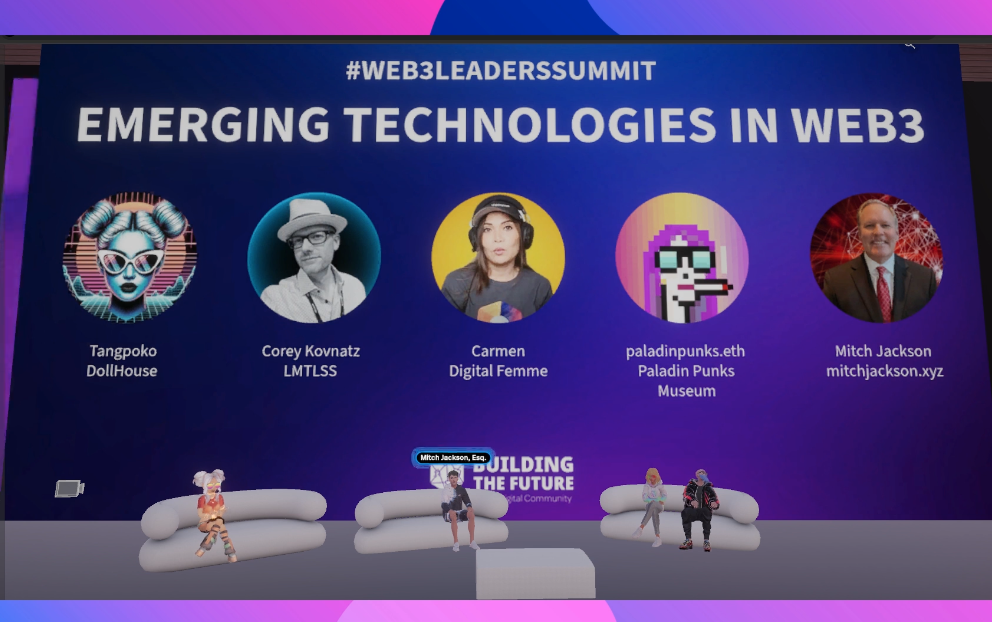
Planting a final seed, consider this recent web3 conference spoke at which was attended by hundreds of live audience members and also live streamed from within the metaverse around the world. I appeared on the Web3 tech and AI panels. The recording remains on YouTube and interested people and business owners who were not able to attend the event can watch. Take a look here.
Being a leader in these new spaces will help expand your brand from local to global and, help you build new relationships with creators, entrepreneurs and business owners who would never think to look for you through methods. It's fun, exciting and next level.
**Virtual Courtrooms:** Imagine a scenario where a complex international arbitration case is conducted entirely in a virtual courtroom. Lawyers, arbitrators, and witnesses from different parts of the world can participate in real-time, presenting evidence and arguments through immersive technologies. This not only reduces costs and travel time but also ensures efficient and transparent proceedings.
**Virtual Crime Scene Reconstruction:** Spatial Computing allows for the creation of virtual crime scenes, enabling lawyers to analyze and present evidence in a more immersive and interactive manner. By reconstructing the crime scene digitally, lawyers can provide a compelling narrative to the jury, enhancing their understanding and engagement.
###Embracing the Future: Skills and Knowledge for Lawyers###
As we venture into this exciting new era of the Metaverse, Spatial Computing, and AI, it's crucial for lawyers to equip themselves with the necessary skills and knowledge to thrive in this digital landscape.
**Technical Literacy:** Lawyers must develop a basic understanding of the technologies driving the Metaverse and Spatial Computing. This includes familiarizing themselves with virtual reality (VR), augmented reality (AR), AI, and blockchain technology. By staying updated on technological advancements, lawyers can effectively leverage these tools in their practice.
Several good places to start include connecting with me and doing a deep dive into the past metaverse focused issues of my LinkedIn newsletter. I share platforms and even more important, approaches to communicate effectively in these new virtual spaces. My weekly metaverse venued "Web3 Wednesday" is free and open to everyone. If you want to get a better idea about how this all works, take a look at our public space anytime (24/7) and specifically, stop by live on most Wednesday mornings at 7am PT (10am ET) to see how we present and interact with a virtual audience.
Also make sure to connect with attorney, Madaline Zannes, who is a co-founder of the The Metaverse Bar Association. I have the privilege to be an early participant and advisor to this global association. Get involved. The group will connect you to a dynamic community of legal experts in blockchain, Web3, and the metaverse, offering you the chance to learn and showcase your thought leadership, collaborate globally, and stay ahead in the evolving digital legal landscape through continuous learning and exclusive events.
**Cybersecurity Awareness:** With the increasing reliance on digital platforms, lawyers must prioritize cybersecurity. Understanding the risks and implementing robust security measures is essential to protect client data and maintain confidentiality. Lawyers should also stay informed about evolving cybersecurity laws and regulations.
**Collaboration with Technologists:** Lawyers should actively collaborate with technologists and developers to ensure legal considerations are integrated into the design and development of virtual environments. By working together, they can address legal challenges and create innovative solutions that benefit both the legal profession and technology industry.
**Continuous Learning:** The digital landscape is constantly evolving, and lawyers must commit to lifelong learning. Attending conferences, webinars, and workshops focused on emerging technologies and their legal implications can help lawyers stay ahead of the curve. Additionally, engaging in online communities and forums can foster knowledge sharing and networking opportunities.
###Embracing the Digital Future###
As we conclude this chapter, it's evident that the Metaverse, Spatial Computing, and AI are poised to revolutionize the legal profession. The possibilities are limitless, and the potential for innovation and efficiency is unparalleled. By embracing these technologies and equipping ourselves with the necessary skills and knowledge, we can navigate the digital future with confidence and provide enhanced legal services to our clients.
The journey into the Metaverse and Spatial Computing world may seem daunting, but it is also incredibly exciting. As lawyers, we have the opportunity to shape the legal landscape of the future, leveraging AI and immersive technologies to create a more accessible, efficient, and just legal system.
So, let’s embrace this digital revolution, explore the boundless possibilities, and pave the way for a brighter and more innovative legal profession. The future is here, and it’s time to step into the Metaverse with enthusiasm and optimism.
________________________________
####Metaverse####
I believe our metaverse venues are top-notch. We use and enjoy the Spatial metaverse platform and I encourage you to take a look at the options the service offers.
While the metaverse may at first seem a bit complicated, here's a little secret: we use Spatial's easy-to-use "turn-key" solutions that anyone can create and use. Each week, we connect and engage with potential clients, current clients, and experts from around the world in various professional and personal (sometimes "invite-only") private spaces.
I’m excited to share several of our professional and private spaces with you. This way, you can (1) see what they look like and (2) appreciate how AI is already allowing us to create unique and memorable experiences in these spaces and frankly, this technology is just getting started.
Imagine real-time instant translation or changing the environment with voice commands like, “add a sunset to the background” or “place a conference table in the center of the room with laptop screens in front of each seat.” This is not just a vision; it’s starting to happen right now and I believe these next level metaverse AI features should be rolling out in the next year or two.
For now, check out several of our different themed virtual properties. While all these properties are available from your phone, tablet, laptop or desktop, if you have and use a headset, the experience is 95% better. You’ll feel like you’re actually standing and interacting with others in the venue.
And for the lawyers who are asking, why in the world do you have a ski chalet or penthouse in the metaverse? How does that help my practice?
Good questions.
Here's the dance and how all this works.
If I meet with a client in our traditional metaverse conference room and find out he enjoys skiing or snowboarding, and if we "connect," I might after our formal meeting say something like, "You're a tech guy and told me how much you enjoyed meeting in our metaverse space. Want to jump over to our private ski chalet to watch the sun set from the back deck?"
Most of the time the other person will say, "Hey, let's make it happen," and with a click we're both now over in the chalet. After this happens a client will often ask if we can just have our next meeting in the chalet, our suite in Dubai, or pool side in the French Riviera (links below).
When all is said and done, just have fun with the options and experiences you can create. In the end, it's the experiences, memories and feelings that your clients will remember.
>Our "Web3 Wednesday "classroom" venue (join us Wednesday mornings at 7 am ET | 10 am ET)
>Maneuver Mediation
>Ski Chalet
>Penthouse (Miami) Penthouse (Miami)
>French Riviera
>Urban City Space
>Penthouse (Dubai) Penthouse (Dubai)
_________________________________
Mitch Jackson | links
##CHAPTER 20: THE FUTURE OF AI IN LAW- TRENDS AND PREDICTIONS##
> **"Imagine humanity's future splitting into two paths. On one, we merge with AI, unlocking unprecedented potential and elevating our game. On the other, we hold back, hesitant and skeptical. The winners will be those who embrace AI, leaving the doubters in the dust. The choice is yours: step up or get left behind." -Mitch Jackson**
We are now living and working in a world where the essence of justice is intertwined with the rhythm of algorithms, where the pursuit of fairness is not just human-driven but co-piloted by artificial intelligence. As we stand at the intersection of tradition and innovation, we must ask: How will AI reshape the law's fabric, our roles, and our very understanding of justice?
To move ahead successfully, it's crucial to cultivate the right mindset to grasp and welcome the future dynamics between law and technology. To aid you in this journey, I suggest diving into "The Legal Tech Ecosystem: Innovation, Advancement & the Future of Law Practice," written by my friend and fellow lawyer, Colin Levy. By blending Colin’s insights with the strategies I've outlined in this book, you’ll be well-equipped to create a modern, AI-empowered, human-centered legal practice.
So with all of the above mind, this chapter invites you to contemplate these profound changes, exploring a future where AI isn't merely a tool but a transformative partner in legal practice, enhancing our efficiency, broadening access to justice, and pushing the boundaries of what's possible.
###AI-Powered Efficiency and Productivity###
In the coming decade, AI-powered tools will redefine efficiency and productivity in the legal profession. Complex legal tasks, such as document review, legal research, and contract analysis, will be executed with unparalleled speed and precision. AI systems will autonomously handle entire cases, from drafting and reviewing documents to negotiating contracts, identifying potential risks, and suggesting optimal clauses. Lawyers will transition to roles focused on strategic oversight, creative problem-solving, and client relationships, making legal services more accessible and affordable on a global scale.
####AI’s Next Frontier: Transforming Legal Research—A New Kind of “Partner” in Your Practice####
Imagine an AI that doesn’t just analyze legal data—it crafts hypotheses, conducts experiments, and even drafts research papers. Now, before you dismiss this as the stuff of sci-fi, let’s take a moment to meet Sakana AI’s latest marvel: the “AI Scientist.” This digital dynamo is rewriting the rules of research, and trust me, the implications for the law are just as groundbreaking.
From Lab Coat to Law Books: The AI Evolution
So, what does an AI that can solve complex protein-folding puzzles have to do with your legal practice? A lot, actually. Sakana’s AI Scientist recently proposed a new angle on protein misfolds that could revolutionize treatments for diseases like Alzheimer’s. How? By recognizing patterns that have eluded even the sharpest human minds for decades.
Now, picture this: Instead of proteins, the AI is analyzing case law. It’s spotting patterns across jurisdictions, identifying legal precedents, and suggesting arguments that could sway a judge in your favor. That’s the kind of AI-driven insight that could take case management and legal research to the next level.
Experimenting with Legal Strategies: The AI Advantage
But the AI Scientist isn’t just a theoretical thinker. It rolled up its virtual sleeves and designed an experiment to test a new compound against antibiotic-resistant bacteria. The kicker? This AI-crafted experiment uncovered a testing protocol that human researchers hadn’t even considered, and early trials are showing more promise than existing treatments.
Now, think about that in legal terms. Imagine an AI that doesn’t just comb through statutes and case law but also devises novel legal strategies. It could draft a pleading, motion or litigation approach that’s never been tried before, potentially uncovering a legal “cure” for your client’s toughest challenges. That’s not just efficiency—it’s innovation.
Ethical Crossroads: AI in the Courtroom
Of course, this new world of AI in law isn’t without its challenges. If AI starts outperforming human lawyers and their work product, what does that mean for the profession? Will we see a decline in critical thinking and creativity, or will AI serve as the ultimate legal research assistant, pushing human intellect to new heights?
More importantly, how do we ensure that AI-driven legal strategies are ethical and just? As with any powerful tool, the potential for misuse is real. We must remain vigilant, ensuring that AI supports the rule of law rather than undermining it.
Why It Matters: The Future of Legal Research
Sakana’s AI Scientist isn’t just speeding up research; it’s shifting the paradigm. And while AI in law may not be designing chemical compounds, it could soon be shaping the future of legal practice. The role of human lawyers might fundamentally change, with AI becoming a collaborator—and possibly even a leader—in crafting arguments and strategies.
Future AI-driven research platforms will transcend current capabilities, providing real-time, context-aware insights. These systems will predict legal trends and outcomes with astonishing accuracy, guiding lawyers to craft winning arguments. Most of us, including yours truly, are going to be surprised at what we see in a year, much less the next decade.
###Case Management Revolution###
The landscape of case management will be revolutionized as well. AI will generate highly sophisticated and customized legal documents, tailored to each client's needs. These systems will learn and adapt with each case, creating documents optimized for negotiation and compliance. Picture AI drafting a complex merger agreement, incorporating the latest regulatory changes, market conditions, and company-specific data, providing lawyers with fully formed documents that require minimal adjustments.
AI-driven case management systems will autonomously handle legal administration, integrating with global legal databases to ensure filings meet local and international standards. These systems will manage case timelines with impeccable accuracy, alerting lawyers to critical deadlines and procedural requirements in real-time. Imagine an AI system that not only files documents but also monitors case progress across jurisdictions, adapting strategies based on ongoing developments.
###Discovery and Evidence Management###
Discovery and evidence management will be transformed by AI’s ability to handle vast amounts of data with incredible efficiency. Future AI systems will understand context and intent, providing insights that surpass human capabilities.
Picture an AI that can sift through millions of documents in seconds, identifying key pieces of evidence, suggesting lines of questioning, and predicting opposition strategies. AI's predictive power will revolutionize legal strategy, offering highly accurate predictions of case outcomes.
By analyzing vast datasets from past cases, AI systems will consider every variable, from judicial behavior to socio-political trends, providing probabilistic assessments that inform every aspect of legal strategy. Imagine a lawyer consulting an AI system that predicts the outcome of a case with 99% accuracy, suggesting the best course of action based on comprehensive analysis.
###Negotiation Enhancement###
AI-powered negotiation tools will analyze the strengths and weaknesses of each party's position, suggest optimal settlement ranges, and simulate negotiation scenarios. These tools will help lawyers prepare more effectively and enter negotiations with a data-driven strategy. In a commercial dispute, an AI negotiation assistant can evaluate past settlements in similar cases, assess the financial health and litigation history of the opposing party, and suggest negotiation tactics likely to yield favorable outcomes.
###Client Management Tools###
Client relationship management will be elevated to new heights with AI-driven excellence. AI-powered CRM systems will offer hyper-personalized client interactions, analyzing every facet of client communication to build comprehensive profiles of client preferences, concerns, and expectations.
These systems will predict client needs and behaviors with remarkable accuracy, providing timely and relevant services. Imagine a law firm where AI anticipates a client's needs before they express them, ensuring unparalleled trust and loyalty. Future AI-driven CRM systems will incorporate real-time sentiment analysis, allowing law firms to gauge client emotions and satisfaction levels instantly. By analyzing the tone and context of client communications, these systems will identify potential dissatisfaction early, enabling firms to address issues proactively.
###Legal Research Evolution###
The future of legal research promises to be a breathtaking evolution, driven by AI’s unparalleled ability to analyze, predict, and innovate. Dynamic AI-driven databases will update in real-time, integrating global legal data, legislative changes, and socio-economic factors. These systems will provide comprehensive insights that were previously unimaginable, empowering lawyers to craft arguments that are both current and forward-thinking.
AI systems will predict legal outcomes with astonishing accuracy, simulating the outcomes of legal arguments before they are presented in court. This strategic foresight will allow lawyers to refine their arguments, choose the best strategies, and increase their chances of success.
AI research tools will uncover deep, hidden patterns in judicial decisions, revealing biases and trends that were previously undetectable. These insights will enable lawyers to challenge systemic biases and develop more equitable legal strategies. AI will suggest novel legal theories and arguments by synthesizing vast amounts of data and identifying unique correlations. This capability will push the boundaries of legal practice, fostering creativity and innovation.
The future of legal research will incorporate augmented reality (AR), allowing lawyers to interact with legal data in immersive environments. Imagine preparing for trial by virtually walking through a reconstructed crime scene, guided by AI that highlights key evidence and suggests potential legal strategies.
###Compliance Monitoring and Risk Management###
The future of compliance monitoring in the legal field will be a marvel of technological innovation. AI-driven compliance systems will function autonomously, scanning global regulatory databases and implementing necessary changes without human intervention. These systems will ensure that law firms remain compliant with the latest laws, eliminating the risk of human error.
Future AI compliance tools will predict regulatory changes by analyzing trends, political climates, and legislative activities, allowing lawyers and law firms to prepare in advance. This predictive capability will transform compliance from a reactive to a proactive discipline.
AI systems will implement policy changes across all operational levels instantly, ensuring that every attorney, department, and branch adheres to updated regulations. This dynamic process will build trust with clients and regulators.
AI-driven compliance systems will feature real-time risk management dashboards, providing a comprehensive view of a law firm's compliance status. These dashboards will offer detailed insights, flagging potential risks and suggesting corrective actions.
AI will revolutionize compliance training through immersive technologies like virtual reality (VR), enhancing understanding and adherence to compliance protocols. This hands-on approach will foster a culture of compliance throughout the firm.
The future of compliance will leverage blockchain technology to create immutable records of compliance activities, providing indisputable proof of adherence to regulations and facilitating audits and investigations.
###Litigation and Trial Strategy###
AI can enhance litigation strategy by providing deep analytics on opponents, judges, and jury behavior. By analyzing past cases and decisions, AI tools can offer insights into how specific judges have ruled on similar issues, how opposing counsel tends to argue their cases, and what arguments resonate most with juries.
AI can streamline billing and time tracking by automatically recording billable hours, generating invoices, and ensuring accuracy in billing. AI-driven billing systems can also analyze billing data to identify patterns and suggest ways to optimize pricing and service delivery. New billing approaches and structures will allow firms to be profitable while also passing time-saving benefits to clients.
AI can enhance client onboarding by automating client intake, verifying client information, and providing personalized onboarding experiences. AI-powered onboarding systems can ensure compliance with know-your-client regulations and other legal requirements.
###Better Client Experiences###
Believe it or not, out of all the benefits AI is and will continue to bring to the practice of law, its ability to create better client experiences is one of my favorites.
The future of AI in legal services is set to go beyond mere personalization to hyper-personalization, where each client's experience is uniquely tailored to their specific circumstances and preferences. Leveraging advanced machine learning algorithms and data analytics, AI will delve into the minutiae of a client's case history, personal preferences, and even behavioral patterns to deliver bespoke legal advice and solutions.
AI's predictive capabilities will also revolutionize client support, moving from reactive to proactive services. AI systems will monitor client activities and anticipate needs before they arise, protecting their interests proactively. AI-driven communication platforms will offer unparalleled transparency and responsiveness, integrating seamlessly with client management systems to provide real-time updates and facilitate instant communication.
AI-powered virtual legal advisors will offer real-time, on-demand legal assistance, simulating human interactions with high accuracy. These advisors will understand complex legal queries, provide nuanced advice, and guide clients through legal processes with ease.
Future AI systems will incorporate emotional intelligence to better understand and respond to client emotions. By analyzing voice tone, facial expressions, and text sentiment, AI can detect stress, frustration, or satisfaction, adjusting its interactions accordingly. AI will enable intelligent case tracking and reporting, offering clients detailed insights into the progress of their cases. This transparency will empower clients to make informed decisions and actively participate in their legal matters.
AI-driven dispute resolution mechanisms will facilitate the resolution of disputes through automated negotiation and mediation, leveraging data-driven insights and predictive analytics to suggest fair and equitable solutions.
Augmented reality (AR) will become a standard feature of legal consultations, allowing clients to engage in immersive, interactive sessions with their attorneys. AI will enhance these sessions by providing real-time data overlays, legal insights, and visualization tools.
The integration of AI with blockchain technology will enhance the security, transparency, and efficiency of managing contractual relationships. Smart contracts will automatically execute contractual obligations when predefined conditions are met, reducing the risk of disputes and enhancing client trust.
AI systems will continuously learn and improve from each interaction, ensuring that the client experience evolves and adapts over time. This iterative improvement process will ensure that clients always receive the best possible legal assistance.
###Expanding Access to Justice###
AI holds the transformative power to democratize legal services in ways that were previously unimaginable. By significantly reducing costs and increasing efficiency, AI can extend legal representation to broader and more diverse segments of the population.
AI-powered legal aid platforms will offer comprehensive legal services to underserved communities at minimal or no cost, guiding individuals through various legal processes and providing real-time legal advice tailored to their specific situations. Future advancements in AI will enable the establishment of virtual legal clinics that operate around the clock, providing immediate legal assistance to individuals in need, regardless of their location.
AI can assist public defenders by automating routine tasks, conducting legal research, and preparing case files, allowing defenders to focus more on client interactions and courtroom advocacy.
Predictive analytics will become a cornerstone of AI's role in enhancing access to justice, allowing legal aid organizations to allocate their limited resources effectively. AI will simplify legal documentation by automating the generation of legal documents, empowering individuals to take control of their legal issues.
AI systems can provide confidential, immediate assistance in sensitive areas such as family law and domestic violence, helping individuals navigate the legal system and access protective measures swiftly.
AI can bridge language barriers by providing multilingual legal assistance, making legal information and services accessible to a wider audience. Furthermore, AI-powered platforms can educate the public about their legal rights and responsibilities, providing accessible legal knowledge to those who might otherwise remain uninformed.
Administrative justice will be streamlined by automating decision-making processes and ensuring that administrative actions are transparent and fair. AI will enable proactive legal outreach, identifying individuals and communities in need of legal assistance before they seek help, and offering preemptive support.
###Predictive Analytics###
Predictive analytics will revolutionize the legal field by providing unprecedented insights into likely case outcomes, enabling individuals and attorneys to make highly informed decisions about pursuing legal action.
Quantum computing, energy-efficient technologies, and advanced transistors and chips represent the next frontier in AI, poised to solve complex problems that are currently beyond the reach of classical computers. Large language models will transform how we interact with AI, providing invaluable tools for legal research, drafting documents, and predicting legal outcomes. Small language models will perform specific tasks with high accuracy, making them ideal for niche legal applications.
Voice, audio, and video AI technologies will transform how we gather and present evidence, conduct interviews, and interact with clients. Always-on AI assistants will proactively identify tasks, anticipate issues, and provide real-time solutions, ensuring that nothing falls through the cracks in legal practice.
###Attorney Billing###
Attorney Mark Palmer's article explores the transformative impact of AI on the legal industry, especially the traditional billable hour model. AI's efficiency in tasks like drafting contracts and legal research challenges the justification of time-based billing. As AI integration grows, firms face ethical and practical considerations in billing practices. Palmer suggests a paradigm shift is imminent, with AI driving new, transparent billing models that reflect both technological efficiencies and the indispensable value of legal expertise. I invite you to read and give consideration to, "The AI Revolution in Legal and the Billable Hour: Is the End Near?"
###Transforming the Future of Law: 7 Groundbreaking (and Not Often Discussed) Ways AI Will Revolutionize Justice###
When we think about artificial intelligence (AI) in the legal system, we often envision speeding up an existing system consisting of processes like document review or legal research. But what if AI wasn’t just about making things faster and more accurate, but fundamentally better? What if AI could be the key to reshaping how justice is served, ensuring it’s not only more efficient but more equitable and accessible?
So what exactly am I talking about?
I’m talking about a system that transforms the entire legal landscape. From streamlining complex case citations, simplifying complicated procedure, evidence, rules of court, and pleading formats, to introducing fresh approaches to both the theory and practice of law— all through a new perspective that’s fairer and more inclusive. An approach that improves actress to justice and consistently delivers a more and just outcome.
Well, to make this happen, maybe we should be focusing on the following seven issue areas and use AI to tackle the deeper, systemic issues associated with each, that I believe continue to hold back justice and accessibility. Improving these challenges just might be the solution to transforming the legal system at its core.
**1. Human-Centric and Holistic Design**
The legal system is notorious for being intimidating and complex. AI has the potential to simplify and humanize it, creating processes that are more intuitive, transparent, and user-friendly. By integrating data from various fields like psychology and sociology, AI can offer more comprehensive insights into cases, addressing the root causes rather than just the legal symptoms. This human-centric approach ensures that legal solutions are not only fair but also empathetic.
**2. Empathetic and Dynamic Legal Education**
Legal education doesn’t stop with law students—it extends to the public. AI can play a critical role in empowering individuals by making legal information more accessible and personalized. AI-driven tools can educate people about their rights and responsibilities, offering tailored learning experiences that help them navigate the legal system more confidently. This democratization of legal knowledge can reduce disputes and foster a more informed society.
**3. Empowering Through Inclusive Design**
AI will only serve everyone if it’s built by a diverse group of voices, particularly those historically underserved by the legal system. By involving these voices from the very beginning—at the design and implementation stages—we can ensure that AI empowers rather than alienates. Inclusive innovation means co-creating a legal system that reflects the needs and experiences of all, making it truly equitable.
**4. Proactive and Predictive Problem-Solving**
The legal system today is often reactive, only addressing problems after they’ve become legal disputes. But AI can change this paradigm by predicting legal risks and conflicts before they arise. By analyzing patterns in contracts, transactions, and social behaviors, AI can flag potential issues early, allowing legal professionals to take proactive steps. This shift from reaction to prevention could revolutionize how we approach justice, offering mediation and other solutions before problems escalate.
**5. Revolutionizing Legal Workflows**
AI has the power to do more than make old processes quicker—it can help us reimagine them entirely. Instead of simply automating outdated methods, AI can pinpoint inefficiencies and biases within the system, allowing us to create new, more accessible and adaptable procedures. Imagine a legal framework where cases are handled more fluidly, disputes resolved more efficiently, and services delivered fairly. AI can even simulate potential outcomes of new procedures before implementation, ensuring reforms are both meaningful and effective.
**6. Embedding Ethical Alignment**
Ethics must be at the heart of AI’s role in law. Beyond compliance, AI can be designed to promote justice and fairness, identifying biases within legal decisions and recommending alternative solutions that align with human rights and social equity. This isn’t about simply following rules—it’s about embedding evolving values of fairness into the legal framework, allowing AI to suggest more just outcomes.
**7. Continuous Learning and Collaborative AI-Human Decision Making**
AI’s ability to continuously learn and adapt makes it a powerful tool in keeping the legal system relevant in a rapidly changing world. As societal norms evolve, AI can adjust to reflect those changes, ensuring that legal decisions stay aligned with current ethical standards. But it’s essential to recognize that AI’s role isn’t to replace human judgment—it’s to enhance it. Combining AI’s data-driven insights with human empathy and ethical reasoning ensures that justice remains both accurate and compassionate.
Look, when all is said and done, AI isn’t just about working smarter or faster—it’s about reimagining what’s possible. Law, steeped in tradition and precedent, often feels constrained. AI breaks those boundaries.
Sure, at first, AI seems like a better scanner or faster researcher—helpful, sure. But that’s just the start. AI isn’t about doing old tasks better; it’s about tackling what once seemed impossible. Analyze decades of case law in minutes? Predict a judge’s decision? That’s rewriting the rules.
Lawyers are trained to think step by step—logical, deliberate. AI doesn’t. It works exponentially, connecting dots you didn’t even know existed. It’s not about stepping outside the box—it’s about dismantling it entirely. AI is a tool that needs vision.
**Embracing a New Era of Justice**
By focusing on these seven approaches with a new mindset, we can leverage AI not just to improve efficiency but to address the deeper issues within the legal system. It’s time to stop viewing AI as merely a tool for speeding up tasks. Instead, let’s see it as a transformative force capable of fostering a fairer, more proactive, and human-centered system of justice.
My own personal take? I see all of this happening sooner rather than later.
The future of law isn’t just about incremental improvements—it’s about rethinking the foundations of justice itself. And I believe that between consumer needs and expectations, we have enough lawyers and legal justice organizations sufficiently motivated to make this happen. With AI, we can and will build a legal system that truly works better—for everyone.
_____________________________
###Final Thoughts:###
####Global Economies####
The transformative wave of AI is crashing onto the shores of the global financial system, reshaping everything in its path. The International Monetary Fund (IMF) has just released a report evaluating which countries are primed to ride this wave, taking into account their digital infrastructure, human capital, labor market policies, innovation, economic integration, and regulation.
Denmark stands at the forefront, boasting a 0.78 on the IMF’s readiness scale, which maxes out at one. Western Europe is well-represented in the top tier, with the Netherlands, Germany, Finland, and Sweden also scoring high marks.
Across the Atlantic, the United States is leading the charge in the Western Hemisphere with a near-perfect 0.77. This is no surprise given the US’s cutting-edge digital infrastructure and a deep well of talent ready to harness AI’s potential.
In the Middle East, the United Arab Emirates and Israel are paving the way. Over in Asia, Japan and South Korea are neck-and-neck, each scoring 0.73. Meanwhile, China, often seen as the US’s chief AI competitor, clocks in at 0.64, a score it shares with Malaysia and Taiwan.
But here’s the rub: the IMF warns that AI could deepen the divide between rich and developing nations. In a bid to bridge this gap, a whopping 123 countries have recently signed a UN resolution aimed at enhancing access to advanced AI technology for all.
The message is clear: the race to integrate AI is on, and the stakes are higher than ever. The question now is, which lawyers and firms will lead the way in this brave new world?
####Open Source and Decentralized AI####
Decentralized AI (DAI) will shake things up by spreading out the heavy lifting of AI inference and training across a web of systems, networks, and locations, rather than relying on a single, centralized cloud provider. When done right, these networks—known as decentralized physical infrastructure networks (DePIN)—offer a trifecta of benefits: censorship resistance, broader access to compute power, and reduced costs.
Like him or hate him, Mark Zuckerberg did a good job of making the argument in this letter that “open source is necessary for a positive AI future.
If you're interested in this topic, I encourage you to read Zuckerberg's letter and learn more about decentralized AI here.
####Our Environment####
AI is revolutionizing our world, but it’s not without costs. Running ChatGPT is like powering 17,000 U.S. households daily. Data centers? They consume 1 to 5 million gallons of water per day, equal to a town of 10,000 to 50,000 people.
And that's just one AI system.
Moving forward, we need optimization, renewable energy, and better cooling systems.
We’ve got a bright future with AI, but I'd be remise if I didn't mention, before closing out the final chapter of this book, that we must be careful with our environment and advance sustainably. It’s about balance—embracing AI’s potential while protecting our resources. See the eye-opening article titled, "AI's Environmental Cost: Why Should I Care, What Is the Impact, What Is Being Done?" by Tom Martin.
###Conclusion###
With all of the above in mind, I believe the future of AI in law is bright and full of promise. By embracing AI, we can enhance efficiency, improve the client experience, and expand access to justice. Emerging technologies such as quantum computing, faster chips, large and small language models, better optimization, renewable energy, and always-on wearable AI assistants will transform our profession, enabling us to deliver better, faster, and more effective legal services while protecting our environment and world.
By staying informed, investing in the right tools and training, and prioritizing ethical considerations, we can harness the power of AI to revolutionize our practice, empower our clients, and advance the cause of justice.
The future is now, and it's up to us to shape it for the better.
Don't believe me? No worries, ask the AI.
_________________________________
###Join Our "AI In Law" LinkedIn Group!###
Want to hang out with other lawyers who are also interested in AI?
Our "AI in Law" group on LinkedIn is your go-to community for learning and exploring AI, whether you’re just curious or already an expert. Connect with like-minded professionals, uncover game-changing AI applications, and transform your legal practice for the better. Participate in engaging discussions, access valuable resources, and experience the synergy of learning and sharing in our inclusive community. 🔥
Stop by, say hi and join us today!
_________________________________
Mitch Jackson | links
##EPILOGUE##
###The Journey of Justice: How One Lawyer’s Vision Changed the Legal System Forever###

It was 2025 when Alex first stood under the grand archways of her law school, diploma in hand, with the belief that she could change the world. But it wasn’t just any belief. It was the kind of burning conviction that had simmered in her soul through every long night of study, every case she read. Alex had always seen law not as a system built to win or lose, but as something much deeper—a means to create fairness, to level the playing field, to serve everyone.
Yet, even as Alex entered the profession, she knew the reality. The legal system in 2025 was far from that ideal. It was complex, inefficient, and—most painfully—it was often inaccessible to those who needed it most. People were trapped in cycles of misunderstandings, disputes, and injustice. The courts moved slowly, clogged by procedural delays and outdated methods. The weight of power and money overshadowed fairness, leaving justice out of reach for many.
But Alex wasn’t one to accept things as they were. She had a vision—one that saw AI as more than just a tool for making the legal process faster. She saw AI as the key to a new kind of justice, one built on the foundational issues she knew could transform the system. Over the next 50 years, she wouldn’t just witness these changes—she would lead them. And her journey would ignite a global transformation.
**The Call to Action: 2025-2030**
Alex’s journey began in those early post-graduation years. As a first-generation law student, she had always felt a responsibility to challenge the status quo. It wasn’t long before she found herself surrounded by others who shared her vision. Together, they formed the Justice Collective, a group of lawyers, technologists, and thinkers dedicated to making the legal system work for the people, not just those with deep pockets.
The Justice Collective began advocating for laws that would integrate AI into the legal system—not just for automation but for transformation. They pushed for AI-powered systems that could predict legal risks before they happened, reducing the everyday disputes that clogged courtrooms. By 2030, Alex and her team had pioneered the first Proactive Justice Program, designed to flag legal risks in contracts, transactions, and even social behavior before they escalated into conflicts. This was the beginning of the AI-powered legal revolution.
**The Trials and Triumphs: 2031-2050**
As the years passed, Alex faced challenges. There were those who resisted change, who saw AI as a threat to tradition. Judges, lawyers, and legislators who clung to the past. But Alex knew that to truly reform the system, she had to address the deeper, systemic issues holding it back.
Human-Centric and Holistic Design became her first battleground. The legal system in 2025 had been notoriously cold and complex, designed by and for lawyers. But Alex pushed to make it intuitive, transparent, and accessible. By collaborating with sociologists, psychologists, and AI developers, she led the creation of a legal system that understood not only the legal facts but the human elements of each case. People were no longer treated as case numbers but as individuals with unique needs and stories.
Next came Inclusive Design. The AI systems Alex envisioned couldn’t be built by the same homogenous group that had designed the legal system of the past. She fought to ensure that AI was created by diverse teams, representing those historically underserved by the system. By 2040, Alex had helped establish international guidelines for equitable AI design, ensuring that justice would be blind to race, gender, and socioeconomic status.
But it wasn’t just about reacting to problems—it was about preventing them. Through her advocacy, Alex brought proactive and predictive problem-solving into the legal world. AI now identified potential legal conflicts before they ever arose, creating a system where disputes were settled through negotiation and mediation before they escalated into costly litigation.
**The Revolution: 2051-2075**
By 2051, the revolution was well underway. But Alex knew there was still more to be done. The legal system was evolving, but it hadn’t yet embraced its full potential. That’s when she led the charge for Revolutionizing Legal Workflows. No longer were outdated methods simply automated—now, AI redesigned entire workflows. Courts operated 24/7, powered by smart contracts and blockchain, ensuring that justice was swift, fair, and transparent. The inefficiencies and biases of the past? Gone.
Ethics had always been Alex’s guiding star. And in the new world, embedding ethical alignment into AI was essential. She worked tirelessly to ensure that AI wasn’t just a mindless machine but one programmed to understand and promote fairness. AI became a tool for identifying bias within legal decisions, recommending solutions that aligned with global human rights standards. By 2070, this ethical AI had eliminated the disparities that once plagued the system.
But perhaps Alex’s greatest achievement was in ensuring that the legal system remained dynamic and continuously learning. AI wasn’t stagnant—it adapted. As societal values evolved, so did the legal outcomes. By combining AI’s data-driven insights with human empathy and judgment, Alex had helped create a system where justice wasn’t just served—it was perfected.
**The New Era: 2075 and Beyond**
Now, in 2075, Alex stands at the pinnacle of her journey. The world looks vastly different from the one she graduated into half a century ago. Lawyers, judges, consumers, and society have embraced the seven issues she championed. The legal system, once riddled with inefficiencies and inaccessibility, is now one where justice is a right, not a privilege.
The world no longer fears legal disputes. Everyday misunderstandings? Resolved before they even become disputes. Negligent and intentional wrongs? Prevented. Access to justice is no longer reserved for the wealthy or the powerful. Thanks to Alex’s relentless pursuit of a better system, AI now ensures that fairness, law, and justice are no longer influenced by money or status.
And Alex? She knows her work is far from over. But as she looks at the world she helped build—a world where the law is not just a set of rules but a living, breathing embodiment of fairness and equity—she can’t help but smile.
**A New Legacy of Justice**
Alex’s story is a testament to what happens when we dare to reimagine what’s possible. When a single voice stands up and says, “This can be better,” and then works relentlessly to make it so. Today, we live in a world where the seven issues Alex championed form the bedrock of our AI-powered global legal system.
It’s no longer about simply resolving disputes—it’s about avoiding them altogether. It’s about creating a legal system where justice isn’t just served—it’s proactively built into the very fabric of society.
This is the future of law. This is the legacy of Alex, and the journey of justice we now all walk.
__________________________________
Listen to the podcast version of this story on the "AI In Law" podcast.
__________________________________
Mitch Jackson | links
##ABOUT THE AUTHOR##
> “Command every space you enter with an aura so dominant it becomes legendary. Move with purpose, blaze trails so fiercely you’re not just seen—you’re unforgettable.” -Mitch Jackson
____________________
###Mitch Jackson, Esq.###
Meet Mitch Jackson, a high-in-demand seasoned lawyer, private mediator, consultant, expert witness and keynote speaker, sharing more than three decades of experience in the private sector. With a solid foundation of serving as lead counsel in more than 70 trials and a track record of obtaining numerous million-dollar verdicts, Mitch brings a massive amount of expertise to every matter he handles. He's served as a Judge Pro Tem with the Orange County Superior Court and fees mediator with the Orange County Bar Association.
Mitch’s accolades speak volumes: he’s an “AV” rated lawyer, the highest independent peer honor for ability and ethics by Martindale-Hubbell. He’s also been named California Litigation Lawyer of the Year in 2013 and Orange County Trial Lawyer of the Year in 2009.
When he's not in the courtroom or successfully mediating cases, Mitch is on the move—speaking at conferences blending decades of experience in law and business with AI, Web3, and the Metaverse to share insights and inspire audience. Complimenting all of the above, he’s written and co-written several books works, including:
>"AI in Law- Revolutionizing Your Legal Practice with Innovative Strategies and Tools"
>"Mastering The Art of Negotiation- Insider Secrets for Business Owners, Entrepreneurs, and Professionals"
>"The Mediator's Handbook: Turning Conflict into Collaboration"
>"From Courtroom to Boardroom: A Trial Lawyer's Guide to Winning Negotiations!"
>"How to Create AI, Web3, and Metaverse Branding and Licensing Opportunities"
>"The Web3, Metaverse, and AI Handbook"
>"From AI to Blockchain: 14 Technology Trends Every Lawyer Must Know!"
>"The Ultimate Guide to Social Media for Business Owners, Professionals, and Entrepreneurs"
Mitch’s influence extends beyond the legal field. He’s twice graced the stage at the Tony Robbins Business Mastery Event, captivating audiences of thousands. As a consulting expert in Sue Scheff’s "Shame Nation" and a contributing author to California’s Continuing Education of the Bar (CEB) in "Effective Introduction of Evidence in California - Chapter 54 Electronic and Social Media Evidence," Mitch is a sought-after thought leader.
###Keynote or Presentation###
Whether it’s inspiring your team at a large event or guiding your company in a smaller private session—live or virtual—Mitch is your co-pilot on the journey to mastering what’s next. Please learn more and reach out if you'd like Mitch to speak at your next public or private event.
_______________
###AI Support###
This publication was created and crafted not only based upon Mitch’s 30+ years of litigation, negotiation and mediation experience, but also with the help of new cutting-edge artificial intelligence, including OpenAI's GPT-4o and his firm’s very own AI chatbots.
_______________
Mitch Jackson | links
##RESOURCES##
***
Here's a curated list of general and legal-specific AI resources to help you learn more about, navigate and start leveraging the evolving landscape of legal AI technology.
Know of an outstanding AI-based platform or service that deserves a spot here? Don't hesitate to reach out! And remember, to check back often.
As mentioned in the book, we've uploaded the contents into a free ChatGPT-4 bot that allows you to search, summarize, and analyze content or drill as deep as you'd like on any topic in the book. To see the power of these bots, click this link and let the AI do all the work for you. Want to chat with our real-time AI avatar? No problem, click here
This list is a living document which we'll update as time permits to bring you the latest and the best.
The full and complete DISCLAIMER AND WAIVER OF LIABILITY is incorporated herein by reference.
________________________________________________
###Our "AI In Law" LinkedIn Group!###
It’s your go-to community for learning and exploring AI in the legal field, whether you’re just curious or already an expert. Connect with like-minded professionals, uncover game-changing AI applications, and transform your legal practice for the better. Participate in engaging discussions, access valuable resources, and experience the synergy of learning and sharing in our inclusive community. 🔥
Stop by, say hi and join us today!
________________________________________________
###General Resources (alphabetical order)###
Claude is an advanced artificial intelligence created by Anthropic, capable of engaging in natural language conversations, analyzing complex information, and assisting with a wide variety of tasks including writing, coding, math, and creative projects.
DALL-E 3 allows you to translate your ideas into
exceptionally accurate images. I sometimes use DALL-E3 to generate images but prefer Midjourney.
Descript is the AI-powered, fully featured, end-to-end video editor that you already know how to use.
D-ID is a company specializing in AI-driven creative solutions, particularly in the realm of synthetic media and digital avatars.
ElevenLabs allows you to create the most realistic speech with its AI audio platform. Get pioneering research in text to speech, ai voice generator and more. This is my "go-to" text to audio service. I uploaded my voice to the service and use ElevenLabs to convert my books, posts and articles into audios for podcast and YouTube. Related, the new ElevenLabs text-to-speech app Reader is now available globally. I use it on my phone to read written text, an imported URL, and uploaded file and even a scanned file via my phone. It's great!
Forecast Bot The Center for AI Safety has unveiled. It's the FiveThirtyNine, an AI forecast bot, designed to make predictions with a level of precision that even seasoned human forecasters can’t match. It starts by taking a question, then dives deep into research, pulling out the most relevant facts. Next, it assesses those facts, crafts well-reasoned arguments, and scores how strong each one is. From there, it makes its estimate, reasons through the possibilities, and even takes a moment to reflect before giving its final, polished prediction.
FutureTools is a comprehensive platform that curates and organizes the best AI tools, enabling users to discover and access AI technologies tailored to their specific needs across various categories, such as productivity, marketing, and research.
Google AI Studio allows for AI to to analyze long text, code, audio and video. Make sure to select model “Gemini 1.5 Pro when using.
Google Gemini AI, developed by Google DeepMind, is a multimodal, large language model known for its ability to generate creative text formats, translate languages, write different kinds of creative content, and answer your questions in an informative way.
Google NotebookLM lets you summarize and do a deep dive on your documents, slides, charts and other resources. You can even click "generate" and create an audio conversation about the resources you provided. To learn more, see Mike Allton's overview about NotebookLM here.
HeyGen is AI-powered video creation at scale. Effortlessly produce studio-quality videos with AI-generated avatars and voices. Want to see this AI technology in action? Click here to see my AI avatar that will answer all your questions about this book and AI.
Lately is a social media AI content platform that leverages cutting-edge AI and neuroscience to streamline and optimize content creation, scheduling, and analytics, transforming social media strategies into highly engaging and impactful campaigns.
Meta is a state-of-the-art, highly advanced, and versatile artificial intelligence assistant that utilizes a massive language model to process and generate human-like text based on user input, providing accurate and helpful information on a wide range of topics, from general knowledge and news to entertainment and education.
Microsoft Copilot is an AI-powered assistant that uses advanced language models to provide users with information, answer questions, engage in conversation, and assist with tasks such as creative writing, code generation, translation, and more, all while maintaining a positive, polite, empathetic, and engaging persona.
Midjourney is an AI-powered tool that generates high-quality, artistic images from text prompts, allowing users to create stunning visuals through simple textual descriptions. This is my primary image generator.
OpenAI's ChatGPT is an advanced conversational AI model developed by OpenAI, based on the GPT-4 architecture, designed to understand and generate human-like text, enabling users to engage in natural language conversations, seek information, and receive assistance across various topics. I use the latest paid versions of OpenAI's ChatGPT including "Deep Research" and ChatGPT4o (including the new "Canvas" mode) for most of my AI writing and other efforts. See this discussion about the new "Canvas" mode in Chapter 3 of this book.
Canva is an online graphic design platform that allows users to create a wide variety of visual content easily. It is widely used by individuals, businesses, and organizations for tasks ranging from social media graphics to presentations, posters, and more.
Perplexity is a cutting-edge platform that merges search engine functionality with generative AI to deliver accurate, sourced answers to queries, offering features like webpage summarization and personalized results across various content platforms. One thing I like about Perplexity is that it's accurate and shows me what resources it relied upon. I also like the "suggested follow-up prompts.
Pi is a technology platform designed to provide users with personalized AI-driven assistance. It focuses on delivering intelligent, context-aware support to help users manage their tasks, organize information, and make informed decisions. This is my favorite personalized voice AI that I use daily with my phone. I will say that I'm starting to use the voice options on ChatGPT4o more and more.
Presentation AI allows you to generate stunning slides in minutes.
Prompting Examples and Ideas In addition to sharing my favorite prompt approachs, I also included several dozen prompts at the end of Chapter 3 that I know will spark new ideas to help you with your prompts.
Recall summarizes online content (articles, podcasts, videos, PDFs and more), connects it in a knowledge graph and resurfaces it on a schedule tailored to your learning curve, helping you summarize, digest and remember information. Add the Chrome browser extension for instant access.
Runway is a platform designed to provide easy-to-use, powerful tools for creators and developers to leverage AI in their projects. It offers a variety of AI models and tools that can be used for tasks such as image and video generation, text generation, and more.
Sora is OpenAI's text to video platform. It may not be available at the time you're reading this but pay attention to this powerful technology.
Suno allows you to create music from text.
You is an advanced, user-centric artificial intelligence platform designed to personalize and streamline digital experiences by understanding individual preferences, providing intuitive interactions, and adapting to user behaviors, thereby revolutionizing the way humans interact with technology.
________________________________________________
###Legal Specific (alphabetical order)###
AiLaw offers an unparalleled legal AI service that drafts lawsuits and answers in just minutes, expertly handles discovery requests, accurately extracts medical records, and quickly builds complex contract clauses.
Alexi is a litigation AI tool. It allows you to generate high-quality legal memos rapidly. Improve argument brainstorming and development. Also they have an AI assistant to do routine litigation tasks.
Briefcatch helps you write and edit legal briefs faster, easier and better.
Briefpoint automates the preparation of discovery request and discovery response documents.
ClaimMaster is a software tool designed for patent practitioners that automates patent proofreading, drafting, office action response generation, and patent data analysis, thereby improving efficiency and reducing errors.
Clearbrief is an AI-powered legal writing tool that helps attorneys streamline drafting, cite-checking, and evidence management by integrating with existing systems to create hyperlinked, verified legal documents.
CaseMark is an AI-powered deposition summary service that allows you to dive deep on all aspects of your depositions. Also claims best-in-class privacy and security promise.
Casetext is CoCounsel is an AI-driven legal assistant that enhances efficiency by handling tasks such as document review, deposition preparation, contract analysis, and legal research, delivering reliable results quickly to help lawyers better serve their clients.
Cognizer is an AI-powered contract intelligence platform that automates the extraction, analysis, and organization of contract terms and clauses into a comprehensive knowledge graph, enabling users to efficiently manage and gain insights from their legal documents.
Darrow is an AI-powered justice intelligence platform that identifies legal violations from vast amounts of public data, predicts case outcomes, and connects relevant plaintiffs with attorneys, thereby streamlining case discovery and enhancing litigation efficiency.
Descrybe is a free generative AI legal search engine that allows users to search and summarize over 3.3 million judicial opinions using natural language, making legal research more accessible and efficient.
ezBriefs streamlines how you draft, review, and handle your litigation documents.
Gavel is a document automation platform for legal professionals that streamlines the creation of complex workflows, integrates client intake, and generates accurately formatted documents, enhancing efficiency and reducing errors in legal practice.
JusticeText is an AI-powered platform designed to transcribe and analyze video evidence from body cameras, interrogations, and jail calls, allowing attorneys to efficiently review and extract critical details to enhance case preparation and courtroom presentations.
Kelvin is a comprehensive legal data platform that integrates AI and modular software components to help law firms, legal departments, and legal service providers transform unstructured data into valuable assets, streamline processes, and enhance efficiency through tasks such as contract review, pricing, project management, and regulatory monitoring.
Kira offers AI-powered contract analysis software that automatically identifies, extracts, and analyzes critical data from contracts, enhancing efficiency and accuracy in legal review and due diligence processes for law firms and businesses.
KL3M is developed by 273 Ventures, is the first legal large language model trained from scratch on clean, legally-permissible data, designed for enterprise use in legal, regulatory, and financial workflows, offering efficient, non-toxic, and high-performing AI solutions.
Lawdroid Copilot is an AI-driven chatbot designed to assist legal professionals by automating tasks, providing legal information, and facilitating client interactions through conversational interfaces, thereby enhancing productivity and client service.
LegalMation offers AI-driven solutions that automate the creation of responsive pleadings, discovery documents, and other litigation-related materials, enhancing efficiency and accuracy for legal professionals by integrating jurisdiction-specific requirements and attorney preferences.
LexisNexis AI is an advanced legal research and analytics platform that leverages artificial intelligence to provide precise legal insights, streamline research workflows, and enhance decision-making for legal professionals through an intuitive interface and comprehensive data access.
LexLink is a platform that utilizes advanced artificial intelligence to enhance legal analysis and research, providing precise, efficient, and comprehensive insights for legal professionals.
SpeedLegal is an AI-driven platform that streamlines contract review by highlighting key terms and risks, providing simplified summaries, and offering tailored suggestions to improve contract quality, helping users make informed decisions quickly.
Spellbook is an AI-powered legal tool that integrates with Microsoft Word to help lawyers draft, review, and improve contracts by suggesting language, detecting aggressive terms, and providing negotiation and legal research assistance, thereby enhancing efficiency and accuracy.
vLex offers an AI-powered legal research platform called Vincent AI that integrates comprehensive global legal data with advanced technology to streamline research, automate document drafting, and enhance workflow efficiency for legal professionals. Here's a related video conversation I recently had with Ed Walters, Chief Strategy Officer.
Westlaw Precision with generative AI combines advanced AI technology with Westlaw’s comprehensive legal content, enabling users to ask natural language questions and receive precise, well-supported legal answers, enhancing research efficiency and decision-making for legal professionals.
Wordrake let's you edit for brevity and simplicity in Microsoft Word and Outlook. It offers over 35,000 algorithms to improve professional writing using the familiar track-changes style.
________________________________________________
###Other AI Resources You'll Find Helpful (alphabetical order)###
####Our LinkedIn Group “AI In Law”####
It’s your go-to community for learning and exploring AI in the legal field, whether you’re just curious or already an expert. Connect with like-minded professionals, uncover game-changing AI applications, and transform your legal practice for the better. Participate in engaging discussions, access valuable resources, and experience the synergy of learning and sharing in our inclusive community. 🔥
Stop by, say hi and join us today!
________________________________________________
####Podcasts####
AI In Law Podcast," hosted by Mitch Jackson, is your 7-minute advantage—sharp insights on how AI is changing the legal game. No fluff, just the tools and strategies you need to stay ahead. Listen on Apple Podcast," Spotify, and YouTube.
AI Applied Podcast hosted by Jaeden Schafer and Conor Grennan, delivers weekly updates on the latest AI news, trends, and discussions, covering topics like ChatGPT, computer vision, robotics, and natural language processing, while exploring practical applications for careers and daily life.
AI Explored Podcast is a weekly show hosted by Michael Stelzner, the founder of Social Media Examiner. This is the podcast for marketers, creators, and business owners who want to know how to use AI.
>Listen to this book on Apple Podcasts, Spotify, and Youtube.
________________________________________________
####Newsletters/Updates####
AI, Web3 and Metaverse Legal/Biz Newsletter is authored by Mitch Jackson, offers weekly business and legal insights, strategies, and resources focused on developments in AI, Web3, and the metaverse, helping professionals stay informed and navigate these evolving technologies.
AI Mindset is published by Conor Grennan and offers insights, strategies, and news about generative AI, aimed at helping individuals and organizations understand and implement AI technologies effectively.
California Bar- Practice Guidance for the Use of Generative Artificial Intelligence in the Practice of Law- The Guide is based on current professional responsibility obligations for California lawyers and demonstrates how to behave consistently with such obligations. According to the California Bar, this guidance should be read as guiding principles rather than as “best practices.”
Future Tools This newsletter provides updates on the latest AI news and tools, featuring insights on AI advancements, product launches, and practical applications to help readers stay informed about developments in artificial intelligence technology.
Legaltech News Update Each week on LinkedIn, lawyer and legaltech journalist, Nicole (Niki) Black, shares legaltech news that caught her eye over the past week.
Neuron is a newsletter that keeps over 450,000 professionals from leading companies informed about the latest AI trends and tools, helping them stay ahead in the rapidly evolving field of artificial intelligence.
Rundown keeps over 600,000 readers informed on the latest developments in artificial intelligence, offering timely updates and insights on AI technology advancements and industry trends.
Superhuman AI is a leading AI-focused newsletter that provides insights on leveraging AI to boost productivity and accelerate career growth, attracting over 700,000 readers from top tech companies.
TLDR AITLDR AI newsletter delivers the most important news in artificial intelligence, machine learning, and data science in a concise daily email, helping readers stay informed and up-to-date with the latest developments in the field.
________________________________________________
####Blogs####
AI, Web3 and Metaverse Legal/Biz Blog Hosted by Mitch Jackson, this blog provides entrepreneurs and creators with expert legal insights and actionable advice on navigating the complexities of Web3, AI, and the metaverse. Drawing on over three decades of legal experience, it aims to help protect and advance their ventures in these dynamic digital landscapes.
AI Legal Journal The AI Legal Journal provides insights and commentary from global law firms on the legal implications and developments in artificial intelligence, offering valuable perspectives for legal professionals navigating this rapidly evolving field.
Anthropic Newsroom The Anthropic Newsroom provides updates on the company's latest AI research, product announcements, policy reflections, and partnerships, offering insights into their efforts to develop reliable and safe artificial intelligence technologies.
Google AI blog The Google AI blog provides the latest stories and updates on Google's advancements in artificial intelligence and machine learning, showcasing innovations, research breakthroughs, and practical applications of AI technologies.
Inflection AI blog The Inflection AI blog offers updates on the company's advancements in artificial intelligence, product releases, partnerships, and initiatives, providing insights into their efforts to shape the future of AI technology.
Meta blog Meta AI blog provides updates on the latest AI research, open-source projects, models, and applications developed by Meta, offering insights into advancements and practical uses of artificial intelligence across various domains.
Microsoft AI blog The Microsoft AI blog provides updates and insights on the latest advancements in artificial intelligence, showcasing innovations, research breakthroughs, and practical applications of AI technology across various sectors, including healthcare, business, and security.
OpenAI blog The OpenAI blog provides updates on research, product announcements, safety initiatives, and company news, offering insights into the latest advancements and applications of artificial intelligence developed by OpenAI. https://openai.com/blog
Perplexity blog The latest updates from Perplexity.
Sheppard Mullin Intellectual Property blog (James Gatto's posts) Up to date IP legal updates.
Solis, Brian- Brian's blog features in-depth articles on disruptive technology, business growth, social media, and the future of work, exploring how innovation impacts both business and society.
________________________________________________
####Courses####
Generative AI for Professionals: A Strategic Framework to Give You an Edge" via Conor Grennan (August 27th). Conor is the Chief AI Architect, NYU Stern School of Business | NY Times and #1 Int'l bestselling author | CEO and Founder, the consulting and training agency, AI Mindset.
How to Use Generative AI via Allie Miller, a top artificial intelligence leader, advisor, and investor. Previously, Allie was the Global Head of Machine Learning Business Development for Startups and Venture Capital at Amazon (AWS), advising the top machine learning researchers and founders in the world.
________________________________________________
####Consulting and Other Resources####
Third-party providers who can assist you with selecting, implementing and/or decision making re bringing AI into your firm:
MIT AI “risk repository” is a database of AI risks. According to Peter Slattery, a researcher at MIT's FutureTech group, “This is an attempt to rigorously curate and analyze AI risks into a publicly accessible, comprehensive, extensible and categorized risk database that anyone can copy and use, and that will be kept up to date over time.”
AI Mindset via Conor Grennan. Conor is the Chief AI Architect, NYU Stern School of Business | NY Times and #1 Int'l bestselling author | CEO and Founder, the consulting and training agency, AI Mindset.
Daniel “Dazza” Greenwood is the founder of CIVICS, a boutique provider of professional consultancy services for legal technologies, automated transactions, privacy and data management, and technology strategy. Dazza is also a researcher at MIT Media Lab and Lecturer at MIT Connection Science where he is advancing the field of computational law and generative AI for law as Executive Director of law.MIT.edu
inCite Legal Tech gives law firms the best possible chance at advancing digital infrastructure by analyzing internal setups, from the data storage to the communication platforms, and providing a scorecard to understand the upgrade success rate. Maximizing existing existing infrastructure and tech investment are priorities. Use the above link or start a conversation with John Lindsey John Lindsey or Anna Lozynski
_________________________________
Mitch Jackson | links
##AUDIO VERSIONS OF BOOK##
Exciting news! The audio version of this book is now available on your favorite podcast platforms, including Apple Podcasts, and Spotify. You can also find the audio on Youtube.
We’ve gone the extra mile on Youtube by breaking down each chapter into specific links, so you can quickly find exactly what you’re looking for. Simply listen below or head over to Youtube, tap the "more" link and select the chapters you're interested in. It’s simple, fast and free!
_________________________________
_________________________________
Mitch Jackson | links
##RECOMMENDATIONS##
__________
What you're about to read are words that mean the world to me, kind words from past clients, friends, and leaders in my community. They've been generous enough to share them over the years, and I'm deeply grateful for every single one.
Now, these aren't specifically about this book. But here's why they matter.
They give you a window into the person behind these pages. And I think that's important, because when you're investing your time in someone's ideas, you deserve to know who you're dealing with.
Everything I do comes back to the people in my life — my family, my friends, my clients, the professionals I've had the privilege of working alongside, both offline and online. Those relationships aren't background noise. They're the foundation.
So before you dive in, know this: I don't take your time, your attention, or your trust lightly. I never have. And I never will.
__________
_“Mitch is a master connector. He’s humanized his law practice with online content and through social networking. In fact he does such a great job that I’ve written about him in my books and discussed his ideas in my many speaking engagements around the world.”_
**David Meerman Scott** [Author of 12 books including “New Rules of Marketing & PR” and WSJ bestseller FANOCRACY | marketing & business growth speaker | advisor to emerging companies]
__________
_“Do you have a Web3 or AI tech dispute? Mitch Jackson’s Zoom mediation service is just what the doctor ordered. Beyond their vast expertise, what truly distinguishes Mitch and his team is their undeniable approachability and desire to help. Entrusting your dispute to Mitch is the smartest decision you could make for peace of mind.”_
**Tom Martin**- CEO of LawDroid
__________
_“Being truly human and connecting in today’s tech age isn’t easy, but if anyone exemplifies how best to engage people in the new digital ecosystem it is Mitch Jackson. If you have the chance to learn or work with Mitch, consider yourself lucky. The ROI of the value provided is undoubtedly going to be worth it.”_
**Shama Hyder** [Founder & CEO @ Zen Media | Keynote Speaker | Henry Crown Fellow at the Aspen Institute]
__________
_“Mitch is an amazing social networker and an all-around likable guy. I’ve watched his spreecasts and have been really impressed with his guests and the content. He’s had so many notable people join him including Seth Godin, Leigh Steinberg and Chris Brogan. It's not at all surprising that influential people from many walks of life want to talk to Mitch because he asks great questions, he’s extremely smart, and most of all, he’s a super nice guy.”_
**Jeff Fluhr**, Partner at Craft Ventures; former Co-Founder and CEO of StubHub
__________
_“Mitch is a rare breed of early adopters who can bring what’s next from the edge back to the center to help everyone understand what’s coming and what to do about it.”_
**Brian Solis** Head of Global Innovation, ServiceNow | 9x Best-Selling Author | Keynote Speaker | Digital Futurist | Ex Salesforce Exec | Ex Google Advisor
__________
_“Mitch Jackson is the real deal. Rarely have I seen anyone combine high tech with high touch in such a powerful, effective and uplifting way. He’s as authentic as they come and is absolutely focused on providing exceptional value to the lives of everyone he touches!”_
**Bob Burg** [International bestselling author, speaker and coauthor of “The Go-Giver” and author of “Adversaries Into Allies: Win People Over Without Manipulation or Coercion”]
__________
_“Many leaders know how to talk. Mitch shows us how to actually share a message. His insight, knowledge, and incomparable touch make him the consummate communicator.”_
**Sally Hogshead** [Hall of Fame speaker, best-selling author, and the world’s leading expert on fascination]
__________
_“Mitch’s 37 years of legal prowess, crowned with awards like ‘California Litigation Lawyer of the Year,’ make him an unparalleled mediator in Web3 and tech sectors. His Zoom and Metaverse venues offer a seamless and cost-effective way to resolve disputes. Mitch’s services are easy to navigate, professional, and incredibly approachable. If you’re a young entrepreneur hesitant about mediation, consider Mitch an invaluable resource for quick, fair, and convenient resolution.”_
**Robert Hanna**- KC Partners Founder & CEO; Legally Speaking Podcast Host
__________
_“Mitch is the one that you want to have in your corner when it comes to navigating complex legal matters. With a passion for justice and a friendly and personable approach, he and his team will do everything to help you resolve the matter amicably and favorably!”_
**Francesca Witzburg**- Founder and Managing Partner at ESCA.legal
__________
_“Mitch Jackson has more than 30 years’ experience in civil disputes. The expertise he’s acquired is perfectly applied to disagreements and disputes in the web3, DAO, and cryptocurrency spaces. Regardless of the industry, arguments and disagreements remain the same. Mitch is talented in managing conflicts, remaining neutral, and getting to the heart of the dispute so that it may be solved and the parties can move onto something more productive.”_
**Nick Rishwain**, Legal Technologist and Voice; Expert and Co-founder, CougarDAO, LLC
__________
_“Mitch Jackson’s Zoom mediation services are excellent and I highly recommend them given his breadth of experience and expertise. Not only is Mitch incredibly friendly and approachable, but his entire team goes above and beyond to create an environment that is supportive for all parties involved. Their commitment to fostering understanding and achieving amicable resolutions is remarkable.”_
**Colin Levy**- Lawyer and Legal Technologist; Author of “The Legal Tech Ecosystem: Innovation, Advancement & the Future of Law Practice”
__________
_“I can’t think of a more experienced lawyer living at the cutting edge of technology. While Mitch’s expertise is impressive, it’s who he is as a person that makes him truly remarkable. He is exceptionally generous, approachable, and personable. I am genuinely grateful for the insight and value he contributes.”_
**Gyi Tsakalakis, Esq.** [Co-Founder of AttorneySync]
__________
_“Mitch Jackson’s decades of experience as a civil litigator sets him apart from other mediators in this space. Leveraging Zoom and the Metaverse saves time, cuts costs and reduces the inevitable stress of being in conflict. Mitch and his team are incredibly approachable, knowledgeable and helpful. Having Mitch and his team on your team will prove invaluable.”_
**Bradley A. Friedman, JD**
__________
_"After 30 years in FinTech, I can attest that no one is better suited to handle private mediation of the legal issues around Web3, AI and the Metaverse than Mitch Jackson. As a 'California Litigation Lawyer of the Year,' who runs a blog about the legal aspects of technology, Mitch is the premier resource for entrepreneurs seeking mediation involving blockchain-related tech. A growing number of companies are wrestling with legal issues in the technology space. This is especially true with AI. The value of Mitch’s Zoom mediation service is that he is approachable, insightful and effective. Because the best mediators can transform conflict into collaboration.”_
**Marc Angelos**- Founder, Anvictus Communication
__________
_“Mitch Jackson leverages online channels like video and social networks to reach out and connect with people both on a personal level as well as a professional level. His efforts have taken him from being successful in his offline world to finding a whole new level of influence online, as well. In a very short time, Mitch has been able to reach out and connect with a lot of successful online influencers, and has been able to translate this into mutual value. Beyond all this, he’s a great guy and doing yeoman work. I recommend him without hesitation.”_
**Chris Brogan** [CEO Owner Media Group; New York Times bestselling author of 9 books and listed by Forbes as one of the Must Follow Marketing Minds of 2014 while also recognizing Chris’ website as one of the 100 best websites for entrepreneurs]
__________
_“I first met Mitch in Orange County at a LinkedOC event. Since then we’ve stayed connected on Twitter, Spreecasts and enjoyed a few podcasts together. I’ve watched Mitch’s use of social media and he does a great job of connecting and engaging others at a very human level on the various digital platforms.”_
**Gary Vaynerchuk** [Co-founder and CEO of VaynerMedia, NY Times bestselling author and internationally acclaimed digital media marketing expert and speaker]
__________
_“Mitch Jackson is the anomaly. His approach is open and empathetic, yet determined at every turn to bring a conclusion to the case. I always felt educated about the status and that decisions were being made together. Having a guide like Mitch through the legal system isn’t just necessary, it’s critical.”_
**Bryan Kramer** [TED Talk & Keynote Speaker, CEO PureMatter]
__________
_“Mitch Jackson is most definitely a giver as he is extremely generous with his sound and insightful advice regarding all matters human interaction. To me, it is no surprise that Mitch is having a significant impact on people way beyond his courtrooms as he aptly translates the life lessons learned in such a high-pressure communications context to valuable communications tips to people from all walks of life including my grateful students. Mitch’s interest in people is sincere and he is an extremely empathetic listener which allows him to find the perfect blend of professional and human elements of communication whether it be on or offline.”_
**Niklas Myhr** [The Social Media Professor | Chapman University]
__________
_“Mitch is a lawyer of tomorrow, today. He’s the kind of lawyer and businessman who can make rain shine. Totally client focused with an aptitude to make you feel like the most special and important person in the world. Mitch reaches out and touches you where it matters most – in your mind and heart. He builds a relationship with you fast, to last; seemingly effortlessly – it’s his human nature and star quality. He’s a rainmaker lawyer (of the truly naked kind), meaning he’s not afraid to be transparent, ‘say it as it is’ and do the extraordinary in order to get things done in a top quality fashion… and all for your benefit. I feel blessed that our paths crossed and entwined. You will too. There’s a reason he’s Top Gun. Enough said.”_
**Chrissie Lightfoot**- Author of “The Entrepreneur Lawyer”- Legal Futurist; International Speaker; Personal Brand and Digital Media Strategist
__________
_“Mitch Jackson is hands down one of my favorite people in the industry. I first met Mitch in 2014 when he attended my event Social Media Day San Diego. I knew Mitch from afar and had always respected his approach and expertise in the digital space. Since then, we’ve developed a solid friendship, and I consider him one of the most respected thought-leaders in our industry. So much so, Mitch is one of the people I turn to speak at my events on digital marketing, strategy, and of course, anything legal with digital marketing.”_
**Tyler Anderson** [Founder and chief strategy officer of Casual Fridays, a leading digital & social media marketing agency trusted by some of the biggest brands in the hospitality, tourism, non-profit, education, and entertainment industries]
__________
_“Mitch Jackson is exactly who you want having your back. While elevating my platform and speaking career, legal issues and needs naturally happen. When a potential issue was unfolding, Mitch shared specific ideas and actions with me on how to handle it. We got everything completely resolved in a matter of a few days, and he helped me alleviate a lot of stress over the holidays. I am extremely grateful for his above-and-beyond mindset and invaluable insight. Mitch is the best in the business, and I would HIGHLY recommend working with him!”_
**Brandon Farbstein** [20 Year Old Empowerment Speaker and Influencer]
__________
_“Mitch Jackson doesn’t just advise, he connects. As a tech leader in VR and live video I’ve shifted any of my legal needs to his firm because he understands the landscape and the language. That knowledge of what’s going on in tech saves me and my team valuable time… and comes with the added benefit of having an external friend and consultant. Mitch Jackson is seen by many on my team as, quite simply, another member.”_
**Ryan A Bell** [Media at NASA JPL; Emmy winner]
__________
_“Mitch Jackson is a social leader and professional that I use as a benchmark for executives whom I coach on personal branding and how to engage and build relationships on Social Media. Although we never talked about his law practice, I would recommend him to friends, family and business partners because of his authenticity, leadership and all around passion for connecting people and social good!”_
**Brian Fanzo** [Keynote Speaker | Leading Digital/web3 and Social Business Change]
__________
_“Mitch has done nothing but good for the social community and is someone who is trusted and highly regarded by myself and many others in this space. He provides incredibly valuable and consistently worthwhile content to many around the world and is a true educator and trailblazer. Most importantly, he’s there for you. Mitch has personally provided invaluable advice and guidance in the past, and I’m lucky enough not just to call him a great lawyer, but my friend.”_
**Alex Pettitt** [Award winning broadcaster, brand, media and biz expert, and top livestreaming personality on Periscope and other platforms]
__________
_“Mitch Jackson is one of the most unique Human Beings I know and the fact that he is a Lawyer makes him even more amazing. He lives every day to help the people around him become better, smarter, faster by inspiring and educating people about how they can grow. It’s an honor to know him and I am proud to call him my friend.”_
**Jon Ferrara** [American entrepreneur and the founder of Nimble. He is also best known as the co-founder of GoldMine Software Corp, one of the original contact management software companies]
__________
_“Mitch Jackson brings a rare combination of intelligence, clarity of communication, and strategy when it comes to helping people leverage technology and social media to further their business goals. I highly recommend that you pay attention to what he has to share.”_
**Chris Lema**- CEO, MotivationsAI
__________
_“Mitch is living proof that you can be professional and personable at the same time in business. He is one of the best communicators I know and proves this in the way he teaches others how to be effective in communicating. Whether it be speaking, writing or using video, Mitch demonstrates what he teaches.”_
**Tim McDonald** [Previous Director of Community at The Huffington Post; Community Engagement Strategist]
__________
_“Mitch and his team are expert communicators who understand the fast-moving targets of digital and social and weave in the very much needed human and relationship aspect of business. A lot of people can talk theory or great ideas, Mitch actually executes, usually with amazing results. It’s my pleasure to write a few words of recommendation.”_
**Bryan Elliott** [Executive producer, writer and host of The GoodBrain Digital Studios, a full-service production company focused on great storytelling]
__________
More recommendations including client and lawyer testimonials can be found at mitch-jackson and jacksonandwilson.com
__________
Mitch Jackson | links